
Period Costs: Definition, Examples & Impact on Financial Statements
Period costs are costs that cannot be capitalized on a company’s balance sheetBalance SheetThe balance sheet is one of the three fundamental financial statements. The financial statements are key to both financial modeling and accounting.. In other words, they are expensed in the period incurred and appear on the income statement. Period costs are also called period expenses.

Understanding Period Costs
In managerial and cost accounting, period costs refer to costs that are not tied to or related to the production of inventory. Examples include selling, general and administrative (SG&A) expenses, marketing expenses, CEO salary, and rent expense relating to a corporate office. The costs are not related to the production of inventory and are therefore expensed in the period incurred. In short, all costs that are not involved in the production of a product (product costs) are period costs.
Period Costs vs. Product Costs
All costs incurred by a company are either period costs or product costs. Additionally, the two types of costs are recorded differently. See the table below for more comparison:
Product Costs Period Costs Definition:Costs related to the production of a productCosts not related to the production of a productMethod of Recording:Capitalized on the balance sheet as inventory and eventually expensed to cost of goods sold on the income statementExpensed on the income statement in the period incurredExamples:Direct labor, direct materials, and manufacturing overheadMarketing expense, selling, general and administrative expense, and CEO salary
To quickly identify if a cost is a period cost or product cost, ask the question, “Is the cost directly or indirectly related to the production of products?” If the answer is no, then the cost is a period cost.
Example of Period Costs
The following illustrates costs incurred by a manufacturing company in the first year of operations:
- $10,000 in direct materials related to the production of a product;
- $50,000 in salariesRemunerationRemuneration is any type of compensation or payment that an individual or employee receives as payment for their services or the work that they do for an organization or company. It includes whatever base salary an employee receives, along with other types of payment that accrue during the course of their work, which related to production workers;
- $5,000 in rent for the company’s corporate office;
- $2,000 in marketing campaigns;
- $300 electricity bill related to the company’s production facility; and
- $20,000 in salaries related to the company’s accountants.
Of the items above, which are period costs that should be expensed in the period incurred?
Answer: $5,000 in rent for the company’s corporate office, $2,000 in marketing campaigns, and $20,000 in salaries related to the company’s accountants are period costs, as they do not relate to the manufacture of products. As such, the total amount of $27,000 should be expensed in the first year of operations.
Impact on the Income Statement
When period costs are expensed, they show up on the income statementIncome StatementThe Income Statement is one of a company's core financial statements that shows their profit and loss over a period of time. The profit or and reduce net income. Consider the following income statement:
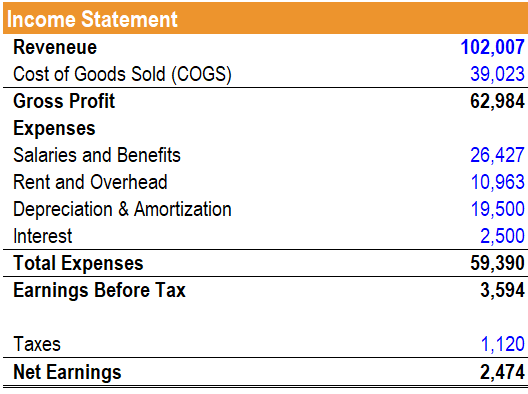
As shown in the income statement above, salaries and benefits, rent and overhead, depreciation and amortization, and interest are all period costs that are expensed in the period incurred. On the other hand, costs of goods sold related to product costs are expensed on the income statement when the inventory is sold.
Related Readings
CFI is the official provider of the Financial Modeling and Valuation Analyst (FMVA)Become a Certified Financial Modeling & Valuation Analyst (FMVA)®CFI's Financial Modeling and Valuation Analyst (FMVA)® certification will help you gain the confidence you need in your finance career. Enroll today!®Become a Certified Financial Modeling & Valuation Analyst (FMVA)®CFI's Financial Modeling and Valuation Analyst (FMVA)® certification will help you gain the confidence you need in your finance career. Enroll today! certification program, designed to transform anyone into a world-class financial analyst.
To keep learning and developing your knowledge of financial analysis, we highly recommend the additional CFI resources below:
- Cost of Goods Sold (COGS)Cost of Goods Sold (COGS)Cost of Goods Sold (COGS) measures the “direct cost” incurred in the production of any goods or services. It includes material cost, direct
- Fixed and Variable CostsFixed and Variable CostsCost is something that can be classified in several ways depending on its nature. One of the most popular methods is classification according
- Projecting Balance Sheet Line ItemsProjecting Balance Sheet Line ItemsProjecting balance sheet line items involves analyzing working capital, PP&E, debt share capital and net income. This guide breaks down how to calculate
- Projecting Income Statement Line ItemsProjecting Income Statement Line ItemsWe discuss the different methods of projecting income statement line items. Projecting income statement line items begins with sales revenue, then cost
-
Understanding Accounting Ratios: A Comprehensive Guide
Accounting ratios cover a wide array of ratios that are used by accountants and act as different indicators that measure profitability, liquidityLiquidityIn financial markets, liquidity refers to how
-
Understanding Administrative Expenses: A Comprehensive Guide
Administrative expenses refer to the costs incurred by a company or organization that include, but are not limited to, the salaries and benefitsRemunerationRemuneration is any type of compensation or
Accounting
- Understanding Agency Costs: Protecting Shareholder Interests
- Understanding Fixed Costs: Definition, Examples & Importance
- Understanding Proceeds: Definition, Types & Calculation
- Understanding Explicit Costs: Definition & Examples
- Understanding Inventoriable Costs: Definition & Examples
- Understanding Business Overheads: Costs & Examples
- Understanding Product Costs: Direct Materials, Labor & Overhead
- Understanding Variable Costs: Definition & Examples
- Understanding Switching Costs: Barriers to Customer Loyalty
-
 Absorption Costing: A Comprehensive Guide for Businesses
Absorption costing is a costing system that is used in valuing inventoryInventoryInventory is a current asset account found on the balance sheet, consisting of all raw materials, work-in-progress...
-
 Understanding Accounting Policies: A Guide for Businesses
Accounting policies are rules and guidelines that are selected by a company for use in preparing and presenting its financial statements. Accounting policies are important, as they set a framework, wh...