
Qualitative Characteristics of Accounting Information: A Comprehensive Overview
The demand for accounting information by investors, lendersTop Banks in the USAAccording to the US Federal Deposit Insurance Corporation, there were 6,799 FDIC-insured commercial banks in the USA as of February 2014. , creditors, etc., creates fundamental qualitative characteristics that are desirable in accounting information. There are six qualitative characteristics of accounting information. Two of the six qualitative characteristics are fundamental (must have), while the remaining four qualitative characteristics are enhancing (nice to have).
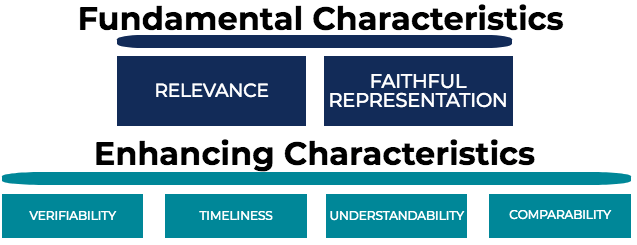
Fundamental (Primary) Qualitative Characteristics
Qualitative characteristics of accounting information that must be present for information to be useful in making decisions:
- Relevance
- Representational faithfulness
Enhancing (Secondary) Qualitative Characteristics
Qualitative characteristics of accounting information that impact how useful the information is:
- Verifiability
- Timeliness
- Understandability
- Comparability
We will look at each qualitative characteristic in more detail below.
Relevance
Relevance refers to how helpful the information is for financial decision-making processes. For accounting information to be relevant, it must possess:
- Confirmatory value – Provides information about past events
- Predictive value – Provides predictive power regarding possible future events
Therefore, accounting information is relevant if it can provide helpful information about past events and help in predicting future events or in taking action to deal with possible future events. For example, a company experiencing a strong quarter and presenting these improved results to creditors is relevant to the creditors’ decision-making process to extend or enlarge credit available to the company.
Representational Faithfulness
Representational faithfulness, also known as reliability, is the extent to which information accurately reflects a company’s resources, obligatory claims, transactions, etc. To help, think of a pictorial depiction of something in real life – how accurately does the picture represent what you see in real life? For accounting information to possess representational faithfulness, it must be:
- Complete – Financial statementsThree Financial StatementsThe three financial statements are the income statement, the balance sheet, and the statement of cash flows. These three core statements are should not exclude any transaction.
- Neutral – The degree to which information is free from bias. Note that there are subjectivity and estimation involved in financial statements, therefore information cannot be truly “neutral.” However, if a company polled 1,000 accountants and took the average of their answers, that would be considered neutral and free from bias.
- Free from error – The degree to which information is free from errors.
Verifiability
Verifiability is the extent to which information is reproducible given the same data and assumptions. For example, if a company owns equipment worth $1,000 and told an accountant the purchase cost, salvage valueSalvage ValueSalvage value is the estimated amount that an asset is worth at the end of its useful life. Salvage value is also known as scrap value, depreciation method, and useful life, the accountant should be able to reproduce the same result. If they cannot, the information is considered not verifiable.
Timeliness
Timeliness is how quickly information is available to users of accounting information. The less timely (thus resulting in older information), the less useful information is for decision-making. Timeliness matters for accounting information because it competes with other information. For example, if a company issues its financial statements a year after its accounting period, users of financial statements would find it difficult to determine how well the company is doing in the present.
Understandability
Understandability is the degree to which information is easily understood. In today’s society, corporate annual reports are in excess of 100 pages, with significant qualitative information. Information that is understandable to the average user of financial statements is highly desirable. It is common for poorly performing companies to use a lot of jargon and difficult phrasing in its annual report in an attempt to disguise the underperformance.
Comparability
Comparability is the degree to which accounting standards and policies are consistently applied from one period to another. Financial statements that are comparable, with consistent accounting standards and policies applied throughout each accounting period, enable users to draw insightful conclusions about the trends and performance of the company over time. In addition, comparability also refers to the ability to easily compare a company’s financial statements with those of other companies.
The qualitative characteristics of accounting information are important because they make it easier for both company management and investors to utilize a company’s financial statements to make well-informed decisions.
More Resources
CFI offers the Financial Modeling & Valuation Analyst (FMVA)Become a Certified Financial Modeling & Valuation Analyst (FMVA)®CFI's Financial Modeling and Valuation Analyst (FMVA)® certification will help you gain the confidence you need in your finance career. Enroll today!®Become a Certified Financial Modeling & Valuation Analyst (FMVA)®CFI's Financial Modeling and Valuation Analyst (FMVA)® certification will help you gain the confidence you need in your finance career. Enroll today! certification program for those looking to take their careers to the next level. To keep learning and advancing your career, the following CFI resources will be helpful:
- Audit MaterialityMateriality Threshold in AuditsThe materiality threshold in audits refers to the benchmark used to obtain reasonable assurance that an audit does not detect any material
- Audited Financial StatementsAudited Financial StatementsPublic companies are obligated by law to ensure that their financial statements are audited by a registered CPA. The purpose of the
- Public Company FilingsPublic Company FilingsPublic company filings are an important source of data and information for financial analysts. Knowing where to find this information is a critical first step in performing financial analysis and financial modeling. This guide will outline the most common sources of public company filings.
- Financial Accounting TheoryFinancial Accounting TheoryFinancial Accounting Theory explains the why behind accounting - the reasons why transactions are reported in certain ways. This guide will
-

Understanding Intangible Assets: Key Characteristics & Value
Assets come in three main forms: tangible, intangible and monetary. The two main characteristics of an intangible asset are that it is not physical, meaning it exists as a legal power, and that it is
-

Information Ratio: A Comprehensive Guide to Risk-Adjusted Returns
The information ratio measures the risk-adjusted returns of a financial asset or portfolio relative to a certain benchmarkDow Jones Industrial Average (DJIA)The Dow Jones Industrial Average (DJIA), al
Accounting
- Key Characteristics of a Successful Budget: Planning & Savings
- Understanding the Limitations of Financial Accounting
- Understanding Common Stock: Features, Benefits & Risks
- Understanding the Accounting Cycle: A Comprehensive Guide
- Understanding the Accounting Equation: Assets = Liabilities + Equity
- Objectives of Income Tax Accounting: A Comprehensive Overview
- Understanding Accounting Policies: A Guide for Businesses
- Understanding Accounting Ratios: A Comprehensive Guide
- Bookkeeping vs. Accounting: Key Differences Explained
-
 Understanding IFRS Standards: A Comprehensive Guide
IFRS standards are International Financial Reporting Standards (IFRS) that consist of a set of accounting rules that determine how transactions and other accounting events are required to be reported ...
-
 Understanding Journal Entries in Accounting: A Comprehensive Guide
In an accounting careerAccountingPublic accounting firms consist of accountants whose job is serving business, individuals, governments & nonprofit by preparing financial statements, taxes, journa...