
Unearned Revenue: Definition, Examples & Accounting Explained
Unearned revenue, sometimes referred to as deferred revenueDeferred RevenueDeferred revenue is generated when a company receives payment for goods and/or services that it has not yet earned. In accrual accounting,, is payment received by a company from a customer for products or services that will be delivered at some point in the future. The term is used in accrual accounting,Accrual AccountingIn financial accounting, accruals refer to the recording of revenues that a company has earned but has yet to receive payment for, and the in which revenue is recognized only when the payment has been received by a company AND the products or services have not yet been delivered to the customer.
Some examples of unearned revenue include advance rent payments, annual subscriptions for a software license, and prepaid insurance. The recognition of deferred revenue is quite common for insurance companies and software as a service (SaaS) companies.
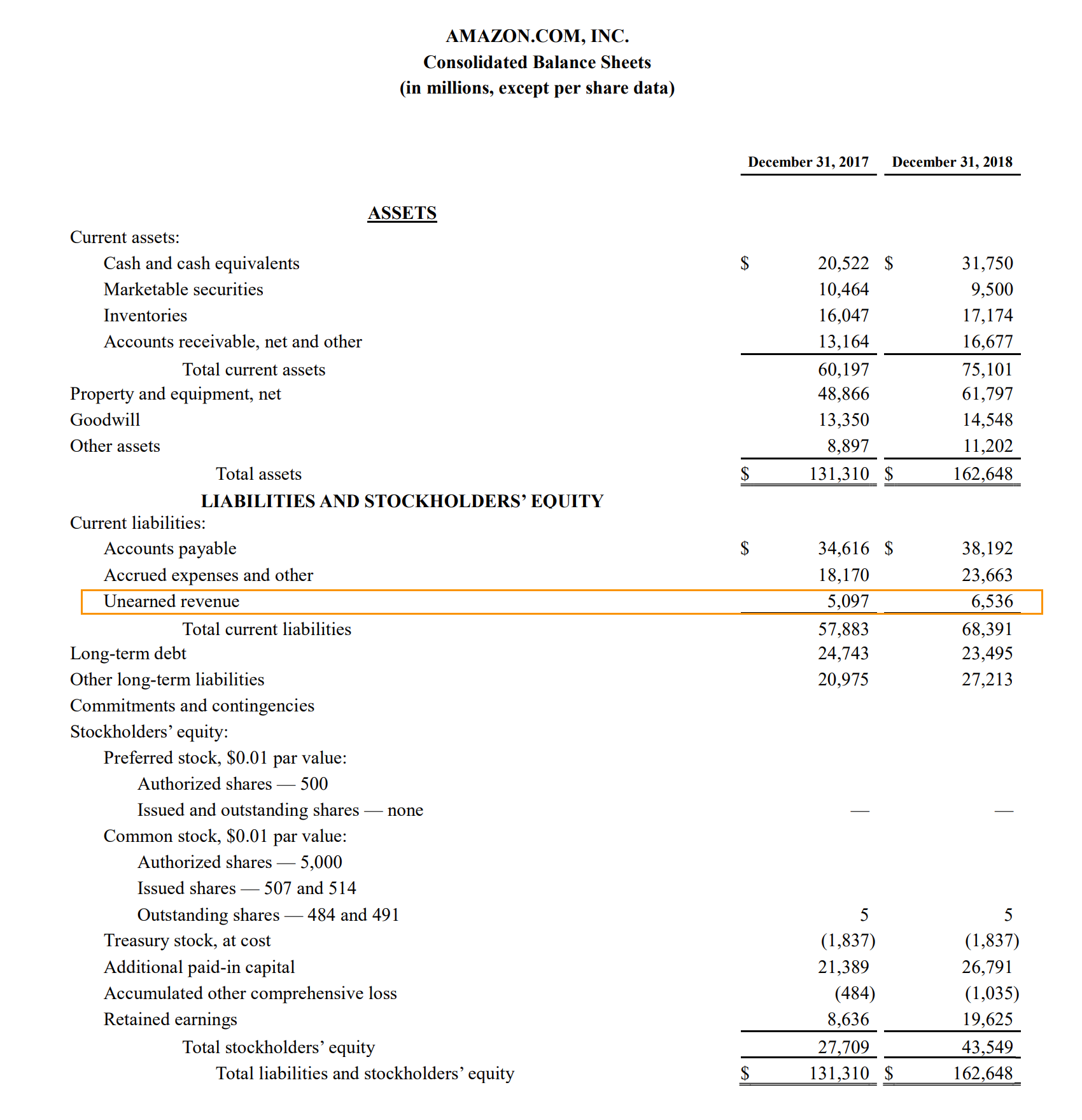
Image from Amazon Balance Sheet. Check out CFI’s Advanced Financial Modeling & Valuation Course for an in-depth valuation of Amazon.
Accounting for Unearned Revenue
Accounting reporting principles state that unearned revenue is a liability for a company that has received payment (thus creating a liability) but which has not yet completed work or delivered goods. The rationale behind this is that despite the company receiving payment from a customer, it still owes the delivery of a product or service. If the company fails to deliver the promised product or service or a customer cancels the order, the company will owe the money paid by the customer.
Therefore, the revenue must initially be recognized as a liability. Note that when the delivery of goods or services is complete, the revenue recognized previously as a liability is recorded as revenue (i.e., the unearned revenue is then earned).
Generally, unearned revenues are classified as short-term liabilitiesCurrent LiabilitiesCurrent liabilities are financial obligations of a business entity that are due and payable within a year. A company shows these on the because the obligation is typically fulfilled within a period of less than a year. However, in some cases, when the delivery of the goods or services may take more than a year, the respective unearned revenue may be recognized as a long-term liability.
Example of Unearned Revenue
Fred is an avid user of Amazon.com’s services. Recently, he discovered Amazon Prime services. Fred wants to enjoy the benefits of the service, such as free two-day shipping and access to unlimited music streaming and buys the annual subscription for $79.
For Amazon, Fred’s payment ($79) is unearned revenue since the company receives the full payment in advance while none of the services have been provided to Fred yet. Initially, the full amount will be recognized as unearned revenue on Amazon’s balance sheetBalance SheetThe balance sheet is one of the three fundamental financial statements. The financial statements are key to both financial modeling and accounting..
However, at the end of the first month, the monthly portion of the total amount ($79/12=$6.58) will be deducted from the unearned revenue figure and recorded as the revenue. A similar procedure will be repeated each subsequent month until the end of the 12th month when the last portion of the payment will be recognized as revenue.
Related Readings
CFI is the official provider of the Financial Modeling and Valuation Analyst (FMVA)® Become a Certified Financial Modeling & Valuation Analyst (FMVA)®CFI's Financial Modeling and Valuation Analyst (FMVA)® certification will help you gain the confidence you need in your finance career. Enroll today!certification program, designed to transform anyone into a world-class financial analyst.
To keep learning and developing your knowledge of financial analysis, we highly recommend the additional CFI resources listed below:
- Analysis of Financial StatementsAnalysis of Financial StatementsHow to perform Analysis of Financial Statements. This guide will teach you to perform financial statement analysis of the income statement,
- Reading Financial Statements Course – Free
- Revenue Recognition PrincipleRevenue Recognition PrincipleThe revenue recognition principle dictates the process and timing by which revenue is recorded and recognized as an item in a company's
- Revenue StreamsRevenue StreamsRevenue Streams are the various sources from which a business earns money from the sale of goods or provision of services. The types of
-

Financial Inclusion: Definition, Benefits & Impact
Financial inclusion refers to the provision of equally available and affordable access to financial services for everyone, regardless of their level of income. It applies to providing services to both
-

Financial Literacy: Understanding Key Concepts & Skills
Financial literacy is the cognitive understanding of financial components and skills such as budgeting, investing, borrowing, taxation, and personal financial management. The absence of such skil
Accounting
- Unearned Revenue: Definition & Financial Statement Reporting
- Accounting Explained: Understanding Financial Records & Reporting
- Ancillary Revenue: Definition, Examples & Maximization
- Understanding Financial Audits: A Comprehensive Guide
- Understanding Finance: A Comprehensive Overview
- Understanding Deferred Revenue: A Comprehensive Guide
- Marginal Revenue: Definition, Calculation & Importance
- Understanding Revenue: A Comprehensive Guide for Businesses
- Revenue vs. Income: Understanding the Key Differences
-
 Financial Engineering: Principles, Applications & Career Paths
Financial engineering encompasses a broad, multidisciplinary field of study and practice that, essentially, applies an engineering approach and methodology to the world of finance. It integrates and u...
-
 Understanding Your Financial Health: A Comprehensive Guide
Financial health is a basic measure of the soundness of an individual’s finances – essentially, it’s about what kind of financial shape you’re in overall. You may also view it ...