
Greenmail Explained: Tactics, Risks & Implications
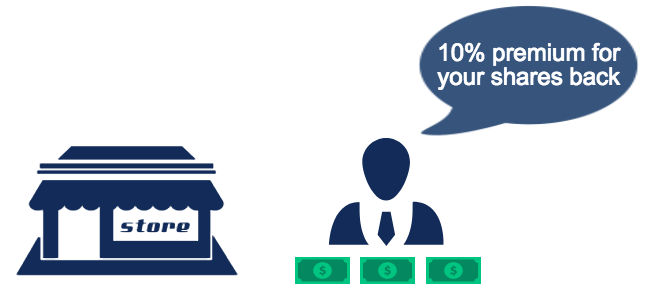
Committing Greenmail involves buying a significant number of sharesStockWhat is a stock? An individual who owns stock in a company is called a shareholder and is eligible to claim part of the company’s residual assets and earnings (should the company ever be dissolved). The terms "stock", "shares", and "equity" are used interchangeably. in a target company, threatening a hostile takeover, and then using the threat to force the target company to buy backDividend vs Share Buyback/RepurchaseShareholders invest in publicly traded companies for capital appreciation and income. There are two main ways in which a company returns profits to its shareholders – Cash Dividends and Share Buybacks. The reasons behind the strategic decision on dividend vs share buyback differ from company to company the shares at a higher price. Similar to blackmail, greenmail is money that is paid to another company to prevent aggressive behavior (i.e., an unwanted takeover).
How Does Greenmail Work?
There are four basic steps to committing Greenmail:
- An investor or company “raider” acquires a large stake in a company by purchasing shares from the open market.
- The investor or company threatens a hostile takeover but offers to sell the shares back to the target company at a premium price (above market valueMarket CapitalizationMarket Capitalization (Market Cap) is the most recent market value of a company’s outstanding shares. Market Cap is equal to the current share price multiplied by the number of shares outstanding. The investing community often uses the market capitalization value to rank companies). The raider also promises to leave the target company alone upon the target company repurchasing the shares.
- The target company uses shareholder money to pay the ransom.
- The target company’s value is reduced, and the greenmailer walks away with a significant amount of profit.
The practice was significantly prominent in the 1980s. Between April 1983 and April 1984 alone, companies paid over US$4 billion in greenmail.
Carl Icahn is widely considered one of the most notorious greenmailers of all time, due to several transactions he was behind in the 80s. You can read more about Carl and his famous takeovers in this Fortune article.
Challenges Faced by Target Companies in a Greenmail
Greenmail, which is a challenging situation for target companies, presents two choices:
- Do nothing and allow their company to be taken over
- Pay a high premium to avoid a hostile takeover
Often, target companies will purchase back the shares at a premium to prevent a hostile takeover.
For example, Company A buys 20% shares of Company B and then threatens a takeover. The management of Company B, without any other options, buys back the shares at a premium in order to avoid being taken over. Company A makes a significant gain through the resale of the shares at a premium back to Company B and Company B loses a significant amount of money.
Legality of Greenmail
Due to the wave of greenmails in the 1980s, several states in the US adopted statutes that prohibit companies from paying greenmail.
For example:
- A New York statute prohibits a New York corporation from purchasing back more than 10% of its own stock from a shareholder at a higher price than market value (unless approved in a majority vote by shareholders).
- Statutes in Ohio and Pennsylvania require investors who use greenmail to remove all profits they earn.
In addition, under Section 5881 of the Internal Revenue Code, a 50% excise tax is payable from the profit generated from a greenmail. However, since the practice is not well-defined, the excise tax is easily avoided.
Famous Example of Greenmail
One famous example involved Goodyear Company and Sir James Goldsmith. In 1986, Sir James Goldsmith held an 11.5% stake (at an average of $42.20 per share) in Goodyear Company and threatened to take over the company for $4.7 billion ($49 per share).
In response, Goodyear agreed to repurchase the existing shares from Sir James for $49.50 per share ($620.7 million) contingent that Sir James refrain from purchasing any Goodyear stock for 5 years. In the end, Sir James made about $93 million in profit.
Additionally, to prevent another takeover attempt in the future, Goodyear offered to repurchase 40 million shares, with 109 million shares outstanding, at $50 per share, in an open offer to all shareholders. Ultimately, the purchase of 40 million shares cost Goodyear $2.6 billion.
Related Readings
To continue learning and advance your career, see the following free CFI resources:
- Dividend vs Share Buyback/RepurchaseDividend vs Share Buyback/RepurchaseShareholders invest in publicly traded companies for capital appreciation and income. There are two main ways in which a company returns profits to its shareholders – Cash Dividends and Share Buybacks. The reasons behind the strategic decision on dividend vs share buyback differ from company to company
- Share CapitalShare CapitalShare capital (shareholders' capital, equity capital, contributed capital, or paid-in capital) is the amount invested by a company’s
- Equity ValueEquity ValueEquity value can be defined as the total value of the company that is attributable to shareholders. To calculate equity value follow, this guide from CFI.
- Enterprise ValueEnterprise Value (EV)Enterprise Value, or Firm Value, is the entire value of a firm equal to its equity value, plus net debt, plus any minority interest
-

Understanding Stocks: A Beginner's Guide to Share Ownership
When a person owns stock in a company, the individual is called a shareholder and is eligible to claim part of the company’s residual assets and earnings (should the company ever have to dissolv
-
Understanding Net-Net: A Financial Health Indicator
Net-net is a term used for a company with a market capitalization that is less than the difference between the company’s current assets and total liabilities. The equation does not consider long
Business strategy
- Authorized Shares: Understanding a Company's Issuance Limit
- Understanding Voting Shares: Your Right to Participate in Company Decisions
- Understanding Stock Dilution: Causes, Effects & Prevention
- Understanding Initial Public Offerings (IPOs): A Comprehensive Guide
- Free Float Explained: Understanding Publicly Traded Shares
- Retired Shares: Definition, Impact & Accounting Methods
- Full Ratchet Options: A Comprehensive Explanation
- Holding Companies: Definition, Purpose & How They Work
- Kaizen: Understanding Continuous Improvement for Business
-
 Leverage in Finance: Strategies, Types & Risks
In finance, leverage is a strategy that companies use to increase assets, cash flows, and returns, though it can also magnify losses. There are two main types of leverage: financial and operating. To ...
-
 Parent Company Explained: Definition, Control & Examples
A parent company is a company that owns more than 50% of the outstanding voting shares of another company. Therefore, it controls the other company or companies and can directly influence the business...