
Retired Shares: Definition, Impact & Accounting Methods
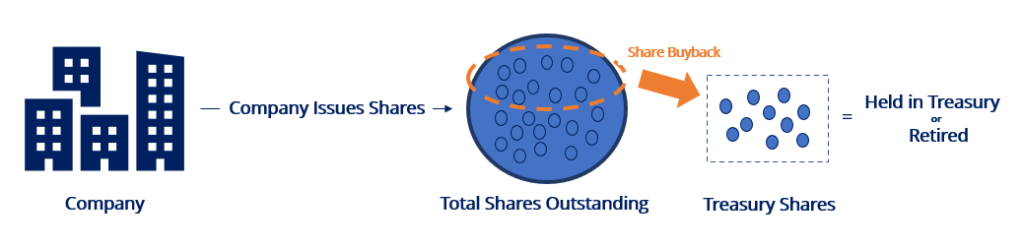
Retired shares are shares that are repurchased and canceled by a company. They don’t possess any financial value and are void of ownership in the company.
Summary
- Retired shares are shares repurchased and canceled by a company.
- The shares reduce the number of authorized shares by the company.
- The two most common methods to account for the buyback and retirement of shares are the cost method and the constructive retirement method.
Understanding Retired Shares
Companies issue shares to raise money and expand business operations. Subsequently, companies can choose to buy back shares from the market for numerous reasons, such as to meet stock optionStock OptionA stock option is a contract between two parties which gives the buyer the right to buy or sell underlying stocks at a predetermined price and within a specified time period. A seller of the stock option is called an option writer, where the seller is paid a premium from the contract purchased by the stock option buyer. obligations, improve financial ratios, take advantage of an undervalued share price, increase ownership, and reduce dilution.
Repurchased shares either sit in the treasury (called treasury shares) or are retired (retired shares). Shares that sit in the treasury can be reissued at a future date, while retired shares cannot.
Retiring shares reduces the number of authorized shares by the company. Investors may get nervous if a company holds many authorized and unsold shares, as it gives a greater potential indication of share dilution in the future.
Retiring shares may signal a lower chance of future dilution. If a company wants to reissue the retired shares, a shareholder vote must be conducted.
Journal Entries to Retire Shares
These are two common methods to account for the buyback and retirement of shares:
1. Cost Method
The cost method is the most used method to account for the repurchase of shares. To retire shares under the method, two sets of journal entries are conducted:
Accounting for the Repurchase of Shares: Record the entire amount of the purchase in the treasury stock account. The cost method ignores the par value of the shares and the amount received from investors when the shares were originally issued.
Assume that Company A repurchases 10,000 shares of its stock at $10 per share (total consideration is $100,000). The shares come with a $1 par value.

From the journal entries above, the repurchased shares now sit in treasury and are considered treasury shares.
Accounting for the Retirement of Shares: Reverse the par value and additional paid-in capital associated with the original stock issue. Any remaining amount is further charged to paid-in capital (until the balance reaches zero) and to retained earnings.
Assume that Company A now wants to retire the 10,000 shares that were purchased. The original per-share issue price was $5.
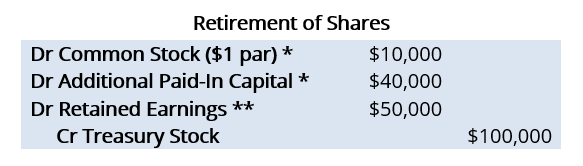
*When shares are retired, the common stock and additional paid-in capital accounts are debited for the amounts recorded when the stock was originally issued. When Company A issued 10,000 shares at $5 per share, the following journal entriesJournal Entries GuideJournal Entries are the building blocks of accounting, from reporting to auditing journal entries (which consist of Debits and Credits) would’ve been made:

**If the repurchase price is greater than the original issue price, as in our example, the difference is a debit to additional paid-in capital until its account balance reaches zero.
Once additional paid-in capitalAPIC (Additional Paid-In Capital)APIC, or Additional Paid-In Capital, is a component of shareholders’ equity that reflects the price investors are willing to pay above the reaches zero, the remaining amount is debited to retained earnings. Here, we were not given the relevant details on the balance in additional paid-in capital and, as a result, retained earnings were debited.
The opposite would be true if the repurchase price is lower than the original issue price.
2. Constructive Retirement Method
The constructive retirement method is used when it is assumed that the shares will not be reissued in the future. Under such a method, the journal entries for the repurchase and retirement of shares are conducted at the same time (i.e., only one set of journal entries are required). If we reuse the same example as above, the journal entries would be as follows:
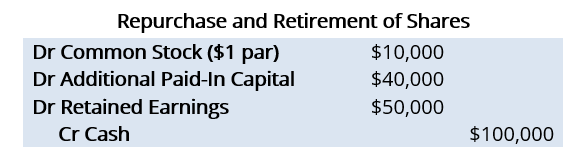
The key difference between the constructive retirement method and the cost method is that the constructive retirement method does not involve the treasury stock account.
It is due to the constructive retirement method, assuming that the shares will not be reissued. Under the cost method, a treasury stock account indicates that the shares could be reissued at a later date.
More Resources
CFI is the official provider of the global Capital Markets & Securities Analyst (CMSA)™Program Page - CMSAEnroll in CFI's CMSA® program and become a certified Capital Markets &Securities Analyst. Advance your career with our certification programs and courses. certification program, designed to help anyone become a world-class financial analyst. To keep advancing your career, the additional resources below will be useful:
- Treasury StockTreasury StockTreasury stock, or reacquired stock, is a portion of previously issued, outstanding shares of stock that a company repurchased from shareholders.
- Journal Entry TemplateJournal Entry TemplateThis journal entry template will help you construct properly formatted journal entries and provide a guideline for what a general ledger should look like.
- Common StockCommon StockCommon stock is a type of security that represents ownership of equity in a company. There are other terms – such as common share, ordinary share, or voting share – that are equivalent to common stock.
- Retained EarningsRetained EarningsThe Retained Earnings formula represents all accumulated net income netted by all dividends paid to shareholders. Retained Earnings are part
-
Common vs. Preferred Stock: Understanding the Differences
Potential investors who are looking to acquire a stake or ownership in a company can choose to purchase between common vs preferred shares. Companies typically issue and sell shares to raise funds for
-

Understanding Debt Covenants: A Comprehensive Guide
Debt covenants are restrictions that lendersLender of Last ResortA lender of last resort is the provider of liquidity to financial institutions that are experiencing financial difficulties. In most de
invest
- Authorized Shares: Understanding a Company's Issuance Limit
- CCPPO Shares Explained: Understanding Cumulative, Convertible, & Participating Preferred Stock
- Understanding Company Bylaws: A Comprehensive Guide
- Understanding Earnings: A Guide to Financial Profitability
- Understanding Voting Shares: Your Right to Participate in Company Decisions
- American Depositary Shares (ADS): A Comprehensive Guide
- Understanding Stock Dilution: Causes, Effects & Prevention
- Understanding Initial Public Offerings (IPOs): A Comprehensive Guide
- Treasury Stock: Definition, Purpose, and Implications
-
 A-Shares Explained: Understanding Preferred Stock & Share Classes
A-shares are a share classification for common or preferred stockPreferred SharesPreferred shares (preferred stock, preference shares) are the class of stock ownership in a corporation that has a prio...
-
 Cash Reserves: Definition, Benefits & Short-Term Needs
Cash reserves are funds that companies set aside for use in emergency situations. The cash that is saved is used to cover costs or expenses that are unplanned or unexpected. In most cases, the reserve...