
Understanding Slippage in Trading: Causes & Impact
Slippage occurs when the execution price of a trade is different from its requested price. It occurs when the market orders could not be matched at preferred prices – usually in highly volatile and fast-moving markets prone to unexpected quick turns in certain trends.
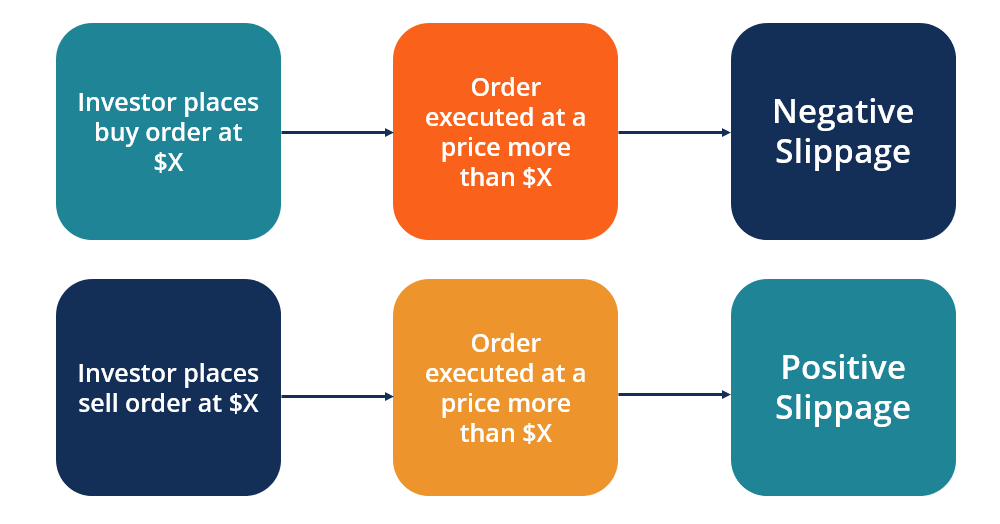
Any variation between the executed price and the intended price is considered a slippage. The slippage may be zero, positive, or negative, and it depends on whether the order is a buy or sell, or whether the order is for opening or closing a position, and on the direction of price movement. Slippage may occur when a huge market orderMarket OrderMarket order is a request made by an investor to purchase or sell a security at the best possible price. It is executed by a broker or brokerage service. is finalized, but there is an insufficient volume at the selected price for maintaining the bid/ask spread.
Summary
- Slippage occurs when an order is executed at a price greater or lower than the quoted price, usually happening in the periods when the market is highly volatile, or market liquidity is low.
- The exposure to slippage risk can be minimized by trading during hours of highest market activity and in low volatility markets.
- A positive slippage gets an investor a better price than expected, while a negative slippage leads to a loss.
Occurrence of Slippage in Trading Market
Slippage usually occurs in periods when the market is highly volatile, or the market liquidity is low. Since the participants are fewer in markets with low liquidity, there is a wide time gap between the placement and execution of an order. The volatile markets experience quick price movements, even quicker than filling an order. Hence, the price of an asset may change during the time gap, which results in slippage.
In forex tradingForex Trading - How to Trade the Forex MarketForex trading allows users to capitalize on appreciation and depreciation of different currencies. Forex trading involves buying and selling currency pairs based on each currency's relative value to the other currency that makes up the pair., slippage normally occurs on less popular currency pairs – such as AUD/JPY – since highly popular currency pairs come with low volatility and high liquidity. For example, an investor decides to open a position on AUD/USD, which is a highly volatile currency pair, at the quoted price of $0.6025. However, the price might’ve increased to $0.6040 in the time gap between the submission and execution of the order. The investor will experience a slippage since he/she will be trading at a higher price than anticipated.
Slippage often occurs during or around major events such as announcements regarding interest rates and monetary policy, earnings reportEarnings ReportAn earnings report is an official financial document issued by a public company that shows expenses, earnings, and overall profit of the company for a of a company, or changes in the management positions. The events increase market volatility, which can increase the chances of investors experiencing slippage.
When investors hold positions after markets close, they can experience slippage when the market reopens. It happens because the price may change due to any news event or announcement that could’ve happened while the market was closed.
Minimizing the Impact of Slippage
There are various ways that an investor can minimize the consequences of slippage. Some of these are as follows:
1. Trade in low volatile and high liquidity markets
The prices in low volatile markets usually do not change quickly, and high volatile markets have many market participants on the other side of the trade. Hence, if investors trade in highly liquid and low volatile markets, they can limit the risk of experiencing slippage.
Moreover, the chances of slippage can be reduced by trading during the periods experiencing the most activity since liquidity will be the highest during that time. It increases the chances of the trade getting executed quickly at the requested price. For example, the largest volume of trades is executed in the stock markets when the major U.S. stock exchanges are open. The forex trading experiences the largest volume during the open hours of the London Stock Exchange (LSE)London Stock Exchange (LSE)The London Stock Exchange (LSE), which is based in London, the United Kingdom, is one of the leading stock markets in the world. Owned by the London Stock Exchange Group, the LSE was established in 1571, making it one of the oldest stock exchanges in the world.
2. Employ guaranteed stops and limit orders
Since an order with a guaranteed stop will be executed at the requested price, slippage risk is prevented. However, a premium attached to the guaranteed stop will be incurred if it is triggered. A limit order can help lessen the risk of slippage when investors enter a trade or seek to gain returns from a successful trade.
When a limit order is activated, the order will be filled at the specified price or a favorable price. It implies that execution of a sell order takes place at the desired price or a higher price, whereas the execution of a buy order takes place at the specified price or a lower price.
3. Check how the trading providers treat slippage
While some providers will execute the orders even if the price does not match the requested price, others will execute the order as long as the price difference is within the investor’s tolerance level. Once the price difference falls outside the tolerance level, the order will be rejected, and resubmission will be required at a new price.
Additional Resources
CFI is the official provider of the global Commercial Banking & Credit Analyst (CBCA)™Program Page - CBCAGet CFI's CBCA™ certification and become a Commercial Banking & Credit Analyst. Enroll and advance your career with our certification programs and courses. certification program, designed to help anyone become a world-class financial analyst. To keep advancing your career, the additional resources below will be useful:
- Day TraderDay TraderA day trader is an individual who opens and closes all of his or her trades before the end of the trading day; no open positions are
- Risk AverseRisk Averse DefinitionSomeone who is risk averse has the characteristic or trait of preferring avoiding loss over making a gain. This characteristic is usually attached to investors or market participants who prefer investments with lower returns and relatively known risks over investments with potentially higher returns but also with higher uncertainty and more risk.
- VIXVIXThe Chicago Board Options Exchange (CBOE) created the VIX (CBOE Volatility Index) to measure the 30-day expected volatility of the US stock market, sometimes called the "fear index". The VIX is based on the prices of options on the S&P 500 Index
- Volume of TradeVolume of TradeVolume of trade, also known as trading volume, refers to the quantity of shares or contracts that belong to a given security traded on a daily basis
-
Understanding Digital Options: A Comprehensive Guide for Traders
A digital option is a form of option that allows traders to manually set a strike price. The digital option provides the traders with a fixed payout in the case when the market price of the underlying
-
Understanding Dirty Price: Bond Pricing Explained
Dirty price is when a bond price includes interest that has accrued since the latest coupon payment. When investors buy fixed-income securities, such as bondsBonds vs StocksFor prospective
invest
- Understanding Divergence in Technical Analysis: A Guide
- Understanding Forward Prices: Definition & How They Work
- Understanding Hedging Strategies: A Comprehensive Guide
- Understanding Strangle Options: A Comprehensive Guide
- Understanding Volatility: A Key Indicator of Investment Risk
- Price Discrimination Explained: Types, Examples & Strategies
- What is Price Fixing?
- Price Skimming: Definition, Strategy & When to Use It
- Understanding Clearing Prices in Stock Trading: A Comprehensive Guide
-
 Understanding Dealer Markets: How Market Makers Function
A dealer market is a financial market where dealers post prices they would be willing to buy and sell specific securitiesTrading SecuritiesTrading securities are securities purchased by a company for ...
-
 Understanding Delta: A Key Risk Measure in Derivatives
Delta is a risk sensitivity measure used in assessing derivativesDerivativesDerivatives are financial contracts whose value is linked to the value of an underlying asset. They are complex financial in...