
Understanding Equity: A Comprehensive Guide for Investors
In finance and accounting, equity is the value attributable to the owners of a business. The book value of equity is calculated as the difference between assetsTypes of AssetsCommon types of assets include current, non-current, physical, intangible, operating, and non-operating. Correctly identifying and and liabilitiesTypes of LiabilitiesThere are three primary types of liabilities: current, non-current, and contingent liabilities. Liabilities are legal obligations or debt on the company’s balance sheetBalance SheetThe balance sheet is one of the three fundamental financial statements. The financial statements are key to both financial modeling and accounting., while the market value of equity is based on the current share price (if public) or a value that is determined by investors or valuation professionals. The account may also be called shareholders/owners/stockholders equity or net worth.
There are generally two types of equity value:
- Book value
- Market value
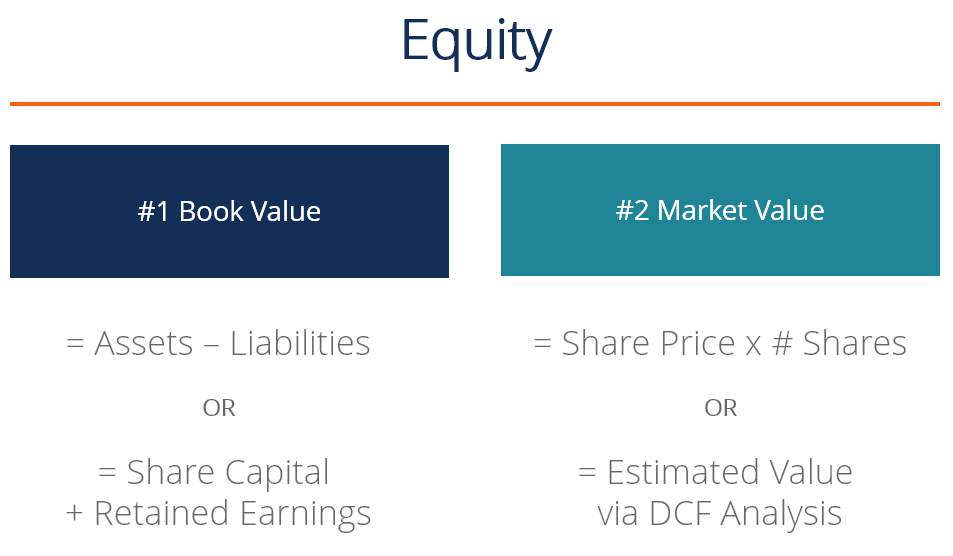
#1 Book value of equity
In accounting, equity is always listed at its book value. This is the value that accountants determine by preparing financial statementsThree Financial StatementsThe three financial statements are the income statement, the balance sheet, and the statement of cash flows. These three core statements are and the balance sheet equation that states: assets = liabilities + equity. The equation can be rearranged to: equity = assets – liabilities.
The value of a company’s assets is the sum of each current and non-current asset on the balance sheet. The main asset accounts include cash, accounts receivable, inventory, prepaid expenses, fixed assets, property plant and equipment (PP&E), goodwill, intellectual property, and intangible assets.
The value of liabilities is the sum of each current and non-current liability on the balance sheet. Common liability accounts include lines of credit, accounts payable, short-term debt, deferred revenue, long-term debt, capital leases, and any fixed financial commitment.
In reality, the value of equity is calculated in a much more detailed way and is a function of the following accounts:
- Share capital
- Contributed surplus
- Retained earnings
- Net income (loss)
- Dividends
To fully calculate the value, accountants must track all capital the company has raised and repurchased (its share capital), as well as its retained earnings, which consist of cumulative net income minus cumulative dividends. The sum of share capital and retained earnings is equal to equity.
#2 Market value of equity
In finance, equity is typically expressed as a market value, which may be materially higher or lower than the book value. The reason for this difference is that accounting statements are backward-looking (all results are from the past) while financial analysts look forward, to the future, to forecast what they believe financial performance will be.
If a company is publicly traded, the market value of its equity is easy to calculate. It’s simply the latest share price multiplied by the total number of shares outstanding.
If a company is private, then it’s much harder to determine its market value. If the company needs to be formally valued, it will often hire professionals such as investment bankers, accounting firms (valuations group), or boutique valuation firms to perform a thorough analysis.
Estimating the market value of equity
If a company is private, the market value must be estimated. This is a very subjective process, and two different professionals can arrive at dramatically different values for the same business.
The most common methods used to estimate equity value are:
- Discounted cash flow (DCF) analysisDCF Model Training Free GuideA DCF model is a specific type of financial model used to value a business. The model is simply a forecast of a company’s unlevered free cash flow
- Comparable company analysisComparable Company AnalysisThis guide shows you step-by-step how to build comparable company analysis ("Comps") and includes a free template and many examples.
- Precedent transactionsPrecedent Transaction AnalysisPrecedent transaction analysis is a method of company valuation where past M&A transactions are used to value a comparable business today.
In the discounted cash flow approach, an analyst will forecast all future free cash flow for a business and discount it back to the present value using a discount rate (such as the weighted average cost of capital). DCF valuation is a very detailed form of valuation and requires access to significant amounts of company information. It is also the most heavily relied on approach, as it incorporates all aspects of a business and is, therefore, considered the most accurate and complete measure.
To learn more, read CFI’s guide to business valuation resourcesValuationValuation refers to the process of determining the present worth of a company or an asset. It can be done using a number of techniques. Analysts that want.
Personal equity (Net worth)
The concept of equity applies to individual people as much as it does to businesses. We all have our own personal net worth, and a variety of assets and liabilities we can use to calculate our net worth.
Common examples of personal assets include:
- Cash
- Real estate
- Investments
- Furniture and household items
- Cars and other vehicles
Common examples of personal liabilities include:
- Credit card debt
- Lines of credit
- Outstanding bills (phone, electric, water, etc.)
- Student loans
- Mortgages
The difference between all your assets and all your liabilities is your personal net worth.
Example in Excel
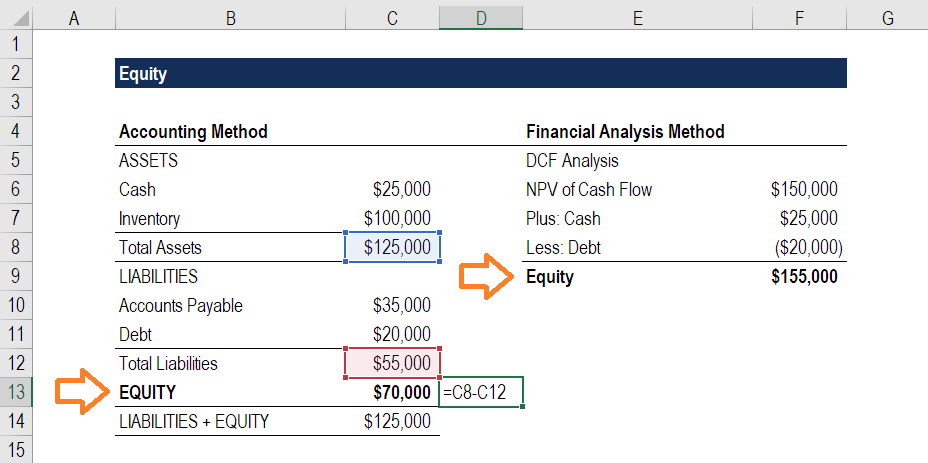
Let’s look at an example of two different approaches in Excel. The first is the accounting approach, which determines the book value, and the second is the finance approach, which estimates the market value.
Download the Free Template
Enter your name and email in the form below and download the free template now!
As you can see, the first method takes the difference between the assets and liabilities on the balance sheet and arrives at a value of $70,000. In the second method, an analyst builds a DCF modelDCF Model Training Free GuideA DCF model is a specific type of financial model used to value a business. The model is simply a forecast of a company’s unlevered free cash flow and calculates the net present value (NPV) of the free cash flow to the firmThe Ultimate Cash Flow Guide (EBITDA, CF, FCF, FCFE, FCFF)This is the ultimate Cash Flow Guide to understand the differences between EBITDA, Cash Flow from Operations (CF), Free Cash Flow (FCF), Unlevered Free Cash Flow or Free Cash Flow to Firm (FCFF). Learn the formula to calculate each and derive them from an income statement, balance sheet or statement of cash flows (FCFF) as being $150,000. This gives us the enterprise value of the firm (EV), which has cash added to it and debt deducted from it to arrive at the equity value of $155,000.
It is very common for this market approach to produce a higher value than the book value.
Additional resources
Thank you for reading this guide to understanding what equity is and how it works.
CFI is the official global provider of the Financial Modeling & Valuation Analyst (FMVA)TMBecome a Certified Financial Modeling & Valuation Analyst (FMVA)®CFI's Financial Modeling and Valuation Analyst (FMVA)® certification will help you gain the confidence you need in your finance career. Enroll today! certification program designed to transform anyone into a world-class financial analyst. To continue advancing your career, these additional CFI resources will be helpful:
- Analysis of financial statementsAnalysis of Financial StatementsHow to perform Analysis of Financial Statements. This guide will teach you to perform financial statement analysis of the income statement,
- Financial modeling guideFree Financial Modeling GuideThis financial modeling guide covers Excel tips and best practices on assumptions, drivers, forecasting, linking the three statements, DCF analysis, more
- All accounting resourcesAccountingAccounting is a term that describes the process of consolidating financial information to make it clear and understandable for all
- All finance templatesExcel & Financial Model TemplatesDownload free financial model templates - CFI's spreadsheet library includes a 3 statement financial model template, DCF model, debt schedule, depreciation schedule, capital expenditures, interest, budgets, expenses, forecasting, charts, graphs, timetables, valuation, comparable company analysis, more Excel templates
-

Value at Risk (VaR): Understanding Investment Risk
Value at risk is a method that is used to determine the possible risk of loss for a particular type of investment. This is a strategy that attempts to determine what the worst-case scenario is f
-
Value Investing: A Comprehensive Guide to Finding Undervalued Investments
Value investing, as the name suggests, consists of finding investments that are good value for money. A value investor actively seeks out stocks, bonds or other investments that he or she believes hav
finance
- Backstop: Understanding Financial Safety Nets and Contingency Funding
- Understanding Financial Denomination: A Comprehensive Guide
- Equity Crowdfunding: A Comprehensive Guide for Startups & Investors
- Face Value Explained: Definition, Examples & Importance
- Understanding Fair Value: Definition & Importance
- Understanding Money: Definition, History & Value
- Understanding Negative Equity: Causes, Risks & Solutions
- Nominal Value Explained: Definition & Financial Significance
- Equity Explained: Definition, Calculation & Examples
-
 Value Engineering: Definition, Benefits & Implementation
Value engineering refers to the systematic method of improving the value of a product that a project produces. It is used to analyze a service, system, or product to determine the best way to manage t...
-
 Value Proposition: Definition, Examples & How to Create One
A value proposition is a promise of value stated by a company that summarizes how the benefit of the company’s product or service will be delivered, experienced, and acquired. Essentially, a val...