
Equity Crowdfunding: A Comprehensive Guide for Startups & Investors
Equity crowdfunding (also known as crowd-investing or investment crowdfunding) is a method of raising capital used by startupsStartup Valuation Metrics (for internet companies)Startup Valuation Metrics for internet companies. This guide outlines the 17 most important e-commerce valuation metrics for internet starts to be valued and early-stage companies. Essentially, equity crowdfunding offers the company’s securities to a number of potential investors in exchange for financing. Each investor is entitled to a stake in the company proportional to their investment.
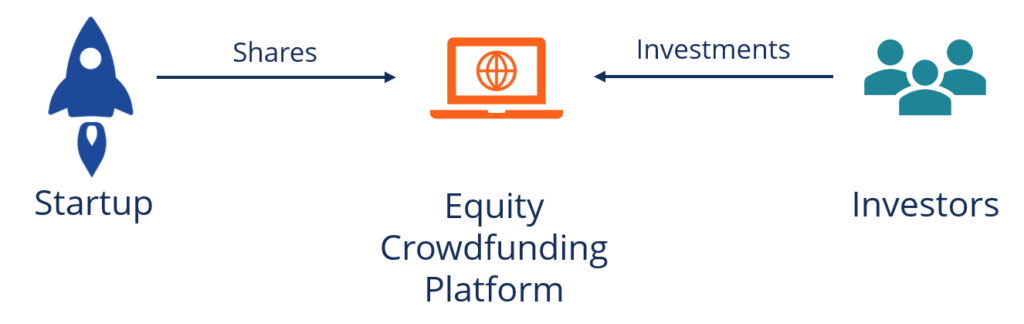
Equity crowdfunding is quite different from other crowdfunding methods such as rewards crowdfunding and donation crowdfunding. The model provides a more conventional capital-raising method by offering financial securitiesMarketable SecuritiesMarketable securities are unrestricted short-term financial instruments that are issued either for equity securities or for debt securities of a publicly listed company. The issuing company creates these instruments for the express purpose of raising funds to further finance business activities and expansion. to investors.
The crowdfunding process is carried out on specialized online platforms such as Wefunder and StartEngine. The digital nature of the crowdfunding platform fosters a more liberal and open way of financing.
Unlike conventional capital-raising methods for early-stage companies, which primarily rely on investments from a small group of professional investors, equity crowdfunding targets a broader group of investors. The main idea of equity crowdfunding is to raise the required capital by obtaining small contributions from a large number of investors.
Benefits of Equity Crowdfunding
Equity crowdfunding introduces a new approach to the investing and capital-raising processStock PromotersStock promoters are individuals or institutions that help companies to raise capital. They raise funds for companies by capturing the attention of potential investors.. It can offer several benefits to both companies and investors.
1. Easier access to capital
Online crowdfunding platforms allow entrepreneurs and companies to showcase their projects to a larger number of potential investors, as compared to conventional forms of capital raising.
2. Less pressure on the management
Unlike the conventional forms of financing, such as venture capitalVenture CapitalVenture capital is a form of financing that provides funds to early stage, emerging companies with high growth potential, in exchange for equity or an ownership stake. Venture capitalists take the risk of investing in startup companies, with the hope that they will earn significant returns when the companies become a success., equity crowdfunding does not result in a dilution of power within a company. Although the number of shares is increased, the involvement of a large number of investors means that power is not concentrated around a particular group of shareholders.
3. Lucrative returns
Although startups are inherently risky ventures, there is still a possibility that a company may become a unicorn and provide very lucrative returns to the investors.
Risks with Equity Crowdfunding
Any party that is willing to participate in equity crowdfunding must be aware of the risks that are associated with it. Some of these risks include the following:
1. Equity dilution
Since equity crowdfunding is related to the issuance of new shares, the stake of current shareholders will be diluted. (Although, as noted above, share dilution does not usually have the same effect as it does in more traditional financing scenarios.)
2. High risk of failure
As mentioned above, startups are extremely risky ventures. Therefore, there is a high likelihood that the company will fail.
3. Low liquidity
Potential investors should be aware that securities purchased on equity crowdfunding platforms are highly illiquid. Thus, exit options are limited or may not even realistically exist. Just as is the case for traditional venture capital investors, crowdfunding investors may have to wait several years for their investment to pay off.
4. Risk of fraud
Investors must also be wary of potential fraud schemes in the equity crowdfunding process. Fraudsters may use asymmetric information, as well as the loopholes in regulations, to deceive investors. However, the crowdfunding platform companies work diligently to verify the information provided by companies seeking capital funding.
Regulations
Equity crowdfunding is still a new phenomenon, only emerging since the turn of the century. Hence, some countries have only recently passed regulations regarding such fundraising methods, while other countries implement only loose, generic regulations.
One of the major goals of regulation is the protection of investors, because the fundraising model is potentially prone to fraud.
The biggest leap for equity crowdfunding regulation occurred in the United States with the introduction of the Jumpstart Our Business (JOBS) Act in 2012. The law allows the participation of both accredited and non-accredited investors in equity crowdfunding. Also, the act establishes limitations on the amount of funds that can be raised by companies, as well as on the amount that can be invested by each investor.
Related Readings
CFI offers the Financial Modeling & Valuation Analyst (FMVA)™Become a Certified Financial Modeling & Valuation Analyst (FMVA)®CFI's Financial Modeling and Valuation Analyst (FMVA)® certification will help you gain the confidence you need in your finance career. Enroll today! certification program for those looking to take their careers to the next level. To keep learning and advancing your career, the following CFI resources will be helpful:
- Fundless SponsorFundless SponsorA fundless sponsor is an investment fund that lacks committed equity capital required to complete acquisition transactions up front. Unlike private equity firms that already possess equity capital to finance transactions, fundless sponsors must raise equity and debt financing on a deal by deal basis.
- Private Equity vs Venture Capital, Angel/Seed InvestorsPrivate Equity vs Venture Capital, Angel/Seed InvestorsCompare private equity vs venture capital vs angel and seed investors in terms of risk, stage of business, size & type of investment, metrics, management. This guide provides a detailed comparison of private equity vs venture capital vs angel and seed investors. It's easy to confuse the three classes of investors
- Secondary MarketSecondary MarketThe secondary market is where investors buy and sell securities from other investors. Examples: New York Stock Exchange (NYSE), London Stock Exchange (LSE).
- Sweat EquitySweat EquitySweat equity refers to the non-monetary contribution that the individuals or founders of a company make towards a business venture. Cash-strapped startups
-

Margin Equity Percentage: Understanding Your Brokerage Loan Limits
A brokerage margin account allows an investor to buy stocks and other securities with a portion of the purchase price paid with a margin loan from the broker. A brokerage margin account allow
-

Understanding Liquid Equity: A Guide to Company Stock
Liquid equities can be bought and sold quickly. Equity is another name for a company stock. When you buy shares in company stock, you take an ownership interest in the company and each share
finance
- Backstop: Understanding Financial Safety Nets and Contingency Funding
- Cost of Equity: Definition, Calculation & Importance
- Understanding Equity: A Comprehensive Guide for Investors
- Understanding Negative Equity: Causes, Risks & Solutions
- Growth Equity: Investing in Expanding Businesses | [Your Company Name]
- Private Equity Crowdfunding: A Comprehensive Guide for Investors
- Understanding Equity Statements: A Comprehensive Guide
- Understanding Home Equity: A Comprehensive Guide
- Crowdfunding: A Comprehensive Guide to Funding Your Ideas
-
![Return on Equity (ROE): Definition & Calculation | [Your Company Name]](https://www.etffin.com/article/uploadfiles/202110/2021100815173670_S.png) Return on Equity (ROE): Definition & Calculation | [Your Company Name]
Return on Equity (ROE): Definition & Calculation | [Your Company Name]Return on Equity (ROE) is the measure of a company’s annual return (net incomeNet IncomeNet Income is a key line item, not only in the income statement, but in all three core financial statement...
-
 Understanding the Yield Gap: Bonds vs. Stocks
The Yield Gap is the difference between the yields of government-issued securitiesBond IssuersThere are different types of bond issuers. These bond issuers create bonds to borrow funds from bondholder...