
Equity Ratio: Understanding Financial Leverage & Risk
The equity ratio is a financial metric that measures the amount of leverage used by a company. It uses investments in assets and the amount of equity to determine how well a company manages its debts and funds its asset requirements.
A low equity ratio means that the company primarily used debt to acquire assets, which is widely viewed as an indication of greater financial risk. Equity ratios with higher value generally indicate that a company’s effectively funded its asset requirements with a minimal amount of debt.
Summary:
- Equity ratio uses a company’s total assets (current and non-current) and total equity to help indicate how leveraged the company is: how effectively they fund asset requirements without using debt.
- The formula is simple: Total Equity / Total Assets
- Equity ratios that are .50 or below are considered leveraged companies; those with ratios of .50 and above are considered conservative, as they own more funding from equity than debt.
Formula for Equity Ratio

Let’s look at an example to get a better understanding of how the ratio works. For this example, Company XYZ’s total assets (current and non-current) are valued $50,000, and its total shareholder (or owner) equity amount is $22,000. Using the formula above:
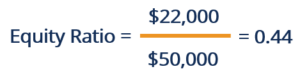
The resulting ratio above is the sign of a company that has leveraged its debts. It holds slightly more debt ($28,000) than it does equity from shareholders, but only by $6,000.
Importance of an Equity Ratio Value
Any company with an equity ratio value that is .50 or below is considered a leveraged company. The higher the value, the less leveraged the company is. Conversely, a company with an equity ratio value that is .50 or above is considered a conservative company because they access more funding from shareholder equityStockholders EquityStockholders Equity (also known as Shareholders Equity) is an account on a company's balance sheet that consists of share capital plus than they do from debt.
Investors tend to look for companies that are in the conservative range because they are less risky; such companies know how to gather and fund asset requirements without incurring substantial debt. Lending institutions are also more likely to extend credit to companies with a higher ratio. The higher the ratio, the stronger the indication that money is managed effectively and that the business will be able to pay off its debts in a timely way.
A high ratio value also shows that a company is, all around, stronger financially and enjoys a greater long-term position of solvencySolvencySolvency is the ability of a company to meet its long-term financial obligations. When analysts wish to know more about the solvency of a company, they look at the total value of its assets compared to the total liabilities held. than companies with lower ratios.
Additional Resources
CFI is the official provider of the global Financial Modeling & Valuation Analyst (FMVA)™Become a Certified Financial Modeling & Valuation Analyst (FMVA)®CFI's Financial Modeling and Valuation Analyst (FMVA)® certification will help you gain the confidence you need in your finance career. Enroll today! certification program, designed to help anyone become a world-class financial analyst. To keep advancing your career, the additional CFI resources below will be useful:
- Cost of EquityCost of EquityCost of Equity is the rate of return a shareholder requires for investing in a business. The rate of return required is based on the level of risk associated with the investment
- Current AssetsCurrent AssetsCurrent assets are all assets that a company expects to convert to cash within one year. They are commonly used to measure the liquidity of a
- Debt vs Equity FinancingDebt vs Equity FinancingDebt vs Equity Financing - which is best for your business and why? The simple answer is that it depends. The equity versus debt decision relies on a large number of factors such as the current economic climate, the business' existing capital structure, and the business' life cycle stage, to name a few.
- Leverage RatiosLeverage RatiosA leverage ratio indicates the level of debt incurred by a business entity against several other accounts in its balance sheet, income statement, or cash flow statement. Excel template
-

Net Debt to EBITDA Ratio: Understanding Company Solvency
The net debt-to-EBITDA ratio measures a company’s ability to pay off its liabilities. It shows how much time the company needs to operate at the current debt and EBITDA levels to pay all of its
-
Pretax Margin Ratio: Definition & Analysis | Financial Insights
The Pretax Margin Ratio, also knows at the Earnings Before TaxEarnings Before Tax (EBT)Earnings before tax, or pre-tax income, is the last subtotal found in the income statement before the net income
finance
- Understanding Liquid Equity: A Guide to Company Stock
- Acid-Test Ratio: Understanding Your Company's Short-Term Liquidity
- Debt-to-Equity Ratio: Definition, Calculation & Importance
- Debt/Equity Swap: Understanding Financial Restructuring
- Understanding the Envy Ratio in Private Equity
- Equity Financing: A Comprehensive Guide for Business Growth
- Equity Multiplier: Definition, Calculation & Financial Significance
- Solvency Ratio: Understanding a Company's Financial Stability
- Portfolio Companies: Definition & How Private Equity Uses Them
-
 Defensive Interval Ratio (DIR): Understanding Company Liquidity
The defensive interval ratio (DIR) is a financial liquidity ratio that indicates how many days a company can operate without needing to tap into capital sources other than its current assetsCurrent As...
-
 Equity Capital Market: Definition & How It Works
The equity capital market is a subset of the broader capital market, where financial institutions and companies interact to trade financial instruments and raise capital for companies. Equity capital ...