
Cash Ratio: Understanding Your Company's Short-Term Liquidity
The cash ratio, sometimes referred to as the cash asset ratio, is a liquidity metric that indicates a company’s capacity to pay off short-term debt obligationsCurrent LiabilitiesCurrent liabilities are financial obligations of a business entity that are due and payable within a year. A company shows these on the with its cash and cash equivalents. Compared to other liquidity ratios such as the current ratioCurrent Ratio FormulaThe Current Ratio formula is = Current Assets / Current Liabilities. The current ratio, also known as the working capital ratio, measures the capability of a business to meet its short-term obligations that are due within a year. The ratio considers the weight of total current assets versus total current liabilities. It indicates the financial health of a company and quick ratioQuick RatioThe Quick Ratio, also known as the Acid-test, measures the ability of a business to pay its short-term liabilities with assets readily convertible into cash, the cash ratio is a stricter, more conservative measure because only cash and cash equivalents – a company’s most liquid assets – are used in the calculation.

Formula
The formula for calculating the cash ratio is as follows:
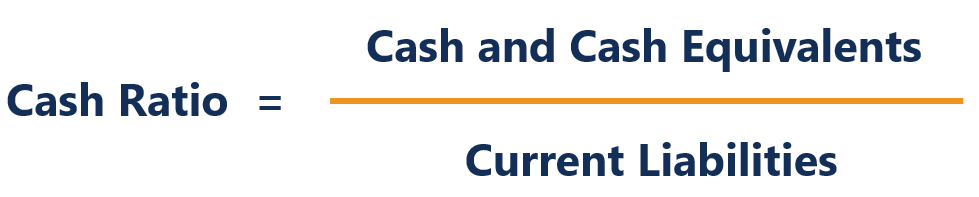
Where:
- Cash includes legal tender (coins and currency) and demand deposits (checks, checking account, bank drafts, etc.).
- Cash equivalents are assets that can be converted into cash quickly. Cash equivalentsCash EquivalentsCash and cash equivalents are the most liquid of all assets on the balance sheet. Cash equivalents include money market securities, banker's acceptances are readily convertible and subject to insignificant risk. Examples include savings accounts, T-billsTreasury Bills (T-Bills)Treasury Bills (or T-Bills for short) are a short-term financial instrument issued by the US Treasury with maturity periods from a few days up to 52 weeks., and money market instruments.
- Current liabilities are obligations due within one year. Examples include short-term debt, accounts payableAccounts PayableAccounts payable is a liability incurred when an organization receives goods or services from its suppliers on credit. Accounts payables are, and accrued liabilities.
Example
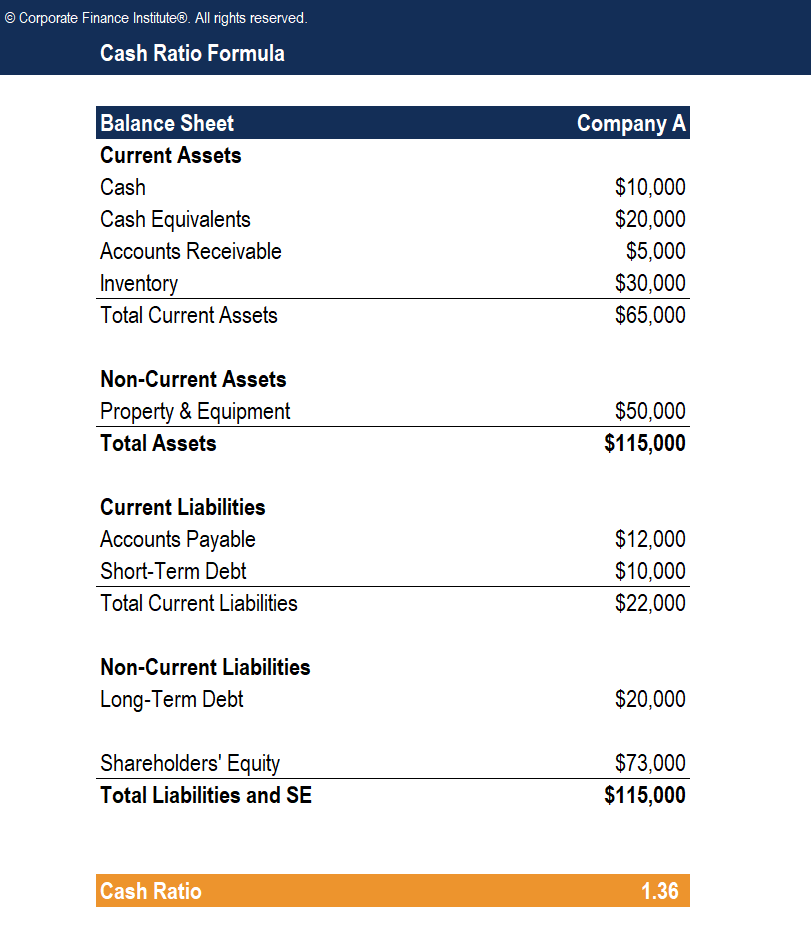
Company A’s balance sheet lists the following items:
- Cash: $10,000
- Cash equivalents: $20,000
- Accounts receivable: $5,000
- Inventory: $30,000
- Property & equipment: $50,000
- Accounts payable: $12,000
- Short-term debt: $10,000
- Long-term debt: $20,000
The ratio for Company A would be calculated as follows:

The figure above indicates that Company A possesses enough cash and cash equivalents to pay off 136% of its current liabilities. Company A is highly liquid and can easily fund its debt.
Download the Free Template
Enter your name and email in the form below and download the free ratio template now!
Interpretation of the Cash Ratio
The cash ratio indicates to creditors, analysts, and investors the percentage of a company’s current liabilities that cashCashIn finance and accounting, cash refers to money (currency) that is readily available for use. It may be kept in physical form, digital form, and cash equivalents will cover. A ratio above 1 means that a company will be able to pay off its current liabilities with cash and cash equivalents, and have funds left over.
Creditors prefer a high cash ratio, as it indicates that a company can easily pay off its debt. Although there is no ideal figure, a ratio of not lower than 0.5 to 1 is usually preferred. The cash ratio figure provides the most conservative insight into a company’s liquidity since only cash and cash equivalents are taken into consideration.
It is important to realize that the cash ratio does not necessarily provide a good financial analysis of a company because businesses do not ordinarily keep cash and cash equivalents in the same amount as current liabilities. In fact, they are usually making poor use of their assets if they hold large amounts of cash on their balance sheet. When cash sits on the balance sheet, it is not generating a return. Therefore, excess cash is often re-invested for shareholders to realize higher returns.
Key Takeaways
- The cash ratio is a liquidity ratio that measures a company’s ability to pay off short-term liabilities with highly liquid assets.
- Compared to the current ratio and the quick ratio, it is a more conservative measure of a company’s liquidity position.
- There is no ideal figure, but a ratio of at least 0.5 to 1 is usually preferred.
- The cash ratio may not provide a good overall analysis of a company, as it is unrealistic for companies to hold large amounts of cash.
Related Readings
CFI offers the Financial Modeling & Valuation Analyst (FMVA)™Become a Certified Financial Modeling & Valuation Analyst (FMVA)®CFI's Financial Modeling and Valuation Analyst (FMVA)® certification will help you gain the confidence you need in your finance career. Enroll today! certification program for those looking to take their careers to the next level. To keep learning and advancing your career in finance, the following CFI resources will be helpful:
- Acid-Test RatioAcid-Test RatioThe Acid-Test Ratio, also known as quick ratio, is a liquidity ratio that measures how sufficient a company's short-term assets can cover current liabilities
- Analysis of Financial StatementsAnalysis of Financial StatementsHow to perform Analysis of Financial Statements. This guide will teach you to perform financial statement analysis of the income statement,
- Financial Analysis Ratios GlossaryFinancial Analysis Ratios GlossaryGlossary of terms and definitions for common financial analysis ratios terms. It's important to have an understanding of these important terms.
- Guide to Financial ModelingFinancial Modeling for BeginnersFinancial modeling for beginners is our introductory guide to financial modeling - we cover how to build a model, Excel formulas, best practices, and more.
-

Understanding Finance: A Comprehensive Overview
In financeFinance OverviewFinance is defined as the providing of funding and management of money for individuals, businesses, and governments. The financial system includes the circulation of money, m
-
Bitcoin Cash (BCH): A Comprehensive Overview - What You Need to Know
‘Bitcoin cash’ (BCH) is a spin-off cryptocurrency created in August 2017, from a fork of Bitcoin. Bitcoin Cash specifically increases the size of blocks, which allow for more transactions to be proces
finance
- Understanding Cash Consideration in Mergers & Acquisitions
- Cash Conversion Ratio (CCR): Definition & Importance
- Understanding Cash Flow: A Comprehensive Guide
- Cash Flow to Debt Ratio: Understanding and Calculation
- Cash Management: A Comprehensive Guide to Financial Stability
- Cash-on-Cash Return: Definition, Calculation & Importance
- Cash Sweep: Reduce Debt & Maximize Earnings | [Your Company Name]
- Cash Turnover Ratio (CTR): Calculation & Interpretation
- Disbursement Explained: Definition, Impact & Accounting Implications
-
 Synthetic Cash: Understanding Simulated Financial Instruments
Synthetic cash is a financial instrument that is created to function like other financial instruments, but certain characteristics of the simulated financial instrument are altered. The simulated inst...
-
 Volatility Ratio: Understanding Price Changes for Trading & Investing
Volatility ratio refers to a technical measure of the changes in the prices of a given security. It enables investors and traders to identify price patterns. It is used in technical analysisTechnical ...