
Cash Conversion Ratio (CCR): Definition & Importance
The Cash Conversion Ratio (CCR), also known as cash conversion rate, is a financial management tool used to determine the ratio of the cash flowsStatement of Cash FlowsThe Statement of Cash Flows (also referred to as the cash flow statement) is one of the three key financial statements that report the cash of a company to its net profit. In other words, it is a comparison of how much cash flow a company generates compared to its accounting profit.
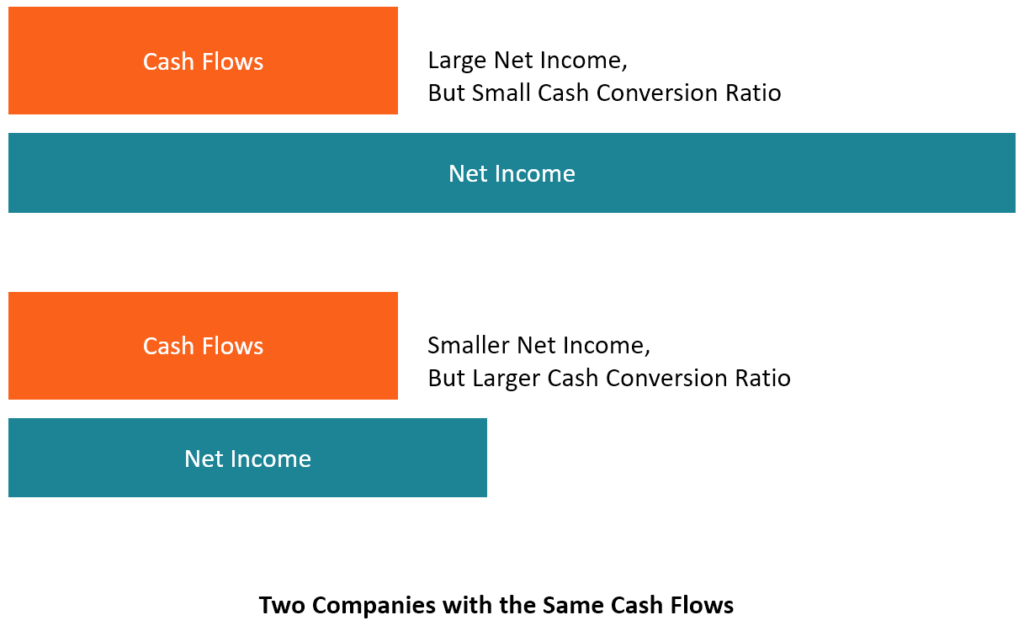
Understanding Cash Conversion Ratio Calculations
When calculating CCR, cash flow is the center of the equation. It is used to determine all cash generated in a given financial period – often quarterly or annually, depending on the company’s accounting cycles.
Cash Flow is generally broken down into three categories:
- Operating activities – Cash generated from the operation of the business
- Investing activities – Covers all purchase and sales of long-term investments and assets
- Financial activities – Covers all transactions related to rasing (or repaying) capital
In this case, we want Cash Flow from Operations, or Free Cash FlowFree Cash Flow (FCF)Free Cash Flow (FCF) measures a company’s ability to produce what investors care most about: cash that's available be distributed in a discretionary way. (which is equal to operating cash flow minus capital expenditures).
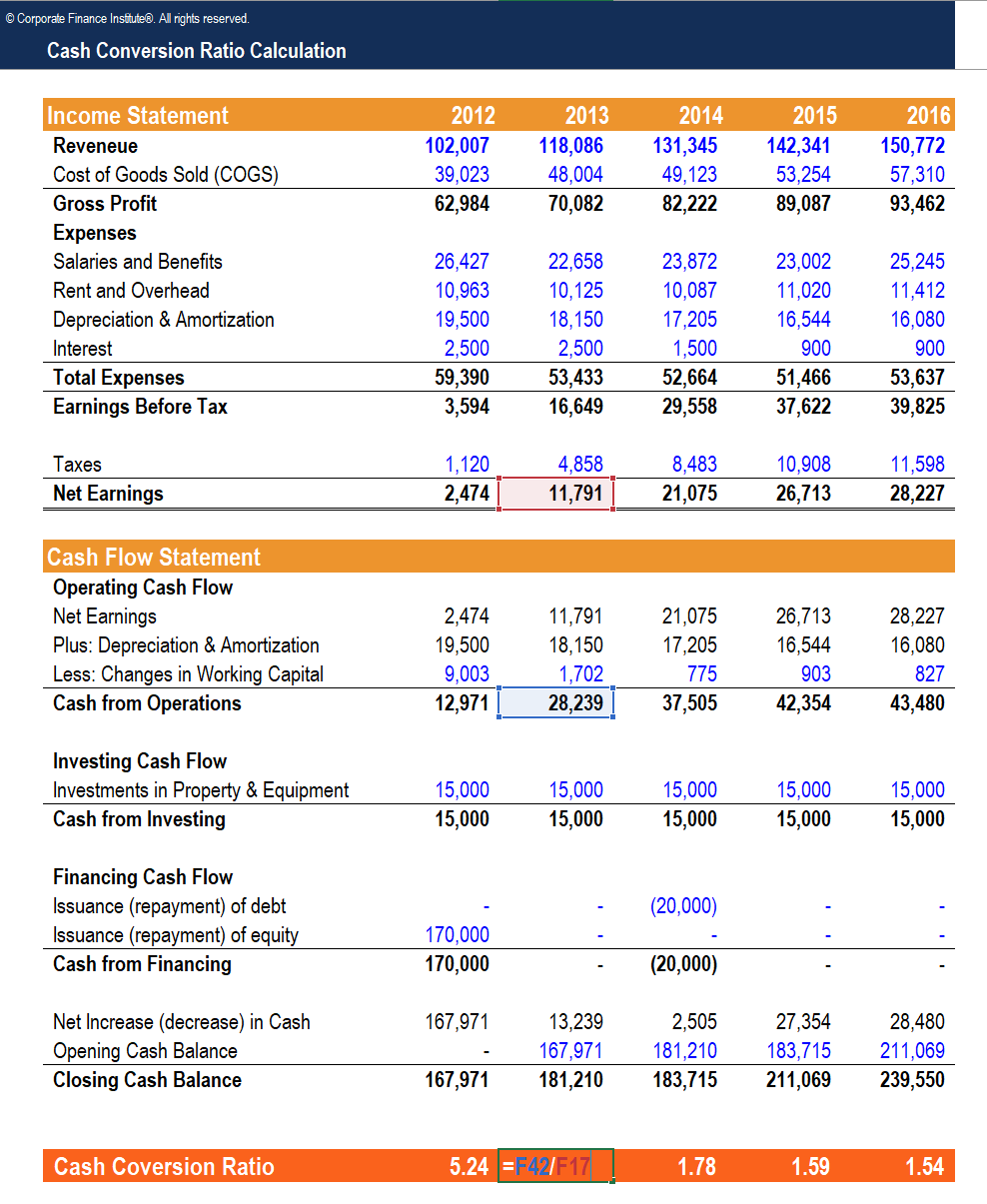
Once cash flow is determined, the next step is dividing it by the net profit. That is the profit after interest, tax, and amortization. Below is the cash conversion ratio formula.

The resulting ratio from this calculation can be either a positive value or a negative value. This can be summarized as: if the ratio is anything above 1, it means that the company possesses excellent liquidity, while anything below 1 implies it’s a weak CCR. Anything negative suggests the company is incurring losses.
Download the Free Template
Enter your name and email in the form below and download the free template now!
Takeaways
Below are some of the takeaways from calculating the Cash Conversion Ratio of a given company.
1. CCR is a quick way to determine the disparity between a company’s cash flow and net profit
A high cash conversion ratio indicates that the company has excess cash flow compared to its net profit. For mature companies, it is common to see a high CCR because they tend to earn considerably high profits and have accumulated large amounts of cash. In contrast, companies in the start-up or growth stage tend to have low or even negative cash flows due to the required amount of capital invested in the business. In early stages, companies often find themselves earning negative profits until they reach a break-even point, thus the CRR of these companies would also be negative or low.
2. It is a tool for management decisions
While a high CRR could be a good sign for liquidity, having too much excess cash might imply that the company is not utilizing its resources in the most effective way. The company should consider re-investing in profitable projects or expanding its operations to further enhance the profitability of the business.
When the ratio is low or negative, it could be an indication that the company needs to adjust its operations and start figuring which activities are sinking its income, or whether it needs to expand its market share or increase sales in favor of revamping cash flows.
3. It is an investing indicator tool
To investors, what matters is whether a given company is generating enough cash flow to provide a solid return per share. Thus, significant investment opportunities will offer a higher ratio, while a weak investment will show a lower ratio. However, some companies may dubiously try to alter the ratio, especially the cash flow part, to attract investors. That’s why proper scrutiny of the books of accounts should be conducted first before making an investment decision based on CCR.
Terms Related to Cash Conversion Ratio
There are familiar terms that look similar to the cash conversion ratio, but they carry a different meaning. They include:
Cash conversion cycles (CCC)
CCC is used for measuring management effectiveness by determining how fast a company can convert cash inputs into cash flows over a given production and sales period.
Conversion cycle
In portfolio management, it is used to determine the number of the common shares which a company has been receiving at a specific time of conversion of each convertible security. That is the ratio of per value of convertible bond divided by the conversion price of equity.
Other resources
CFI is the official provider of the global Financial Modeling & Valuation Analyst (FMVA)™Become a Certified Financial Modeling & Valuation Analyst (FMVA)®CFI's Financial Modeling and Valuation Analyst (FMVA)® certification will help you gain the confidence you need in your finance career. Enroll today! certification program, designed to help anyone become a world-class financial analyst. To keep advancing your career, the additional CFI resources below will be useful:
- Operating Cash Flow RatioOperating Cash Flow RatioThe Operating Cash Flow Ratio, a liquidity ratio, is a measure of how well a company can pay off its current liabilities with the cash flow generated from its core business operations. This financial metric shows how much a company earns from its operating activities, per dollar of current liabilities.
- Comparable Company AnalysisComparable Company AnalysisThis guide shows you step-by-step how to build comparable company analysis ("Comps") and includes a free template and many examples.
- Due DiligenceDue DiligenceDue diligence is a process of verification, investigation, or audit of a potential deal or investment opportunity to confirm all relevant facts and financial information, and to verify anything else that was brought up during an M&A deal or investment process. Due diligence is completed before a deal closes.
- Financial Analysis Ratios GlossaryFinancial Analysis Ratios GlossaryGlossary of terms and definitions for common financial analysis ratios terms. It's important to have an understanding of these important terms.
-

Debt-to-Assets Ratio: Definition, Calculation & Risk Assessment
The Debt to Assets Ratio is a leverage ratioLeverage RatiosA leverage ratio indicates the level of debt incurred by a business entity against several other accounts in its balance sheet, income statem
-
Debt-to-Equity Ratio: Definition, Calculation & Importance
The Debt to Equity ratio (also called the “debt-equity ratio”, “risk ratio”, or “gearing”), is a leverage ratioLeverage RatiosA leverage ratio indicates the le
finance
- Cash Flow to Debt Ratio: Understanding and Calculation
- Cash Ratio: Understanding Your Company's Short-Term Liquidity
- Cash Turnover Ratio (CTR): Calculation & Interpretation
- Current Ratio: Definition, Calculation & Financial Health
- Understanding the Operating Cash Flow Ratio: A Key Liquidity Metric
- Operating Cash to Debt Ratio: Understanding Financial Health
- Operating Cash to Total Cash Ratio: Meaning & Significance
- Operating Ratio: Definition, Calculation & Importance
- Price-to-Cash Flow Ratio (P/CF): Definition & Analysis
-
 Advertising to Sales Ratio: Measuring Ad Effectiveness & ROI
The advertising to sales ratio, also called the “A to S” for short, measures the effectiveness, or how successful, a company’s advertising strategiesAIDA ModelThe AIDA model, which s...
-
 Understanding the CAPE Ratio: A Guide to Cyclically Adjusted P/E
The CAPE Ratio (also known as the Shiller P/E or PE 10 Ratio) is an acronym for the Cyclically-Adjusted Price-to-Earnings Ratio. The ratio is calculated by dividing a company’s stock price by th...