
Compilation Engagement: Definition & Benefits | [Your Company Name]
A compilation engagement is a service provided by an outside accountant to assist the management in the presentation of financial data in the form of financial statements. The accountant should possess a greater knowledge of the operations of the business in order to compile the financial statements.
![Compilation Engagement: Definition & Benefits | [Your Company Name]](https://www.etffin.com/Article/UploadFiles/202110/2021100815133559.jpeg)
In some cases, a compilation engagement allows companies without an in-house accountant to hire an outside professional accountant to prepare their financial statements without incurring higher costs of preparing audited financial statementsAudited Financial StatementsPublic companies are obligated by law to ensure that their financial statements are audited by a registered CPA. The purpose of the.
Quick Summary
- A compilation engagement is a type of engagement where a company engages an outside accountant to prepare and present financial statements.
- It is not designed to express an opinion or provide assurance regarding the information contained in the financial statement.
- The accountant uses financial data provided by the management to compile the required financial statements.
How a Compilation Engagement Works
An accountantAccountantAn accountant plays a very crucial role in an organization, regardless of whether it is a multinational company or a small, domestic one. tasked with the responsibility of providing compilation services is required to possess sufficient industry-level knowledge of the client. He or she is not required to be independent of the company requiring compilation services in order to perform such a form of engagement. The management accepts full responsibility for the preparation and presentation of the financial statements, which can be either an individual financial statement, such as the balance sheet, or a complete set of financial statements.
When performing compilation, the accountant should prepare adequate documentation that provides information on the work that has been carried out. Some of the documentation includes the engagement letter, financial statements, and communication with management regarding significant issues identified during the audit.
Once the audit is completed, the accountant prepares a compilation report that states that he/she has not audited the financial statements, and therefore, the audit should not be viewed as an assurance that the financial statements have complied with the financial accounting framework or as an opinion on the accuracy of the financial statements.
Where the financial statements have been materially misstated, the accountant should desist from issuing financial statements that are misleading. Instead, the accountant should obtain more information from the management, and if the information is not forthcoming, he/she should withdraw from the engagement.
Compilation Documentation Requirements
The three main documentation that an accountant is required to prepare during compilation engagement include:
1. Engagement letter
The engagement letter is an agreement to provide compilation engagement to a client, and it defines the services to be performed by the professional accountant/auditor and the compensation to be paid. For the engagement letter to be legally binding, it must be signed by the authorized representatives of both the service provider and the client.
Some of the information contained in an engagement letter includes the services to be provided, the amount and timing of payments, specific due dates, how the parties can terminate the contract, etc. Most compilation engagement letters will state that the accountant will prepare and present financial statements and provide a compilation service.
2. Financial statements
When an accountant accepts the audit engagement terms, he/she is tasked with preparing and presenting the financial statements of the client’s company. He/she is required to follow the accepted reporting framework (IFRS or US GAAPIFRS vs. US GAAPThe IFRS vs US GAAP refers to two accounting standards and principles adhered to by countries in the world in relation to financial reporting) when preparing the financial statements. Depending on the terms of the engagement, the accountant may be required to prepare a single financial statement or a set of key financial statements.
The financial statements can cover a short period such as a month, quarter, or annual period, depending on the requirements of the management. The accountant may include a reference to the compilation report note at the bottom of each financial report to notify the reader that a compilation report exists.
3. Compilation report
A compilation report is a report prepared by the accountant tasked with performing compilation service by a client and should accompany the compiled financial statements. Unlike an audit or review report, a compilation report comprises a single paragraph, without paragraph titles. It should identify the entity (client), compiled financial statements, and the period covered.
The report should include a statement that the management is responsible for the financial statements, that the financial statements have not been reviewed or audited, and the accountant does not express an opinion or assurance on the financial statements.
At the bottom, the report should include a signature of the accountant or accountant’s firmBig Four Accounting FirmsThe Big Four accounting firms refer to Deloitte, PricewaterhouseCoopers (PwC), KPMG, and Ernst & Young. These firms are the four largest professional services firms in the world that provide audit, transaction advisory, taxation, consulting, risk advisory, and actuarial services., the accountant’s city and state, and date of the report (date when accountant completed compilation procedures).
Compilation Engagement vs. Audit and Review Engagements
Unlike an audit engagement where auditors are required to provide an opinion on the fairness of the financial statements, a compilation engagement does not require the accountant to provide an opinion on the correctness of the financial statements.
Also, it does not provide assurance that the company has complied with the accepted accounting principles. Therefore, the accountant engaged in a compilation engagement is not required to use analytical procedures, review procedures, or inquiries, or engage in other audit procedures. A compilation engagement is the least expensive of the various audit types. It is preferred by entities whose key stakeholders approve such a form of engagement.
More Resources
CFI is the official provider of the global Commercial Banking & Credit Analyst (CBCA)™Program Page - CBCAGet CFI's CBCA™ certification and become a Commercial Banking & Credit Analyst. Enroll and advance your career with our certification programs and courses. certification program, designed to help anyone become a world-class financial analyst. To keep advancing your career, the additional resources below will be useful:
- Accounting Salary GuideAccounting Salary GuideIn this accounting salary guide, we give you the midpoint compensation figures for those employed both in public and private accounting. Accountants are responsible for examining financial statements to ensure accuracy and compliance with existing laws and regulations, handling tax-related tasks such as calculating the
- Analysis of Financial StatementsAnalysis of Financial StatementsHow to perform Analysis of Financial Statements. This guide will teach you to perform financial statement analysis of the income statement,
- Audit AssertionsLegal Importance of an AuditThe legal importance of an audit is to uphold the reliability of financial statements for all external users. Auditors face civil and criminal
- Forensic Audit GuideForensic Audit GuideA forensic audit is a detailed audit of a company's records to be used in a court of law in a legal proceeding. Accountants, lawyers, and
-

Financial Analysis: A Comprehensive Guide for Professionals
Financial analysis involves using financial dataFinancial DataWhere to find data for financial analysts - Bloomberg, CapitalIQ, PitchBook, EDGAR, SEDAR and more sources of financial data for financial
-
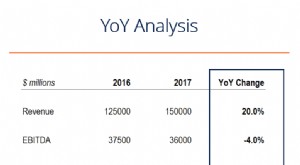
YoY Analysis: Understanding Year-over-Year Growth & Financial Insights
YoY stands for Year over Year and is a type of financial analysisAnalysis of Financial StatementsHow to perform Analysis of Financial Statements. This guide will teach you to perform financial stateme
finance
- Understanding Auditors: Roles, Responsibilities & Audit Processes
- EBITDARM Explained: A Comprehensive Guide to Financial Analysis
- Eurocurrency Explained: What It Is & How It Works
- Factset: Financial Data & Analytics Solutions for Investment Professionals
- Understanding Finance: A Comprehensive Overview of Key Concepts
- Understanding Financial Crises: Causes, Impacts, and Examples
- Financial Engineering: Principles, Applications & Career Paths
- Understanding Review Engagements: Limited Assurance on Financial Statements
- Understanding Financial Statements: A Comprehensive Guide
-
 Understanding Guarantees: Protecting Lenders and Borrowers
A guarantee is a legal promise made by a third party (guarantor) to cover a borrower’s debt or other types of liability in case of the borrower’s defaultDebt DefaultA debt default happens ...
-
 MiFID II Explained: A Comprehensive Guide for Investors
MiFID II is the revision of the Markets in Financial Instruments Directive (MiFID), originally published in 2004. It is the foundation of financial legislation for the European UnionEconomic UnionAn e...