
Norwegian Krone (NOK): A Comprehensive Guide - Currency & Value
The Norwegian krone is the primary currency of Norway, and it is regulated by the Norges Bank, the country’s central bank. The term “krone” is a Norwegian term that means “crown” in English. The krone is subdivided into 100 øre, which came into use electronically beginning in 2012.
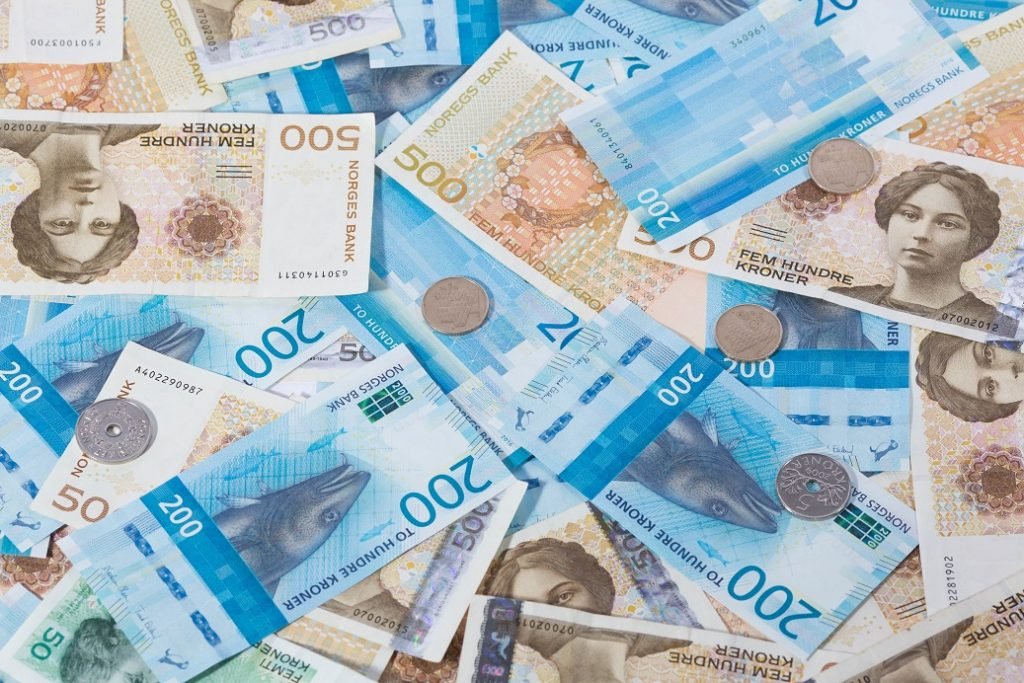
Norwegians use both coins and banknotes for cash transactions. Coins come in multiple denominations of 1, 5, 10, and 20. Banknotes in circulation come in multiple denominations of 50, 100, 200, 500, and 1,000. The banknotes use the images of prominent Norwegians that have had an impact on the country’s history.
Some of the prominent Norwegians include scientists and artists, and the notes include information on their contributions to the national culture. In forex markets, the Norwegian krone uses the code “NOK.”
Summary
- The Norwegian krone is the main currency of Norway that citizens use to make payments for goods and services.
- Consumers may use krone coins and banknotes. Coins come in denominations of 1, 5, 10, and 20, while the banknotes come in denominations of 50, 100, 200, 500, and 1000.
- The value of the Norwegian krone is affected by changes in interest rates and oil prices.
History of the Norwegian Krone
Before 1875, the active Norwegian currency was the Norwegian speciedaler. The currency was dropped in favor of the krone when Norway joined the Scandinavian Monetary Union in 1875. Other members of the union included Denmark and Sweden.
When the monetary union was dissolved in 1914 at the onset of World War I, the member countries retained the names of their respective currencies. The krone was used as the gold standard for the Scandinavian Monetary Union, and one kilogram of gold was equivalent to 2,490 kroner. The standard was suspended in 1931, but Norway continued holding the union’s gold reserves.
During the German occupation, which lasted up to 1945, one krone was equivalent to 0.6 reichsmark. At that time, the krone was fixed to the value of reichsmark. After the end of the war, the krone was pegged to the British pound at the rate of 20 kroner to 1 pound.
In 1992, the Norwegian central bank abandoned the fixed exchange rateFixed vs. Pegged Exchange RatesForeign currency exchange rates measure one currency's strength relative to another. The strength of a currency depends on a number of factors such as its inflation rate, prevailing interest rates in its home country, or the stability of the government, to name a few., and instead adopted the floating exchange rate due to the increased speculation against the Norwegian krone in the early 1990s. The decision was necessitated by increased betting against the krone that resulted in approximately two billion kroner in losses incurred by the Norges Bank. The Norwegian central bank still follows the floating exchange rate to date.
The Norwegian Krone vs. Other Currencies and Oil Prices
The Norwegian krone is the 14th most-traded currency in the world based on value, and it is highly correlated to other currencies. The value of the krone against other currencies such as the US dollar and euro varies considerably from year to year, and it is mainly affected by changes in interest ratesInterest RateAn interest rate refers to the amount charged by a lender to a borrower for any form of debt given, generally expressed as a percentage of the principal. and oil prices in the global market.
For example, long after the Scandinavian Monetary Union was dissolved, the Krone remains highly correlated with the Danish krone and the Swedish krona. There is also a low correlation with the British pound, the euro, the Canadian dollar, and other currencies that are affected by the price of oil. Some stores in Oslo, Norway’s capital city, accept the US dollar or Euro as a currency when paying for goods and services.
As a leading oil exporter in Western Europe, Norway funds a large portion of its budget from oil revenues. The value of the krone changes with changes in the price of crude oil. The currency is affected by trends in the crude oil market.
For example, during the oil crisis of 2015, the krone fell 20% against the dollar. It was the lowest level for the krone, and it lasted for five months from October 2014 until February 2015.
Usage of the Norwegian Krone
The krone is used throughout Norway as the primary currency when making payments for goods and servicesProducts and ServicesA product is a tangible item that is put on the market for acquisition, attention, or consumption while a service is an intangible item, which arises from. It is also accepted when making payments in neighboring countries that share a border with Norway, such as Sweden and Finland.
The Norwegian currency is also used in Hirtshals and Frederikshavn, which are popular ferry ports in Denmark. Border shopping is a common practice among Norwegians who shop for food, alcohol, and tobacco in large quantities at the border, as a way of saving on the high taxes and fees on the domestic purchase of such products.
Norwegians and tourists visiting Norway can get banknotes at the ATMs, commonly referred to as mini-banks, which are spread throughout the country. Debit and credit cards are also accepted in almost all stores and restaurants and can be used to make payments rather than paying using cash denominations.
Some shops may require customers to use Norwegian debit cards rather than international debit cards for convenience purposes. Alternatively, customers can use mobile payment apps to make payments in dozens of convenience stores around the country.
More Resources
CFI is the official provider of the global Commercial Banking & Credit Analyst (CBCA)™Program Page - CBCAGet CFI's CBCA™ certification and become a Commercial Banking & Credit Analyst. Enroll and advance your career with our certification programs and courses. certification program, designed to help anyone become a world-class financial analyst. To keep advancing your career, the additional resources below will be useful:
- EurozoneEurozoneAll European Union countries that adopted the euro as their national currency form a geographical and economic region known as the Eurozone. The Eurozone forms one of the largest economic regions in the world. Nineteen of the 28 countries in Europe use the euro
- Forex Trading – How to Trade the Forex MarketForex Trading - How to Trade the Forex MarketForex trading allows users to capitalize on appreciation and depreciation of different currencies. Forex trading involves buying and selling currency pairs based on each currency's relative value to the other currency that makes up the pair.
- Nordic ModelNordic ModelThe Nordic model is an economic model that is practiced in Scandinavian countries, including Sweden, Norway, Denmark, Finland, and Iceland.
- Top Banks in NorwayTop Banks in NorwayBanks in Norway comprise 17 commercial banks, 105 savings banks, and a small number of state-owned banks. The Financial Supervisory Authority of Norway
-
Klinger Oscillator: Understanding Long-Term Trends & Price Reversals
The Klinger oscillator is a financial tool that was designed by Stephen Klinger in 1977 to predict long-term trends in money flow while also detecting short-term fluctuations. In addition, it predicts
-

Margin of Safety: A Powerful Investment Principle
The margin of safety is an investment principle where the investor buys stocks when the market price is below their actual value. It is evaluated as the change between the price of a financial in
invest
- Danish Krone (DKK): Currency Overview, Value & Facts
- Understanding the Investment Accumulation Phase: Building Wealth Over Time
- Bandwagon Effect: Understanding Social Influence & Conformity
- Understanding the Call Market: Trading Hours & Price Determination
- Understanding the Credit Curve: A Guide for Investors
- Understanding the Dot-Com Bubble: Causes, Impact & Lessons Learned
- Dow 30 Explained: Understanding the Dow Jones Industrial Average
- Understanding the Dow Divisor: How It Impacts the DJIA
- Rule of 72: Calculate Investment Doubling Time | [Your Brand Name]
-
 Kelly Criterion: A Guide to Optimal Betting & Investment Strategy
Kelly criterion is a mathematical formula for bet sizing, which is frequently used by investors to decide how much money they should allocate to each investment or bet through a predetermined fraction...
-
 Keltner Channel: Definition, How to Use & Trading Strategies
Keltner Channel refers to a technical analysis indicator composed of three separate lines. It includes a central moving average line along with channel lines located above and below the central one.&n...