
Understanding Debt Issuance Fees: Costs of Bond Sales
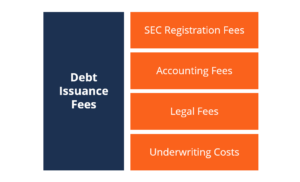
Debt issuance fees refer to expenses that the government or public companies incur in selling bonds. The expenses include registration fees, legal fees, printing costs, underwriting costs, etc. The costs are paid to law firms, auditors, financial markets regulatorsSecurities and Exchange Commission (SEC)The US Securities and Exchange Commission, or SEC, is an independent agency of the US federal government that is responsible for implementing federal securities laws and proposing securities rules. It is also in charge of maintaining the securities industry and stock and options exchanges, and investment banks that are involved in the underwriting process. They do not provide any benefits to the issuer, and accounting rules require the costs to be amortized over the term of the bonds.
What is Debt Issuance?
Debt issuance is an approach used by both the government and public companies to raise funds by selling bonds to external investors. In return, the investors earn periodic interest on the amount invested.
For example, the government can sell treasury bonds to the public as a way of raising money to finance development projects such as building roads and hospitals, as well as paying salaries to government employees. In return, investors earn periodic interest payments over the term of the bond, plus the face value of the bond upon maturity.
Accounting for Debt Issuance Fees
Whether a bond issuer decides to use private placement or underwriter placement, the company will incur certain costs such as legal costs, printing costs, and registration fees. The US Generally Accepted Accounting PrinciplesGAAPGAAP, Generally Accepted Accounting Principles, is a recognized set of rules and procedures that govern corporate accounting and financial provides guidelines on how companies should account for such costs.
To account for the expenses associated with bond issuance, debit the debt issuance costs account and credit the accounts payable account to account for the associated liability. Since the debt issuance account is an asset account, the issuance costs will first be recorded in the balance sheet of the bond issuer.
The asset will be charged to expense gradually. This is done by debiting the debt issuance expense and crediting the debt issuance account to shift the cost from the balance sheet to the income statementIncome StatementThe Income Statement is one of a company's core financial statements that shows their profit and loss over a period of time. The profit or.
Amortization of Debt Issuance Fees
The debt issuance costs should be amortized over the period of the bond using the straight-line method. That makes the annual expense equal over the term of the bond. To record the amortizationAmortizationAmortization refers to the process of paying off a debt through scheduled, pre-determined installments that include principal and interest expense, debit the debt issuance expense account and credit the credit issuance cost account.
For example, assume that Company ABC incurred $50,000 in debt issuance fees and other charges, and the bond comes with a term of 10 years. The company would amortize the fees over the term of the bond. It can be calculated as follows:
$50,000/10 = $5,000
The expense is amortized at the rate of $5,000 per year for the term of the bond, which is 10 years. The journal entry for the transaction is as follows:
DebitCreditDebt issue expense$5,000Debt issue costs$5,000
More Resources
CFI offers the Financial Modeling & Valuation Analyst (FMVA)®Become a Certified Financial Modeling & Valuation Analyst (FMVA)®CFI's Financial Modeling and Valuation Analyst (FMVA)® certification will help you gain the confidence you need in your finance career. Enroll today! certification program for those looking to take their careers to the next level. To keep learning and advancing your career, the following CFI resources will be helpful:
- Investing: A Beginner’s GuideInvesting: A Beginner's GuideCFI's Investing for Beginners guide will teach you the basics of investing and how to get started. Learn about different strategies and techniques for trading
- Projecting Balance Sheet Line ItemsProjecting Balance Sheet Line ItemsProjecting balance sheet line items involves analyzing working capital, PP&E, debt share capital and net income. This guide breaks down how to calculate
- UnderwritingUnderwritingIn investment banking, underwriting is the process where a bank raises capital for a client (corporation, institution, or government) from investors in the form of equity or debt securities. This article aims to provide readers with a better understanding of the capital raising or underwriting process
- 10-Year US Treasury Note10-Year US Treasury NoteThe 10-year US Treasury Note is a debt obligation that is issued by the US Treasury Department and comes with a maturity of 10 years.
-

Debt Financing: A Comprehensive Guide for Businesses
Debt financing occurs when a company raises money by selling debt instruments, most commonly in the form of bank loans or bonds. Such a type of financing is often referred to as financial leverage.&nb
-

Debt Refinancing: A Comprehensive Guide to Lowering Your Payments
Debt refinancing is the replacement of an existing debt by means of another debt with terms and/or conditions that are more favorable. In other words, debt refinancing refers to the replacement of exi
finance
- Understanding Debt Cancellation Fees: What You Need to Know
- Understanding Debt Covenants: A Comprehensive Guide
- Understanding Debt Issuance Fees: Costs of Bond Sales
- Understanding Lending Ratios: A Guide for Credit Analysis
- Understanding Payment Processing Fees: A Comprehensive Guide
- Funding Sources for Businesses: A Comprehensive Guide
- Understanding Management Fees: What They Are & How They Work
- Understanding Equity Issuance Fees: Costs of Raising Capital
- Understanding 12b-1 Fees: What Mutual Fund Investors Need to Know
-
 Debt Consolidation: Simplify Payments & Lower Interest Rates
Debt consolidation is a form of debt refinancing in which several smaller debts are consolidated into one simplified debt. It generally results in a lower interest rateInterest RateAn interest rate re...
-
 Understanding Debt Default: Causes, Consequences, and Prevention
A debt default happens when a borrower fails to pay his or her loan at the time it is due. The time a default happens varies, depending on the termsDebt CovenantsDebt covenants are restrictions that l...