
Discounting: Understanding Present Value & Future Cash Flows
In relation to the time value of money, which argues that a dollar today is worth more than a dollar tomorrow, discounting can be defined as the act of estimating the present value of a future payment or a series of cash flows that are to be received in the future. Discounting is a key element in valuing future cash flows.

Summary
- Discounting can refers to the act of estimating the present value of a future payment or a series of cash flows that are to be received in the future.
- A discount rate (also referred to as the discount yield) is the rate used to discount future cash flows back to their present value.
- When discounting the cash flows of investments or business ventures, it is vital to note that the discount rates used will vary depending on various elements.
Understanding Discounting
When it comes to business ventures and investments, assets are considered to not carry value unless they come with cash flow generation potential. It means that they can produce cash flows that allow the business owner or investor a return.
Examples of such cash flows can be interest received from a bond or fixed-term deposit, or dividendsDividendA dividend is a share of profits and retained earnings that a company pays out to its shareholders. When a company generates a profit and accumulates retained earnings, those earnings can be either reinvested in the business or paid out to shareholders as a dividend. received from a stock. The future cash flows’ present value is obtained by using a discount rate or factor and applying it to the cash flows.
Discount Rate
A discount rate (also referred to as the discount yield) is the rate used to discount future cash flows back to their present value. In corporate finance, cash flows are normally discounted at a company’s weighted average cost of capital (WACC)WACCWACC is a firm’s Weighted Average Cost of Capital and represents its blended cost of capital including equity and debt., its hurdle rate, or the required rate of return. The hurdle rate is the return that investors anticipate concerning the risk associated with the investment they have made.
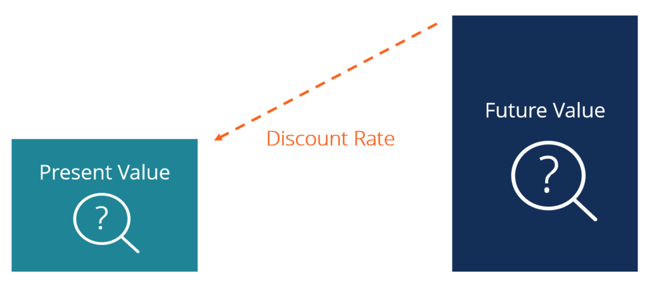
When discounting the cash flows of investments or business ventures, it is vital to note that the discount rates used will vary depending on various elements. An important element when estimating a suitable discount factor would be the stage at which the business venture is at, in terms of the business cycleBusiness CycleA business cycle is a cycle of fluctuations in the Gross Domestic Product (GDP) around its long-term natural growth rate. It explains the. Mature companies, for example, are likely to have lower discount rates than start-ups or early-stage businesses.
Start-ups tend to be discounted at relatively higher rates to account for the risk associated with the investment and uncertainties on the guarantee of the future cash flows. Founders tend to derive optimistic projections for their ventures, and due to their reduced marketability, there is a limited number of investors who are willing to take on the investments.
The projected cash flows for start-ups that are seeking money can be discounted at any rate between 40% to 100%, early-stage start-ups can be discounted at any rate between 40% to 60%, late start-ups can be discounted at 30% to 50%, and mature company cash flows can be discounted at 10% to 25%.
Formula
To derive a discounted value or the present value, the following equation can be used:
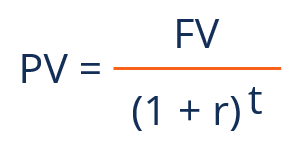
Where:
- FV is used to denote the future value of cash flow
- r is used to denote the discount rate
- t is used to denote the time period that an investment will be held for
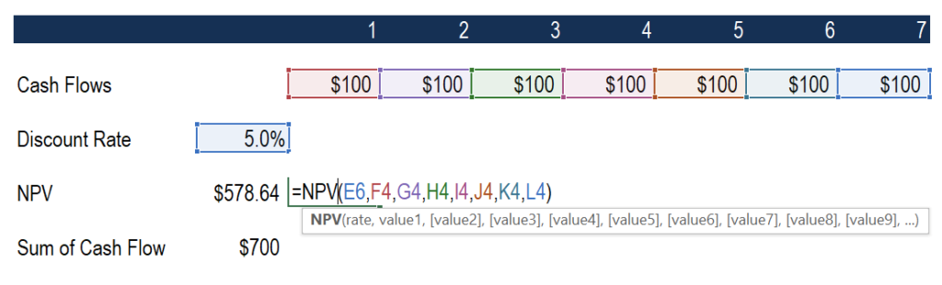
The present value can also be the sum of all future cash flows discounted back. It is known as the Net Present Value (NPV)Net Present Value (NPV)Net Present Value (NPV) is the value of all future cash flows (positive and negative) over the entire life of an investment discounted to the present..
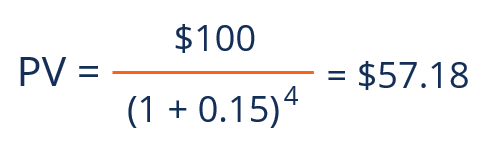
Consider a future cash flow of $100, which is set to be received in four years. The discount rate is given at 15%. What is the present value?
An Excel example of a more complex PV computation can be seen below:
Types of Discount Rates
The types of discount rates commonly used in corporate finance include:
- Weighted Average Cost of Capital (WACC): Normally used to compute a company’s enterprise value.
- Cost of equity: Can be used to calculate a company’s equity valueEquity ValueEquity value can be defined as the total value of the company that is attributable to shareholders. To calculate equity value follow, this guide from CFI..
- Cost of debt: Used for bond and fixed-income security valuation.
- A pre-defined hurdle rate: Generally used in evaluating corporate projects that are internal and to account for the time value of money
- Risk-free rate: Used in calculating the cost of equity (as calculated using the CAPM)
Uses of Discount Rates
Discount rates can be used to account for risk associated with a potential investment and the time value of money. The rate also represents a company’s opportunity cost and can act as a hurdle rate used for decision making.
Related Readings
CFI offers the Commercial Banking & Credit Analyst (CBCA)™Program Page - CBCAGet CFI's CBCA™ certification and become a Commercial Banking & Credit Analyst. Enroll and advance your career with our certification programs and courses. certification program for those looking to take their careers to the next level. To keep learning and advancing your career, the following resources will be helpful:
- Enterprise ValueEnterprise Value (EV)Enterprise Value, or Firm Value, is the entire value of a firm equal to its equity value, plus net debt, plus any minority interest
- NPV TemplateNet Present Value TemplateThis net present value template helps you calculate net present value given the discount rate and undiscounted cash flows. Net Present Value (NPV) is the value of all future cash flows (positive and negative) over the entire life of an investment discounted to the present. NPV analysis is a form of intrinsic valuation
- Opportunity CostOpportunity CostOpportunity cost is one of the key concepts in the study of economics and is prevalent throughout various decision-making processes. The
- Time Value of MoneyTime Value of MoneyThe time value of money is a basic financial concept that holds that money in the present is worth more than the same sum of money to be received in the future. This is true because money that you have right now can be invested and earn a return, thus creating a larger amount of money in the future. (Also, with future
-

Understanding Conventional Cash Flow: Definitions and Examples
Conventional cash flow is a series of cash flows which, over time, go in one direction. It means that if the initial transaction is an outflow, then it will be followed by successive periods of inward
-
EBIT Explained: Understanding Earnings Before Interest & Taxes
EBIT stands for Earnings Before Interest and Taxes and is one of the last subtotals in the income statementIncome StatementThe Income Statement is one of a companys core financial statements
finance
- Capital Budgeting: A Comprehensive Guide for Business Leaders
- Understanding Cash Consideration in Mergers & Acquisitions
- Understanding Cash Flow: A Comprehensive Guide
- Cash Management: A Comprehensive Guide to Financial Stability
- Cash-on-Cash Return: Definition, Calculation & Importance
- Cash Ratio: Understanding Your Company's Short-Term Liquidity
- Cash Sweep: Reduce Debt & Maximize Earnings | [Your Company Name]
- Disbursement Explained: Definition, Impact & Accounting Implications
- Understanding Liquidity in Financial Markets: A Comprehensive Guide
-
 Capital Appropriation: Definition, Process & Examples
Appropriation is the process of allocating capital for specific purposes. Companies, governments, and individuals all appropriate capital for specific objectives. The budgeting process involves approp...
-
 Cash Credit (CC): A Comprehensive Guide for Businesses
A Cash Credit (CC) is a short-term source of financing for a company. In other words, a cash credit is a short-term loanBridge LoanA bridge loan is a short-term form of financing that is used to meet ...