
Understanding Flow-Through Entities: Tax Advantages & Types
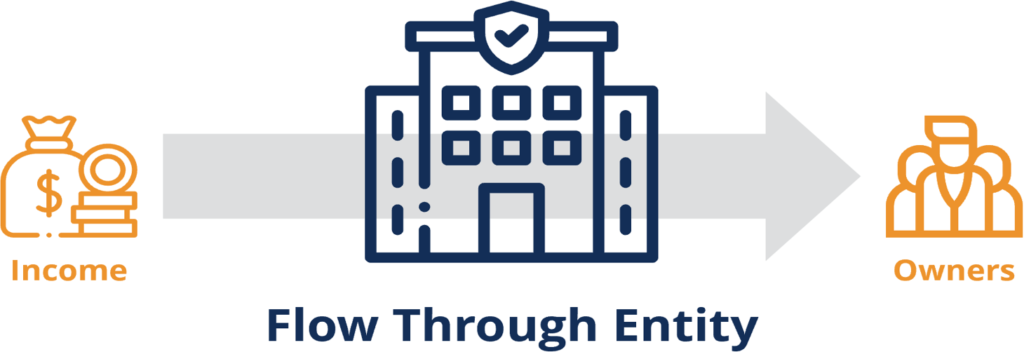
A flow-through entity – also known as a “pass-through entity” or “fiscally-transparent entity” – is a legal business entity where its profits flow directly to the investors/owners, and only the investors or owners are taxed on the income. The structure helps avoid double taxation, which is when an income from the same source is taxed both at a corporate and personal level.
Types of Flow-Through Entities
A flow-through entity can be categorized into three types:
1. Sole Proprietorships
A sole proprietorshipSole ProprietorshipA sole proprietorship (also known as individual entrepreneurship, sole trader, or proprietorship) is a type of an unincorporated entity that is owned only, also known as a sole trader, is a business owned and operated by a single individual. There is no legal distinction between the owner and the company—both operate as the same legal entity.
In such a case, the income of the entity is the same as the income of the sole owner of the entity. This income is reported by the individual in their personal tax returns (Schedule C). The Internal Revenue Services (IRS) also considers this as a disregarded entity since the revenue is treated the same as the owner’s personal income.
2. Limited Liability Companies (LLCs)
A limited liability company (LLC)Limited Liability Company (LLC)A limited liability company (LLC) is a business structure for private companies in the United States, one that combines aspects of partnerships and corp is a business structure that combines flow-through taxation with limited liability – whereby the owners or partners are not personally responsible for the company’s debt obligations.
The entities are given the option to elect the tax structure that applies to them – a disregarded entity, a corporation, and so on. Several LLCs choose to be taxed as a partnership, where the profits/losses are allocated across the LLC owners/shareholders as per the formal ownership agreement and taxed individually.
3. S Corporations
S Corporations are closely held forms of LLCs, whereby ownership is limited to certain individuals, trusts, and estates, and less than 100 shareholders.
S CorporationsS Corporation (S Subchapter)An S Corporation (S Corp) is a closely held corporation (Limited Liability Company (LLC), partnership, or C Corporation) that is treated as a are required to file corporate taxes, but profits are reflected in Schedule E of their personal income taxes. A new law states that from 2018-2025, an S Corporation allows shareholders to claim a 20% deduction from the tax on their share of profit.
Advantages of a Flow-Through Entity
There are two major reasons why owners choose a flow-through entity:
1. Tax advantages
The entity’s income only goes through a single layer of tax rather than two – corporate tax and shareholder tax. It allows owners/shareholders to receive higher net returns on their investment.
2. Lower financial risk
Individuals generally cannot use the income earned through a source to offset losses from another. However, shareholders of a flow-through entity can deduct business losses from their personal incomes coming through other sources.
Disadvantages of a Flow-Through Entity
Although a flow-through entity brings several advantages to shareholders and owners, some drawbacks also need to be evaluated before a flow-through tax structure is elected for one’s entity.
1. Potential income tax burden
Specifically, for sole proprietorships, there is always the dilemma in reinvesting the profits of the entity due to the burden falling on personal income taxes – even if the owners do not retain profits or pay dividends to themselves, they are taxed for it due to the direct flow-through.
2. Complicated process for charitable deductions
Also, deducting charitable endowments is a complicated process in a flow-through entity. If a shareholder plans to allocate significant monetary donations to charities, they would be better off adopting the tax structure of C Corporations.
Practical Example
Company X is owned by two businessmen in Los Angeles. The basic financials of X are as follows:
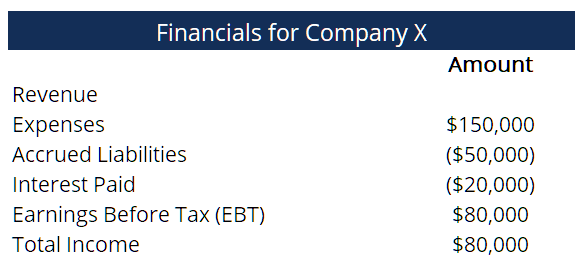
Since it is a flow-through entity, the owners must report their earnings as income when filing personal income taxes. Given that it is a partnership, the income to each owner will be half of $80,000 – both will report an income of $40,000 each.
Assuming they do not receive multiple sources of income and that they aren’t married, as per the U.S. Income Tax Calculator, they would be taxed $6,202. It means, in all, the entity paid around $12,404 (double of $6,202) in taxes, which comes up to a 15.5% tax rate.
If it were not a flow-through entity, the corporate income tax rate applied to the entity’s total income would be 21%, as prescribed by U.S. laws and regulations in 2020. More so, it does not accommodate the additional taxes that would be paid when individual owners file their personal income taxes, thus losing more money compared to the 15.5% tax rate, making the adoption of a flow-through tax structure a beneficial choice.
Related Readings
CFI offers the Capital Markets & Securities Analyst (CMSA)®Program Page - CMSAEnroll in CFI's CMSA® program and become a certified Capital Markets &Securities Analyst. Advance your career with our certification programs and courses. certification program for those looking to take their careers to the next level. To keep learning and advancing your career, the following resources will be helpful:
- Business StructureBusiness StructureBusiness structure refers to the legal structure of an organization that is recognized in a given jurisdiction. An organization's legal structure is a key determinant
- Domestic CorporationDomestic CorporationA domestic corporation refers to a company that is incorporated in and conducts business affairs in its own country. Domestic corporations are
- PartnershipPartnershipA partnership is a type of business where two or more people establish and run a business together. There are three main types of partnerships: GP, LP, LLP
- Schedule CSchedule CThe Schedule C tax form is used to report profit or loss from a business. It is a form that sole proprietors (single owners of businesses)
-
EBIT Explained: Understanding Earnings Before Interest & Taxes
EBIT stands for Earnings Before Interest and Taxes and is one of the last subtotals in the income statementIncome StatementThe Income Statement is one of a companys core financial statements
-

Understanding Federal Income Tax: A Comprehensive Guide
In many countries, taxes are imposed at the federal, state/provincial, and local level. The income tax that one pays at the federal level is determined by applying a predetermined rate to the earnings
finance
- Understanding Discretionary Income: Definition & Examples
- EBITDA Explained: Understanding Earnings Before Interest, Taxes, Depreciation & Amortization
- Entity Theory: Separating Business & Personal Finances - Definition & Benefits
- Understanding Income: Definition, Types & Uses
- Understanding Income Properties: A Guide to Real Estate Investment
- Understanding Income Tax: A Comprehensive Guide for Individuals & Businesses
- Understanding Interest Income: A Comprehensive Guide
- Understanding Taxable Income: Definition & Calculation
- Net Income Explained: A Comprehensive Guide for Businesses & Individuals
-
 Revenue vs. Income: Understanding the Key Differences
This guide provides an overview of the main differences between revenue vs income. RevenueSales RevenueSales revenue is the income received by a company from its sales of goods or the provision of ser...
-
 Understanding Business Entities: Types & Legal Structures
An entity is an organization created by one or more individuals to carry out the functions of a business, and that maintains a separate legal existence for tax purposesAccounting For Income TaxesIncom...