
Understanding Earnings Guidance: A Comprehensive Guide
An earnings guidance is the information provided by the management of a publicly traded companyPrivate vs Public CompanyThe main difference between a private vs public company is that the shares of a public company are traded on a stock exchange, while a private company's shares are not. regarding its expected future results, including estimates of revenues, expenses, margins, and earnings. In addition, the company’s management sets up its future direction by defining its short-term and long-term goals.

The earnings guidance is important information delivered to the company’s shareholders, market analysts, and potential investors. The information is disclosed in the company’s quarterly and annual reportsThree Financial StatementsThe three financial statements are the income statement, the balance sheet, and the statement of cash flows. These three core statements are.
Publicly traded companies are not obligated to provide earnings guidance statements regarding future financial performance. However, the majority of public companies provide such information. Earnings guidance can affect the recommendation of a stock analyst or the decision of potential investors.
Sources of Earnings Guidance
There are several major sources of earnings guidance, including:
1. Quarterly and annual reports
Public companies are required to provide publicly available quarterly and annual reports (10-Q10-KForm 10-K is a detailed annual report that is required to be submitted to the U.S. Securities and Exchange Commission (SEC). The filing provides a comprehensive summary of a company’s performance for the year. It is more detailed than the annual report that is sent to shareholders and 10-K10-KForm 10-K is a detailed annual report that is required to be submitted to the U.S. Securities and Exchange Commission (SEC). The filing provides a comprehensive summary of a company’s performance for the year. It is more detailed than the annual report that is sent to shareholders in the U.S.) with past financial results and earnings guidance on expected financial performance. The most crucial part of the reports is the management’s discussion and analysis of financial condition and results of operations (MD&A). In this section, the company’s management analyzes its financial results in a given period, as well as provides insights and expectations for future periods.
2. Earnings call
An earnings call is a conference call between the management of a company, investors, analysts, and media. The earnings calls support the information provided by a company in its reports. During the earnings call, the management discusses the major financial results, while investors, analysts, and the media can ask questions about the main concepts or events. Companies usually publish the recordings of their earnings call on their respective websites.
3. Press release
Before the publication of financial reports or an earnings call, a press release becomes available to the public. In the press release, information about the dates of the reports and the conference call is disclosed. In addition, the main past financial results and earnings guidance are provided.
Reliability of Earnings Guidance
Although earnings guidance is a vital source of information from the company’s insiders, an analyst or an investor should not make his stock recommendation or investment based solely on this source.
Though the information is provided by insiders, earnings guidance is considered a subjective view on the company’s future financial performance, which is exposed to uncertainties and risks. There is no guarantee that the goals and results contained in the guidance will be achieved. The company’s reports are accompanied by cautions and disclaimers regarding the guidance and forward-looking statements to prevent any legal issues.
In the U.S., companies are protected by the Private Securities Litigation Reform Act (PSLRA). Under the law, they cannot be held liable for failing to achieve the goals and expectations outlined in the earnings guidance.
Additional Resources
CFI is the official provider of the global Financial Modeling & Valuation Analyst (FMVA)™Become a Certified Financial Modeling & Valuation Analyst (FMVA)®CFI's Financial Modeling and Valuation Analyst (FMVA)® certification will help you gain the confidence you need in your finance career. Enroll today! certification program, designed to help anyone become a world-class financial analyst. To keep advancing your career, the additional CFI resources below will be useful:
- Audited Financial StatementsAudited Financial StatementsPublic companies are obligated by law to ensure that their financial statements are audited by a registered CPA. The purpose of the
- Sarbanes Oxley ActSarbanes Oxley ActThe Sarbanes-Oxley Act is a U.S. federal law that aimed to protect investors by making corporate disclosures more reliable and accurate.
- The 1933 Securities ActThe 1933 Securities ActThe 1933 Securities Act was the first major federal securities law passed following the stock market crash of 1929. The law is also referred to as the Truth in Securities Act, the Federal Securities Act, or the 1933 Act. It was enacted on May 27, 1933 during the Great Depression. ...the law was aimed at correcting some of the wrongdoings
- Types of SEC FilingsTypes of SEC FilingsThe US SEC makes it mandatory for publicly traded companies to submit different types of SEC filings, forms include 10-K, 10-Q, S-1, S-4, see examples. If you are a serious investor or finance professional, knowing and being able to interpret the various types of SEC filings will help you in making informed investment decisions.
-

Financial Analysis: A Comprehensive Guide for Professionals
Financial analysis involves using financial dataFinancial DataWhere to find data for financial analysts - Bloomberg, CapitalIQ, PitchBook, EDGAR, SEDAR and more sources of financial data for financial
-
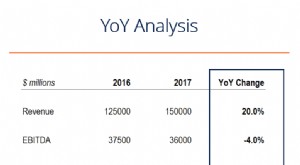
YoY Analysis: Understanding Year-over-Year Growth & Financial Insights
YoY stands for Year over Year and is a type of financial analysisAnalysis of Financial StatementsHow to perform Analysis of Financial Statements. This guide will teach you to perform financial stateme
finance
- Understanding Auditors: Roles, Responsibilities & Audit Processes
- Earnings Management: Definition, Techniques & Impact
- Understanding Earnings Volatility: Risk & Stock Price Prediction
- EBITDARM Explained: A Comprehensive Guide to Financial Analysis
- Eurocurrency Explained: What It Is & How It Works
- Factset: Financial Data & Analytics Solutions for Investment Professionals
- Understanding Finance: A Comprehensive Overview of Key Concepts
- Understanding Financial Crises: Causes, Impacts, and Examples
- Financial Engineering: Principles, Applications & Career Paths
-
 Understanding Guarantees: Protecting Lenders and Borrowers
A guarantee is a legal promise made by a third party (guarantor) to cover a borrower’s debt or other types of liability in case of the borrower’s defaultDebt DefaultA debt default happens ...
-
 MiFID II Explained: A Comprehensive Guide for Investors
MiFID II is the revision of the Markets in Financial Instruments Directive (MiFID), originally published in 2004. It is the foundation of financial legislation for the European UnionEconomic UnionAn e...