
Fintech Explained: Revolutionizing Financial Services with Technology
The term fintech refers to the synergy between finance and technology, which is used to enhance business operations and the delivery of financial services. Fintech can take the form of software, a service, or a business that provides technologically advanced ways to make financial processes more efficient by disrupting traditional methods.
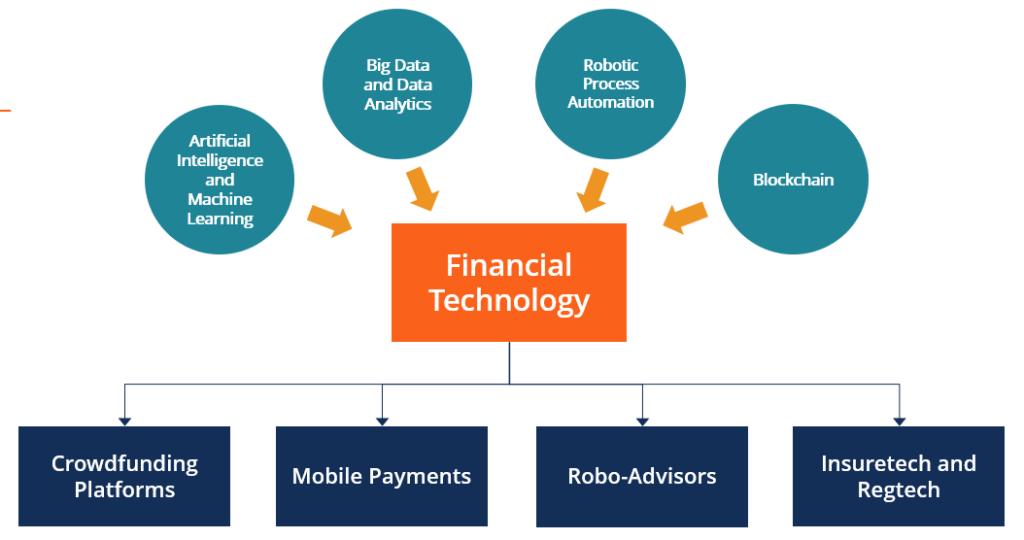
Some of the most prominent applications of fintech are mobile payments, automated investment apps (Robo-advisorsRobo-AdvisorsRobo-advisors are online investment management services that employ mathematical algorithms to provide financial advice with minimal human intervention.), cryptocurrency, online lending businesses, and crowdfunding platforms.
Technologies that Contribute to Fintech
1. Artificial Intelligence (AI) and Machine Learning (ML)
Artificial Intelligence (AI) and Machine Learning (ML) are some of the most used technologies in fintech, offering the potential to play an even bigger role in the finance industry as developments continue. Some of the fintech applications of AI and ML include credit scoringCredit Score AnalysisCredit score analysis is the process through which different companies evaluate an individual’s or a company’s credit score to help determine how creditworthy the entity is. A credit score is significant because it takes into account how many times credit was used and how efficiently it was repaid., fraud detection, regulatory compliance, and wealth management.
2. Big Data and Data Analytics
Data from customers and markets is of high value to fintech companies. Through large datasets, consumer preferences, spending habits, and investment behavior can be extracted and used to develop predictive analytics.
Predictive analytics refers to predicting how consumers are likely to behave using past information and a mathematical algorithm. The collected data also helps in formulating marketing strategies and fraud detection algorithms.
3. Robotic Process Automation (RPA)
Robotic Process Automation (RPA) refers to the process of assigning manual, repetitive tasks to robotics instead of humans in order to streamline workflows in financial institutions. The most widespread applications of RPA in finance are:
- Statistics and data collection
- Regulatory compliance management
- Communication and marketing through e-mails and chatbots
- Transaction management
4. Blockchain
Blockchain technology is being adopted at a large scale in the financial industry, primarily due to its ability to securely store transaction records and other sensitive data. Each transaction is encrypted, and the chances of successful cyber-attacks are relatively low when blockchain technology is employed. Blockchain technology is also the backbone of many cryptocurrenciesCryptocurrencyCryptocurrency is a form of digital currency that is based on blockchain networking. Cryptocurrency like Bitcoin and Ethereum are becoming widely accepted..
Applications of Fintech
1. Crowdfunding Platforms
Crowdfunding platforms like Kickstarter, GoFundMe, and Patreon are the result of developments in fintech. The platforms allow entrepreneurs and early-stage businesses to raise funds from all over the world, allowing them to bypass geographical boundaries and reach international markets and investors.
2. Mobile Payments
Mobile payment applications and gateways are some of the most prevalent uses of fintech. Such applications allow users to carry out banking activities without physically visiting a bank. For example, companies like Venmo and Interac allow customers to send and receive money through smartphones at minimal transaction fees.
3. Robo-Advisors
Robo-advisors are online investment management services that use algorithms to allocate assets and generate portfolios for customers optimally. They allow users of all age groups to engage in investment activities at low fees with minimal manual effort.
4. Insuretech
The term insuretech refers to the application of technology to the insurance model, which allows companies to provide tailored insurance services and data security. Insuretech helps streamline the insurance process through online claims filing and policy management.
5. Regtech
Regtech (regulatory technology) focuses on the automation of compliance processes for financial institutions. It offers fast and cost-effective management of large amounts of data, including transaction records and compliance documents, such as corporate tax returns.
Related Readings
CFI is the official provider of the global Business Intelligence & Data Analyst (BIDA)®Become a Certified Business Intelligence & Data Analyst (BIDA)™From Power BI to SQL & Machine Learning, CFI's Business Intelligence Certification (BIDA) will help you master your analytical superpowers. certification program, designed to help anyone become a world-class financial analyst. To keep advancing your career, the additional resources below will be useful:
- AlgorithmsAlgorithms (Algos)Algorithms (Algos) are a set of instructions that are introduced to perform a task. They automate trading to generate profits at a frequency impossible to a human trader.
- Online Payment CompaniesOnline Payment CompaniesOnline payment companies are responsible for handling online or internet-based methods of payment. Examples include PayPal, Alipay, and Google Pay.
- Transitioning from Excel to PythonTransitioning from Excel to PythonMany companies are now transitioning from Excel to Python, a high-level, general-purpose programming language created by Guido van Rossum.
- Types of Financial AnalysisTypes of Financial AnalysisFinancial analysis involves using financial data to assess a company’s performance and make recommendations about how it can improve going forward. Financial Analysts primarily carry out their work in Excel, using a spreadsheet to analyze historical data and make projections Types of Financial Analysis
-
YoY Analysis: Understanding Year-over-Year Growth & Financial Insights
YoY stands for Year over Year and is a type of financial analysisAnalysis of Financial StatementsHow to perform Analysis of Financial Statements. This guide will teach you to perform financial stateme
-

Defining Financial Success: Goals & Strategies for a Secure Future
Monetary success is difficult to define in concrete terms. Even though everyone has their own definitions, there is plenty of advice on how to plan for a better financial futu
finance
- Understanding Auditors: Roles, Responsibilities & Audit Processes
- EBITDARM Explained: A Comprehensive Guide to Financial Analysis
- Eurocurrency Explained: What It Is & How It Works
- Factset: Financial Data & Analytics Solutions for Investment Professionals
- Understanding Finance: A Comprehensive Overview of Key Concepts
- Understanding Financial Crises: Causes, Impacts, and Examples
- Financial Engineering: Principles, Applications & Career Paths
- Understanding Your Financial Health: A Comprehensive Guide
- Fintech Explained: A Comprehensive Guide to Financial Technology
-
 MiFID II Explained: A Comprehensive Guide for Investors
MiFID II is the revision of the Markets in Financial Instruments Directive (MiFID), originally published in 2004. It is the foundation of financial legislation for the European UnionEconomic UnionAn e...
-
 Financial Analysis: A Comprehensive Guide for Professionals
Financial analysis involves using financial dataFinancial DataWhere to find data for financial analysts - Bloomberg, CapitalIQ, PitchBook, EDGAR, SEDAR and more sources of financial data for financial...