
Fisher Equation Explained: Understanding Inflation & Interest Rates
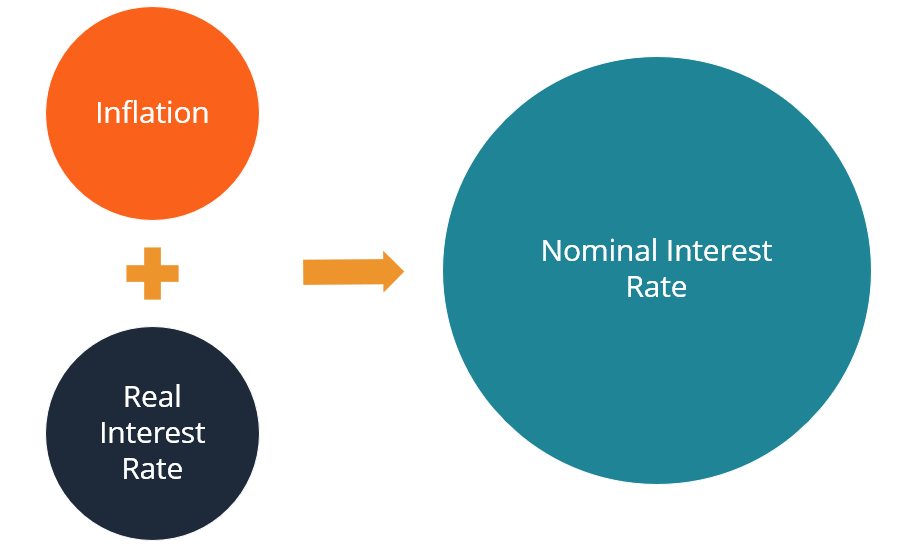
The Fisher equation is a concept in economics that describes the relationship between nominal and real interest rates under the effect of inflationInflationInflation is an economic concept that refers to increases in the price level of goods over a set period of time. The rise in the price level signifies that the currency in a given economy loses purchasing power (i.e., less can be bought with the same amount of money).. The equation states that the nominal interest rate is equal to the sum of the real interest rate plus inflation.
The Fisher equation is often used in situations where investors or lenders ask for an additional reward to compensate for losses in purchasing power due to high inflation.
The concept is widely used in the fields of finance and economics. It is frequently used in calculating returns on investmentsReturn on Investment (ROI)Return on Investment (ROI) is a performance measure used to evaluate the returns of an investment or compare efficiency of different investments. or in predicting the behavior of nominal and real interest rates. One example is when an investor wants to determine the actual (real) interest rate earned on an investment after accounting for the effect of inflation.
One interesting finding of the Fisher equation is related to monetary policyMonetary PolicyMonetary policy is an economic policy that manages the size and growth rate of the money supply in an economy. It is a powerful tool to. The equation reveals that monetary policy moves inflation and the nominal interest rate together in the same direction. Whereas, monetary policy generally does not affect the real interest rate.
American economist Irving Fisher proposed the equation.
Fisher Equation Formula
The Fisher equation is expressed through the following formula:
(1 + i) = (1 + r) (1 + π)
Where:
- i – the nominal interest rate
- r – the real interest rate
- π – the inflation rate
However, one can also use the approximate version of the previous formula:
i ≈ r + π
Fisher Equation Example
Suppose Sam owns an investment portfolio. Last year, the portfolio earned a return of 3.25%. However, last year’s inflation rate was around 2%. Sam wants to determine the real return he earned from his portfolio. In order to find the real rate of return, we use the Fisher equation. The equation states that:
(1 + i) = (1 + r) (1 + π)
We can rearrange the equation to find real interest rate:
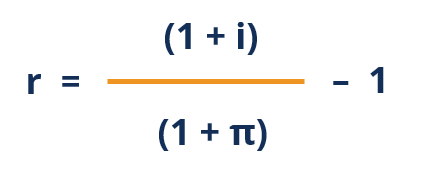
Therefore, the real interest rate, or actual return on investment, of the portfolio equals:
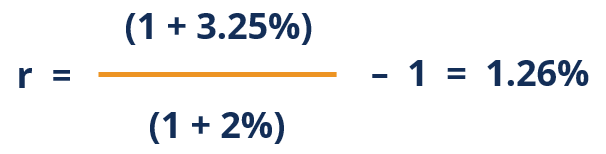
The real interest that Sam’s investment portfolio earned last year, after accounting for inflation, is 1.26%.
Related Readings
CFI offers the Financial Modeling & Valuation Analyst (FMVA)®Become a Certified Financial Modeling & Valuation Analyst (FMVA)®CFI's Financial Modeling and Valuation Analyst (FMVA)® certification will help you gain the confidence you need in your finance career. Enroll today! certification program for those looking to take their careers to the next level. To keep learning and advancing your career, the following CFI resources will be helpful:
- Effective Annual Interest RateEffective Annual Interest RateThe Effective Annual Interest Rate (EAR) is the interest rate that is adjusted for compounding over a given period. Simply put, the effective
- Floating Interest RateFloating Interest RateA floating interest rate refers to a variable interest rate that changes over the duration of the debt obligation. It is the opposite of a fixed rate.
- Market Risk PremiumMarket Risk PremiumThe market risk premium is the additional return an investor expects from holding a risky market portfolio instead of risk-free assets.
- Normative EconomicsNormative EconomicsNormative economics is a school of thought which believes that economics as a subject should pass value statements, judgments, and opinions on
-

Uncovered Interest Rate Parity (UIRP): Explained & Implications
The Uncovered Interest Rate Parity (UIRP) is a financial theory that postulates that the difference in the nominal interest rates between two countries is equal to the relative changes in the foreign
-

Savings Account Interest Rates: What to Expect & How to Maximize Your Returns
When it comes to the interest rate paid on savings accounts, you don't want to be
finance
- Binomial Interest Rate Tree: Definition, Uses & Applications
- Debentures Explained: A Comprehensive Guide to Unsecured Corporate & Government Debt
- Effective Annual Interest Rate (EAR): Understanding & Calculation
- Effective Annual Rate (EAR): Understanding & Calculation
- Understanding Interest Rates: A Comprehensive Guide
- Interest Rate Parity (IRP): Understanding the Relationship
- Nominal Interest Rate Explained: Definition & Implications
- Swap Rate Explained: Understanding Fixed Exchange Rates in Derivatives
- Understanding the Policy Interest Rate: Its Impact on the Economy
-
 Rate of Return vs. Interest Rate: Understanding the Key Differences
The rate of return is an internal measure of the return on money invested in a project. The interest rate is the external rate at which money can be borrowed from lenders. Rate of R...
-
 Understanding the Net Interest Rate Differential (NIRD)
Net interest rate differential (NIRD) occurs when there is a difference in interest rates between two countries or regions. It normally takes place in the international foreign exchangeForeign Exchang...