
Forward Contracts: Definition, How They Work & Examples
A forward contract, often shortened to just forward, is a contract agreement to buy or sell an assetAsset ClassAn asset class is a group of similar investment vehicles. They are typically traded in the same financial markets and subject to the same rules and regulations. at a specific price on a specified date in the future. Since the forward contract refers to the underlying asset that will be delivered on the specified date, it is considered a type of derivativeDerivativesDerivatives are financial contracts whose value is linked to the value of an underlying asset. They are complex financial instruments that are.

Forward contracts can be used to lock in a specific price to avoid volatilityVolatilityVolatility is a measure of the rate of fluctuations in the price of a security over time. It indicates the level of risk associated with the price changes of a security. Investors and traders calculate the volatility of a security to assess past variations in the prices in pricing. The party who buys a forward contract is entering into a long positionLong and Short PositionsIn investing, long and short positions represent directional bets by investors that a security will either go up (when long) or down (when short). In the trading of assets, an investor can take two types of positions: long and short. An investor can either buy an asset (going long), or sell it (going short)., and the party selling a forward contract enters into a short positionLong and Short PositionsIn investing, long and short positions represent directional bets by investors that a security will either go up (when long) or down (when short). In the trading of assets, an investor can take two types of positions: long and short. An investor can either buy an asset (going long), or sell it (going short).. If the price of the underlying asset increases, the long position benefits. If the underlying asset price decreases, the short position benefits.
Summary
- A forward contract is an agreement between two parties to trade a specific quantity of an asset for a pre-specified price at a specific date in the future.
- Forwards are very similar to futures; however, there are key differences.
- A forward long position benefits when, on the maturation/expiration date, the underlying asset has risen in price, while a forward short position benefits when the underlying asset has fallen in price.
How do Forward Contracts Work?
Forward contracts have four main components to consider. The following are the four components:
- AssetAsset ClassAn asset class is a group of similar investment vehicles. They are typically traded in the same financial markets and subject to the same rules and regulations.: This is the underlying asset that is specified in the contract.
- Expiration Date: The contract will need an end date when the agreement is settled and the asset is delivered and the deliverer is paid.
- Quantity: This is the size of the contract, and will give the specific amount in units of the asset being bought and sold.
- Price: The price that will be paid on the maturation/expiration date must also be specified. This will also include the currency that payment will be rendered in.
Forwards are not traded on centralized exchanges. Instead, they are customized, over the counter contracts that are created between two parties. On the expiration date, the contract must be settled. One party will deliver the underlying asset, while the other party will pay the agreed-upon price and take possession of the asset. Forwards can also be cash-settled at the date of expiration rather than delivering the physical underlying asset.
What are Forward Contracts Used For?
Forward contracts are mainly used to hedge HedgingHedging is a financial strategy that should be understood and used by investors because of the advantages it offers. As an investment, it protects an individual’s finances from being exposed to a risky situation that may lead to loss of value.against potential losses. They enable the participants to lock in a price in the future. This guaranteed price can be very important, especially in industries that commonly experience significant volatility in prices. For example, in the oil industryOil & Gas PrimerThe oil & gas industry, also known as the energy sector, relates to the process of exploration, development, and refinement of crude oil and natural gas. It, entering into a forward contract to sell a specific number of barrels of oil can be used to protect against potential downward swings in oil prices. Forwards are also commonly used to hedge against changes in currency exchange rates when making large international purchases.
Forward contracts can also be used purely for speculative purposes. This is less common than using futures since forwards are created by two parties and not available for trading on centralized exchanges. If a speculatorSpeculatorA speculator is an individual or firm that, as the name suggests, speculates – or guesses – that the price of securities will go up or down and trades the securities based on their speculation. Speculators are also people who create fortunes and start, fund, or help to grow businesses. believes that the future spot priceSpot PriceThe spot price is the current market price of a security, currency, or commodity available to be bought/sold for immediate settlement. In other words, it is the price at which the sellers and buyers value an asset right now. of an asset will be higher than the forward price today, they may enter into a long forward position. If the future spot price is greater than the agreed-upon contract price, they will profit.
What is the Difference Between a Forward Agreement and a Futures Contract?
Forwards and futuresFutures ContractA futures contract is an agreement to buy or sell an underlying asset at a later date for a predetermined price. It’s also known as a derivative because future contracts derive their value from an underlying asset. Investors may purchase the right to buy or sell the underlying asset at a later date for a predetermined price. contracts are very similar. They both involve an agreement on a specific price and quantity of an underlying asset to be paid at a specified date in the future. There are, however, a few key differences:
- Forwards are customized, private contracts between two parties, while futures are standardized contracts that are traded on centralized exchanges.
- Forwards are settled at the expiration date between the two parties, meaning there is higher counterparty risk RiskIn finance, risk is the probability that actual results will differ from expected results. In the Capital Asset Pricing Model (CAPM), risk is defined as the volatility of returns. The concept of “risk and return” is that riskier assets should have higher expected returns to compensate investors for the higher volatility and increased risk.than there is with futures contracts that have clearing houses.Clearing HouseA clearing house acts as a mediator between any two entities or parties that are engaged in a financial transaction. Its main role is to ensure that the transaction goes smoothly, with the buyer receiving the tradable goods he intends to acquire and the seller receiving the right amount paid
- Forwards are settled on a single date, the expiration date, while futures are marked-to-market daily, meaning they can be traded at any time the exchange is open.
- Since forwards are settled on a single date, they are not commonly associated with initial marginsContribution MarginContribution margin is a business’ sales revenue less its variable costs. The resulting contribution margin can be used to cover its fixed or maintenance marginsMaintenance MarginMaintenance margin is the total amount of capital that must remain in an investment account in order to hold an investment or trading position and avoid a like futures contracts.
- Although both contracts can involve the delivery of the asset, or settlement in cash, physical delivery is more common for forwards while cash settlement is much more common for futures.
Forward Contract Payoff Diagram and Example
The payoff of a forward contract is given by:
- Forward contract long position payoff: ST – K
- Forward contract short position payoff: K – ST
Where:
- K is the agreed-upon delivery price.
- ST is the spot price of the underlying asset at maturity.
Let us now look at what the payoff diagram of a forward contract is, based on the price of the underlying asset at maturity:
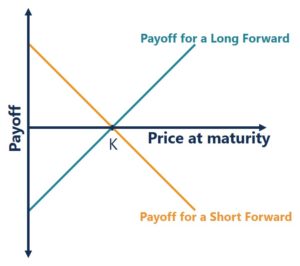
Here, we can see what the payoff would be for both the long positionLong and Short PositionsIn investing, long and short positions represent directional bets by investors that a security will either go up (when long) or down (when short). In the trading of assets, an investor can take two types of positions: long and short. An investor can either buy an asset (going long), or sell it (going short). and short positionLong and Short PositionsIn investing, long and short positions represent directional bets by investors that a security will either go up (when long) or down (when short). In the trading of assets, an investor can take two types of positions: long and short. An investor can either buy an asset (going long), or sell it (going short)., where K is the agreed-upon price of the underlying asset, specified in the contract. The higher the price of the underlying asset at maturity, the greater the payoff for the long position.
A price below K at maturity, however, would mean a loss for the long position. If the price of the underlying asset were to fall to 0, the long position payoff would be -K. The forward short position has the exact opposite payoff. If the price at maturity were to drop to 0, the short position would have a payoff of K.
Let us now consider an example question that uses a forward to deal with foreign exchange rates. Your money is currently in US dollars. However, in one year’s time, you need to make a purchase in British pounds of €100,000. The spot exchange rate today is 1.13 US$/€, but you don’t want cash tied up in foreign currency for a year.
You do want to guarantee the exchange rate one year from now, so you enter into a forward deal for €100,000 at 1.13 US$/€. At the date of maturity, the spot exchange rate is 1.16 US$/€. How much money have you saved by entering into the forward agreement?
The contract is an agreement to pay $113,000 (calculated from €100,000 x 1.13 US$/€) for €100,000.
If you had not entered into the contract, at the maturity date you would have paid €100,000 x 1.16 US$/€ = $116,000
By hedging your position with a forward contract, you saved: $116,000 – $113,000 = $3,000.
Additional Resources
CFI offers the Financial Modeling & Valuation Analyst (FMVA)™Become a Certified Financial Modeling & Valuation Analyst (FMVA)®CFI's Financial Modeling and Valuation Analyst (FMVA)® certification will help you gain the confidence you need in your finance career. Enroll today! certification program for those looking to take their careers to the next level. To keep learning and developing your knowledge base, please explore the additional relevant CFI resources below:
- Futures and ForwardsFutures and ForwardsFuture and forward contracts (more commonly referred to as futures and forwards) are contracts that are used by businesses and investors to hedge against risks or speculate.
- Futures ContractsFutures ContractA futures contract is an agreement to buy or sell an underlying asset at a later date for a predetermined price. It’s also known as a derivative because future contracts derive their value from an underlying asset. Investors may purchase the right to buy or sell the underlying asset at a later date for a predetermined price.
- HedgingHedgingHedging is a financial strategy that should be understood and used by investors because of the advantages it offers. As an investment, it protects an individual’s finances from being exposed to a risky situation that may lead to loss of value.
- Long and Short PositionsLong and Short PositionsIn investing, long and short positions represent directional bets by investors that a security will either go up (when long) or down (when short). In the trading of assets, an investor can take two types of positions: long and short. An investor can either buy an asset (going long), or sell it (going short).
-
Asset Valuation: Understanding Property Value for Business & Finance
Asset valuation simply pertains to the process to determine the value of a specific property, including stocksStockWhat is a stock? An individual who owns stock in a company is called a shareholder an
-
Currency Swap Contracts: Definition & How They Work
A currency swap contract (also known as a cross-currency swap contract) is a derivative contract between two parties that involves the exchange of interest payments, as well as the exchange of princip
finance
- Roll Forward: Extending Option & Futures Contracts Explained
- Synthetic Forward Contracts: Definition & How They Work
- Asset Management: Definition, Types & Importance
- Asset Turnover Ratio: Definition & Importance
- Fixed Income Forward Contracts: Definition & Uses
- Understanding Forward Prices: Definition & How They Work
- Variable Prepaid Forward Contracts: Tax-Efficient Stock Sales Explained
- Understanding Leases: Types, Classifications, and Key Concepts
- Synthetix: A Decentralized Platform for Synthetic Asset Trading
-
 Understanding Asset Base: Definition, Value & Significance
Asset base refers to all the assets held by a company that gives value to the business. The value placed on the assets is not fixed and can fluctuate as the company buys and sells new assets. Although...
-
 Asset Coverage Ratio: Understanding Financial Solvency
The asset coverage ratio is a financial metric that indicates how a company can potentially settle its debts by selling its tangible assetsTangible AssetsTangible assets are assets with a physical for...