
Asset Coverage Ratio: Understanding Financial Solvency
The asset coverage ratio is a financial metric that indicates how a company can potentially settle its debts by selling its tangible assetsTangible AssetsTangible assets are assets with a physical form and that hold value. Examples include property, plant, and equipment. Tangible assets are. The ratio is used to evaluate the solvency of a company and helps lenders, investors, management, regulatory bodies, etc. determine how risky a particular company is. The asset coverage ratio is calculated as follows:
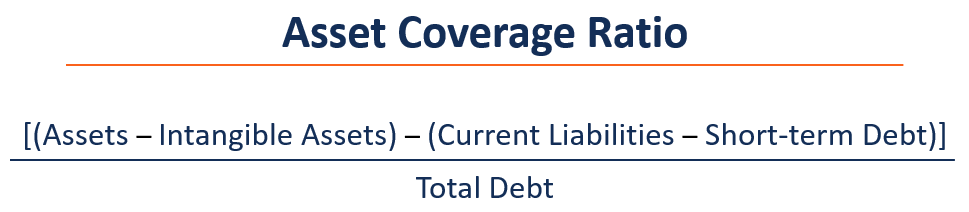
The higher the asset coverage ratio is, the lower the risk of the evaluated company. The ratio can be used in comparable company analysisComparable Company AnalysisThis guide shows you step-by-step how to build comparable company analysis ("Comps") and includes a free template and many examples. to compare companies within the same industry.
Understanding the Asset Coverage Ratio
Going back to the formula above, the first portion of the numerator is assets less intangible assetsIntangible AssetsAccording to the IFRS, intangible assets are identifiable, non-monetary assets without physical substance. Like all assets, intangible assets, and it refers to physical assets and excludes non-physical assets such as franchises, trademarks, copyrights, goodwill, securities, contracts, and patents. The reason for leaving intangible assets out is that they cannot be easily valued or sold.
The second portion of the numerator is current liabilities less short-term debt. Current liabilities are short-term financial obligations that are owed typically to suppliers but are not considered debt since it is not an interest-bearing liability. The reason for leaving short-term debt out of the numerator is that short-term debt is included in total debt in the denominator.
The denominator includes total debt, which includes both short-term and long-term interest-bearing debt.
Debt to Equity Tradeoff
Assets are funded with two main sources of capital: debt and equity. Debt investors need to be paid interest and principal on a scheduled basis. Equity investors refer to the owners of the company and will receive residual earnings after the debt holders are paid.

Companies funded with less equity and more debt can achieve higher returns on equity due to fewer claimants on earnings. However, high debt levels lead to increased agency risk and bankruptcy risk.
Agency risk involves the conflict of interest between equity holders and debt holders. Management is obligated to act in the best interest of equity holders, and what is in the best interest of equity holders may not always be optimal for debt holders.
Bankruptcy risk is the risk that a company will not be able to meet its debt obligations and will be forced to liquidate assets or sell some assets in order to meet the obligations. It usually occurs because a company is unprofitable or with poorly managed capital.
Companies funded with less debt and more equity face reduced bankruptcy risk, but also provide a lower return to individual equity holders since earnings are spread out between more equity claimants.
Usage of Asset Coverage Ratio
The asset coverage ratio is very useful to determine how exposed a company is to the risk of bankruptcyBankruptcyBankruptcy is the legal status of a human or a non-human entity (a firm or a government agency) that is unable to repay its outstanding debts. The asset coverage ratio is a solvency ratio – which means it measures the ability to cover debt obligations in the future.
Investors, debtholders, analysts, and other stakeholders use the asset coverage ratio to assess the financial stability, capital management, overall capital structure, and level of risk of a company. A high ratio from an investor or debtholder’s perspective is beneficial because it shows that the assets are greater than debt liabilities, and that the company is less exposed to bankruptcy risk.
On the other hand, a company does not want the ratio to be too high, since it may indicate that it is not taking on enough debt and are not maximizing the returns to shareholders.
There is no optimal asset coverage ratio. The ratio should be used in context; it should be compared to relevant comparable companies and evaluated on a case-by-case basis.
Limitations
The asset coverage ratio is useful for quickly evaluating the solvency of a company. However, it comes with the following limitations:
1. Comparability
The asset coverage ratio can be used to compare companies and their associated riskiness. However, companies in different industries or different stages of their lifecycle may adopt drastically different capital structures that make a comparison not feasible.
2. Accuracy
The components of the asset coverage ratio are items from the balance sheet of a company. In most cases, the items are measured at book value and may not reflect the actual current market value or liquidation value of these items.
The market value or liquidation valueLiquidation ValueLiquidation value is an estimation of the final value which will be received by the holder of financial instruments when an asset is sold or liquidated. may be either higher or lower than what the book value indicates. In the event of liquidation, assets are usually worth less than they normally would be, since they need to be disposed of immediately. Thus, the asset coverage ratio may not be entirely accurate.
More Resources
CFI offers the Commercial Banking & Credit Analyst (CBCA)™Program Page - CBCAGet CFI's CBCA™ certification and become a Commercial Banking & Credit Analyst. Enroll and advance your career with our certification programs and courses. certification program for those looking to take their careers to the next level. To keep learning and advancing your career, the following resources will be helpful:
- Financial RatiosFinancial RatiosFinancial ratios are created with the use of numerical values taken from financial statements to gain meaningful information about a company
- Debt Service Coverage RatioDebt Service Coverage RatioThe Debt Service Coverage Ratio (DSCR) measures the ability of a company to use its operating income to repay all its debt obligations, including repayment of principal and interest on both short-term and long-term debt.
- Forced Sale ValueForced Sale ValueA forced sale value is the estimate of the amount that a business would receive if it sold off its assets one piece at a time during an unforeseen or uncontrollable event. The appraiser assumes that the business needs to sell its assets within a short duration at an immediate auction.
- Ratio AnalysisRatio AnalysisRatio analysis refers to the analysis of various pieces of financial information in the financial statements of a business. They are mainly used by external analysts to determine various aspects of a business, such as its profitability, liquidity, and solvency.
-

Understanding Debt: Types, Obligations & Financial Implications
Debt is the money borrowed by one party from another to serve a financial need that otherwise cannot be met outright. Many organizationsTypes of OrganizationsThis article on the different types of org
-
Understanding Debt Capacity: A Guide for Businesses
Debt capacity refers to the total amount of debt a business can incur and repay according to the terms of a debt agreementDebt ScheduleA debt schedule lays out all of the debt a business has in a sche
finance
- Cash Debt Coverage Ratio: Definition & Calculation
- Asset Turnover Ratio: Definition & Calculation - Financial Analysis
- Coverage Ratio: Understanding Your Company's Debt Repayment Ability
- Debt Service Coverage Ratio (DSCR): Definition & Calculation
- Debt-to-Asset Ratio: Definition, Calculation & Significance
- Debt-to-Assets Ratio: Definition, Calculation & Risk Assessment
- Debt-to-Equity Ratio: Definition, Calculation & Importance
- Loan Life Coverage Ratio (LLCR): Definition & Importance
- Understanding Current Debt: Definition & Implications
-
 Cash Ratio: Understanding Your Company's Short-Term Liquidity
The cash ratio, sometimes referred to as the cash asset ratio, is a liquidity metric that indicates a company’s capacity to pay off short-term debt obligationsCurrent LiabilitiesCurrent liabilit...
-
 Understanding the Credit-Market Debt to Income Ratio
The credit-market debt to disposable income ratio is a financial metric used to measure financial conditions in householdsHouseholdA household refers to a social unit of people who live together under...