
Growth Capex: Definition, Examples & Strategic Importance
Growth capex is a form of capital expenditure undertaken by a company to expand existing operations or further growth prospects. It focuses on activities such as the acquisition of fixed assetsTypes of AssetsCommon types of assets include current, non-current, physical, intangible, operating, and non-operating. Correctly identifying and, purchase of hardware (e.g., computers), vehicles for transporting goods, and building expansion. Usually, transactions relating to growth capex are recorded on the balance sheetBalance SheetThe balance sheet is one of the three fundamental financial statements. The financial statements are key to both financial modeling and accounting. (PP&E) and the cash flow statementCash Flow StatementA cash flow Statement contains information on how much cash a company generated and used during a given period. (investing activities).
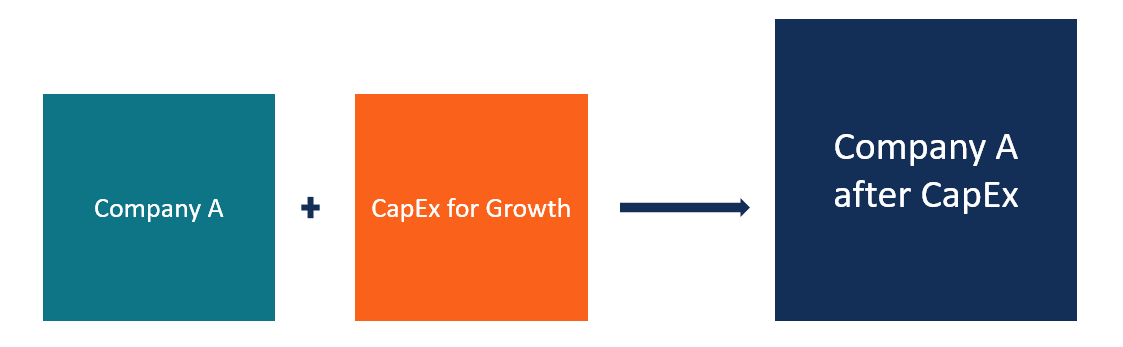
Overview of Growth Capex
Capital expenditure, commonly known as capex, is an integral part of strategic decisionsCorporate StrategyCorporate Strategy focuses on how to manage resources, risk and return across a firm, as opposed to looking at competitive advantages in business strategy for organizations, because it helps foster growth, improve customer service, increase margin, and promote quality performance. Due to the large sums of money allocated to projects, it is critical for the investments to generate high returns. Two approaches are used to implement growth capex:
1. Acquisition of New Equipment and Automation
Every organization is looking for ways to increase efficiency, and automation provides a viable solution. Automation not only reduces operational costs but also helps in the realization of a company’s goals within a shorter period of time. The significant investment made in robots and other automation equipment can be justified by the increased processing output and reduced labor costs. However, companies should determine if the capital expenditure contributes to the company’s value before acquiring the equipment for automating the process. For example, they should assess if:
- The automated equipment helps the company ship or take more orders or reduce the customer’s waiting time
- The automation creates more WIP leading to new challenges downstream
- The output or throughput will increase
2. Facility Expansion
Facility expansion requires similar considerations for the acquisition of new equipment – cost, risk, implementation time, and staff training, among other factors. Not all businesses need facility expansion if they can gain significant profits from existing facilities. Hence, the need to ask several questions:
- Has the company made a critical analysis of the WIP, space demand for stored parts and material, as well as the aged inventory?
- What has the company done to improve the efficiency of material and people flows using the current facility?
The answers to the questions above should help a company determine if it needs to expand or not. The rule of the thumb is to embark on a project that can generate immediate, tangible returns.
How to Calculate Growth Capex
Companies use the acquired assets to grow their businesses and generate more profit. The amount spent on such acquisitions is shown on the cash flow statement to show how much money the company is re-investing in the business. A growing capex between different accounting periodsFiscal Year (FY)A fiscal year (FY) is a 12-month or 52-week period of time used by governments and businesses for accounting purposes to formulate annual means the company is spending more cash on fixed assets. Here’s how to calculate it:
- Find the company’s recent cash flow statement and that of the previous accounting period in its quarterly or annual reports.
- Find the amount spent on capital expenditure on each cash flow statement. It is listed in the investing activities section. For example, the company may spend $200,000 in the most recent period and $150,000 in the previous period.
- Subtract the two figures and divide the amount by the capital expenditure in the previous period to get a growth capex of 0.33%. It shows the company spent 33% more on fixed assets in the most recent period. A growing company normally grows its capital expenditure over time, but such growth should also be reflected in its profits and revenues. If the profit figures indicate a downward trend despite significant investments in fixed assets, the company may be using the money inefficiently.
Growth Capex vs. Maintenance Capex
Evaluating the nature of capital expenditure is imperative when preparing a discounted cash flow model and free cash flows. This is because a company’s revenue may grow significantly due to several reasons – improved utilization of existing capital, significant investment in fixed assets, or the company’s ability to maintain the existing capital.
Growth as a result of the acquisition of new equipment that helped the business to process additional orders from new customers is classified as growth capex. However, growth caused by proper maintenance of the existing machines, e.g., replacement of tires on a truck, is referred to as maintenance capex.
Companies rarely break down growth and maintenance expenditures in their annual and quarterly reports. As such, investors are compelled to use rough estimates when separating the two expenditures. Two methods are used to distinguish them. The first and simplest involves deducting the depreciation from the capital expenditure to get the growth capex. The depreciation acts as the maintenance capex.
However, the success of the formulaCapEx Formula TemplateThis CapEx formula template helps you calculate the amount of capital expenditures using numbers in the income statement and balance sheet. CapEx (short for Capital Expenditures) is the money invested by a company in acquiring, maintaining, or improving fixed assets such as property, buildings, factories, equipment, an relies on the accuracy of the depreciation amount. Thus, if the firm is overly confident about the economic life of the fixed assets or understates it in a bid to manage the earnings upwards, the growth capex may be overstated materially. Another method for calculating maintenance capex involves:
- Calculating the ratio of the average PPE (use gross amount) to sales in the last seven years
- Determine the sales of the current year.
- Multiply the initial ratio (PPE/Sales ratio) by the growth in sales to get the growth capex.
- Subtract the capex amount obtained from the cash flow statement from the growth capex calculated above to get the maintenance capex.
Wrap Up
Growth capital expenditures involve significant purchases that extend beyond the current accounting period. The costs are recovered after a long period through depreciation, hence the need for companies to budget for such purchases separately from operational budgets. They should also assess the need for implementing such capital budgeting decisions to avoid incurring losses in the future.
Related Readings
Thank you for reading CFI’s guide to growth capex. CFI is the official provider of the Financial Modeling and Valuation Analyst (FMVA)™Become a Certified Financial Modeling & Valuation Analyst (FMVA)®CFI's Financial Modeling and Valuation Analyst (FMVA)® certification will help you gain the confidence you need in your finance career. Enroll today! certification program, designed to transform anyone into a world-class financial analyst. To keep learning and developing your knowledge of financial analysis, we highly recommend the additional CFI resources below:
- Corporate StrategyCorporate StrategyCorporate Strategy focuses on how to manage resources, risk and return across a firm, as opposed to looking at competitive advantages in business strategy
- Capital ExpendituresCapital ExpendituresCapital expenditures refer to funds that are used by a company for the purchase, improvement, or maintenance of long-term assets to improve
- Fixed and Variable CostsFixed and Variable CostsCost is something that can be classified in several ways depending on its nature. One of the most popular methods is classification according
- Sustainable Growth RateSustainable Growth RateThe sustainable growth rate is the rate of growth that a company can expect to see in the long term. Often referred to as G, the sustainable growth rate can be calculated by multiplying a company's earnings retention rate by its return on equity. The growth rate can be calculated on a historical basis and average
-

Outsourcing: A Comprehensive Guide to Benefits & Strategy
Outsourcing is a strategic decisionCorporate StrategyCorporate Strategy focuses on how to manage resources, risk and return across a firm, as opposed to looking at competitive advantages in business s
-
Ramp-Up: Definition, Benefits & How to Achieve It
In business, ramp-up is a term that describes a significant increase in the output of a company’s products or services. Essentially, ramp-up implies bringing the company’s capacity utiliza
finance
- Acquirer Definition: Understanding Corporate Acquisitions
- Understanding Clawbacks: Protecting Stakeholders from Failed Performance
- Understanding Financial Gearing: Debt & Leverage Explained
- Leverage in Finance: Strategies, Types & Risks
- Understanding Negative Growth: Causes, Impacts & Examples
- Parent Company Explained: Definition, Control & Examples
- Understanding Stocks: A Beginner's Guide to Share Ownership
- Sustainable Growth Rate (SGR): Definition & Calculation
- Organic Growth: Definition, Strategies & Benefits | [Your Brand]
-
 Holding Companies: Definition, Purpose & How They Work
A holding company is a company that doesn’t conduct any operations, ventures, or other active tasks for itself. Instead, it exists for the purpose of owning assets. In other words, the company d...
-
 Kaizen: Understanding Continuous Improvement for Business
Kaizen is a Japanese word (改善) that means “improvement” or “to improve.” When applied to the world of business, kaizen refers to every action, operation, or rule ...