
Iranian Rial (IRR): Currency Overview, Value & History
The Iranian Rial is the official legal currency of the Islamic Republic of Iran. It is subdivided into 100 dinars; however, dinar denominations of the Iranian currency are not typically used due to the extremely low value of one Iranian rial. Unlike most other currencies, there is no official symbol for the Iranian rial.
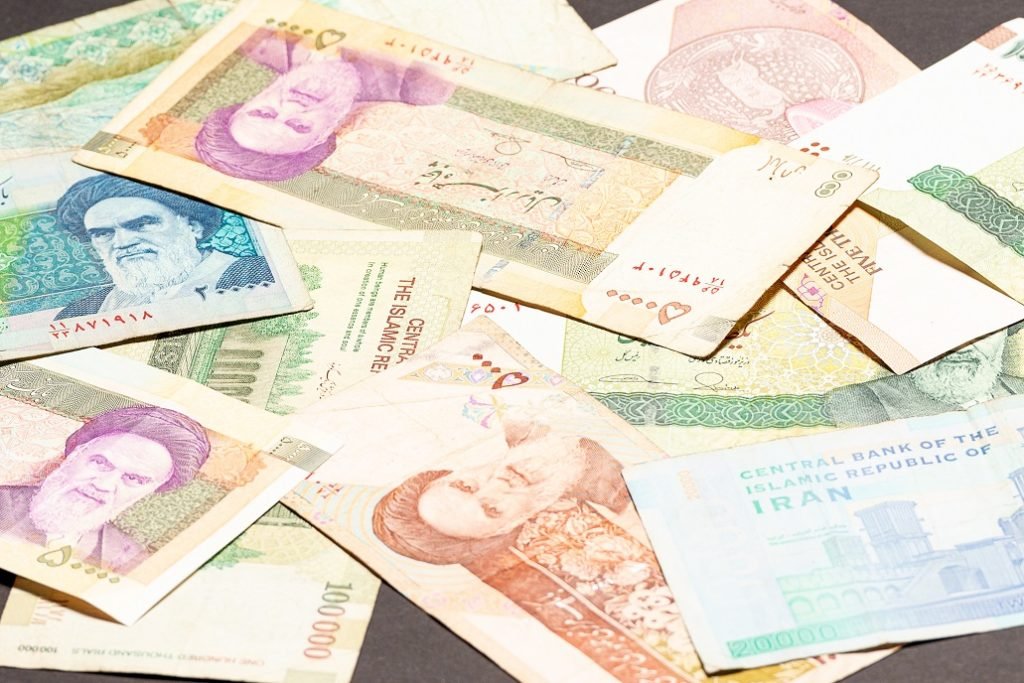
The Iranian currency is, as of 2020, in a period of transition. Because of the rial’s low value, the Iranian parliament voted to gradually remonetize the nation’s currency from the rial to the toman between 2020 and 2022, with an exchange rateExchange RateAn exchange rate is the rate at which one currency can be exchanged for another between nations or economic zones. It is used to determine the of 1 toman = 10,000 rials. The changeover from rials to tomans is projected to cost the Iranian government upwards of $150 million.
The rial is the only official legal currency in the nation of Iran, but is also informally used in Afghanistan, Saudi Arabia, Iraq, and Syria. Because of its extremely low value, the rial is not commonly traded in the foreign exchange market. Its forex symbol is IRR. For example, the exchange rate with the US dollarUnited States Dollar (USD)The United States Dollar refers to the national currency of the U.S and is represented by the ISO code USD and is often abbreviated as US$. is denoted as USD/IRR.
The Iranian rial is issued by the Central Bank of Iran – also referred to as the Bank Markazi.
Summary
- The Iranian Rial is the official legal currency of the Islamic Republic of Iran.
- Because of its extremely low value, the Iranian rial is not commonly traded in the foreign exchange market. Its forex symbol is IRR.
- The rial is scheduled to be gradually replaced by a new official currency, the toman, between 2020 and 2022.
History of the Rial
The Iranian rial was a currency in use in what is now the nation of Iran (formerly Persia) as far back as 1798. It was replaced with the qiran in 1825, at an exchange rate of 1 qiran = 10 rials. A little over a century later, in 1932, the nation of Iran returned to the rial as its official currency, with a 1:1 exchange rate of qirans for rials.
Initially, the rial was pegged to the British pound sterlingPound Sterling (GBP)The Pound Sterling refers to the national currency of the Isle of Man, the United Kingdom, South Sandwich Islands, Gibraltar, South Georgia, at a rate of 59.75 rials = 1 British pound. The nation transferred to a peg with the US dollar in 1945 at 32.25 rials = 1 US dollar. By the late 1950s, the exchange rate with the US dollar was as high as 75.75 rials. Iran discontinued pegging its currency to the US dollar in 1975, shortly after the United States completely abandoned the gold standard.
The value of the rial plummeted following the Islamic revolution, as tens of billions of dollars’ worth of currency was moved out of the country. By mid-1999, it took over 9,000 rials to secure 1 US dollar. High inflation, due to a poor, state-controlled economy, continues to erode the value of the Iranian rial. As of late 2020, 42,105 rials = 1 US dollar.
Iranian Rial Currency – Coins and Banknotes
With the rial’s reintroduction in 1932 as the official currency, both gold and silver Iranian coins were minted, but the use of gold and silver in the coinage ceased in 1953. The most recently minted series of Iranian coins is the 2010 series (likely to be the last, with the coming changeover to the toman as the nation’s official currency).
Iranian coins, which are now made of a copper and nickel alloy, exist in denominations of 50, 100, 250, 500, 1000, 2000, and 5000 rials. To save money on minting costs, the Iranian central bank’s gradually reduced the size of coins since 1992. Note that no current coins in denominations of dinars are in circulation.
Iranian banknotes are printed in a wide range of denominationsDenominationA denomination is a classification for the face value of a financial instrument. This includes financial instruments such as bonds, currency – 100, 200, 500, 1,000, 2,000, 5,000, 10,000, 20,000, 50,000, and 100,000 rials. The largest denominations, notes over 10,000 rials, were added after the turn of the century to cope with the ever-rising inflation in Iran.
All banknotes of denominations 1,000 and above carry the image of Ayatollah Khomeini on the obverse side. The reverse sides of Iranian rial banknotes feature various historical sites and landmarks, such as the Dome of the Rock.
Related Readings
CFI offers the Commercial Banking & Credit Analyst (CBCA)™Program Page - CBCAGet CFI's CBCA™ certification and become a Commercial Banking & Credit Analyst. Enroll and advance your career with our certification programs and courses. certification program for those looking to take their careers to the next level. To keep learning and developing your knowledge base, please explore the additional relevant resources below:
- DemonetizationDemonetizationDemonetization is an economic process in which a country’s currency unit is no longer legal tender. A currency unit is what we would commonly
- Iraqi Dinar (IQD)Iraqi Dinar (IQD)The Iraqi dinar refers to Iraq’s national currency and is represented by ISO code IQD. Iraq’s Central Bank issues the Iraqi dinar, which
- Exchange Rate Mechanism (ERM)Exchange Rate Mechanism (ERM)An exchange rate mechanism (ERM) is a device used by countries to manage the strength of their currency. The ERM is a critical pillar in any
- Kuwaiti Dinar (KWD)Kuwaiti Dinar (KWD)Kuwaiti Dinar is the legal tender of the State of Kuwait, an oil-rich nation in the Middle East that is surrounded by Iraq and Saudi Arabia.
-
![Rule of 72: Calculate Investment Doubling Time | [Your Brand Name]](https://www.etffin.com/article/uploadfiles/202110/2021100815281678_S.png)
Rule of 72: Calculate Investment Doubling Time | [Your Brand Name]
In finance, the Rule of 72 is a formula that estimates the amount of time it takes for an investment to double in value, earning a fixed annual rate of returnRate of ReturnThe Rate of Return (ROR) is
-

Nifty 50: History, Significance & Key Stocks - A Comprehensive Guide
The Nifty 50 refers to the fifty most popular large-cap stocks that traded at high valuations in the 1960s and 1970s. They included household names such as Xerox (XRX), IBM, Polaroid and Coca-Cola (
finance
- Current Ratio: Definition, Calculation & Financial Health
- Understanding Forward Rates: A Comprehensive Guide
- Hope Credit: Understanding Your Post-Secondary Education Tax Credit
- Internal Rate of Return (IRR): Definition & Calculation
- Iranian Rial (IRR): Currency Overview, Value & History
- Libra Cryptocurrency: A Comprehensive Overview
- Modigliani-Miller Theorem: Understanding Capital Structure & Firm Value
- Understanding NCREIF: Real Estate Investment Performance Data
- Operating Ratio: Definition, Calculation & Importance
-
 Understanding the Yield Curve: Definition & Significance
The Yield Curve is a graphicalTypes of GraphsTop 10 types of graphs for data presentation you must use - examples, tips, formatting, how to use them for effective communication and in presentations. r...
-
 Dow 30 Explained: Understanding the Dow Jones Industrial Average
The Dow 30, or Dow Jones Industrial Average, is a stock index that tracks the performance of the 30 biggest companies listed on the stock indices in the United States. Despite being used by analysts t...