
Money-Weighted Rate of Return (MWRR) Explained: A Comprehensive Guide
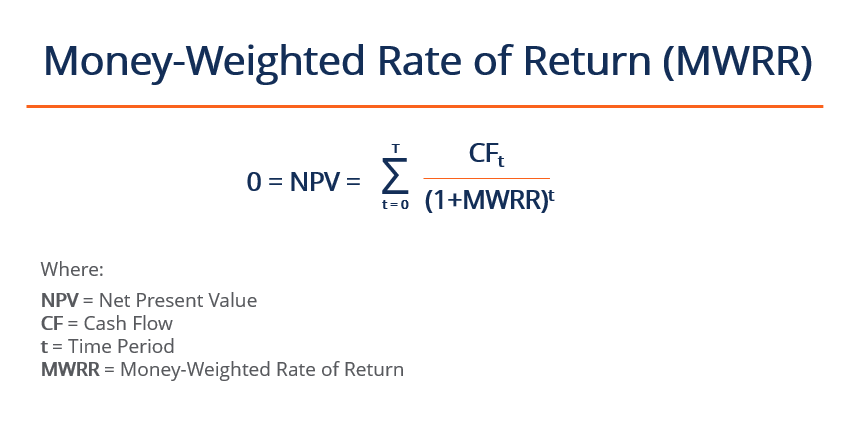
The money-weighted rate of return (MWRR) refers to the discount rate that equates a project’s present value cash flows to its initial investment. It is used to determine the profitability of a project or investment and is used interchangeably with the internal rate of return (IRR)Internal Rate of Return (IRR)The Internal Rate of Return (IRR) is the discount rate that makes the net present value (NPV) of a project zero. In other words, it is the expected compound annual rate of return that will be earned on a project or investment..
Summary
- The money-weighted rate of return (MWRR) is the discount rate that equates a project’s present value cash flows to its initial investment.
- It represents the expected compounded annual rate of return on the project/investment.
- MWRR is used to determine the profitability of a project or investment and is used interchangeably with the internal rate of return (IRR).
Understanding Money-Weighted Rate of Return
In finance, the time value of moneyTime Value of MoneyThe time value of money is a basic financial concept that holds that money in the present is worth more than the same sum of money to be received in the future. This is true because money that you have right now can be invested and earn a return, thus creating a larger amount of money in the future. (Also, with future is an important concept which states that the same amount of money today is more valuable than it is in the future because money today can be invested to grow in value. Therefore, any cash flows in the future must be discounted to the present value for an accurate comparison.
As the discount rate that equates the net present value (NPV) to zero, the money-weighted rate of return represents the expected compounded annual rate of return on the project/investment. The NPV is the sum of the present value of cash inflows and outflows of the project.
The higher the money-weighted rate of return, the more valuable the project is, likewise with the net present value. Any projects with a negative MWRR or NPV should not be undertaken because they will incur a loss. When making a decision whether or not to pursue a certain project, the MWRR is often compared to a company’s cost of capital or hurdle rate.
The cost of capital refers to the weighted average cost of capital (WACC)WACCWACC is a firm’s Weighted Average Cost of Capital and represents its blended cost of capital including equity and debt. to finance the project, and the hurdle rate is the minimum rate of return set for the project – usually the cost of capital with risk-adjusted considerations. If the MWRR is greater than these comparables, the project will increase a company’s value.
Benefits and Disadvantages of Money-Weighted Rate of Return
While both the NPV and MWRR are common tools used in comparing the profitability of potential projects, the benefit of MWRR to NPV is its ability to compare across projects of different sizes. The NPV returns a nominal value based on the magnitude of the project, while the MWRR returns a percentage that is better suited for comparisons.
The major downside to MWRR is its inherent assumption that all positive cash flows are reinvested at the same rate. It can overinflate the expected profitability of the project, so it should be taken with a grain of salt.
Another downside is the multiple solutions problem. Typically, project finance follows conventional cash flows, which involve negative cash flows at the onset (initial investment), followed exclusively by positive cash flows.
In cases of non-conventional cash flow, where cash flows bounce between negative and positive, the formula will result in multiple MWRR solutions. As such, the best option is to stick with using the NPV metric or adopting the MIRR (Modified Internal Rate of Return) formulaModified Internal Rate of Return (MIRR)The modified internal rate of return (commonly denoted as MIRR) is a financial measure that helps to determine the attractiveness of an investment and that can be used to compare different investments. Essentially, the modified internal rate of return is a modification of the internal rate of return (IRR) formula.
Money-Weighted Rate of Return Example
The money-weighted rate of return is difficult to calculate by hand as it requires a lot of trial-and-error plugging; thankfully, there are many programs that can solve it easily, such as the =IRR() function on Microsoft Excel or Google Sheets.
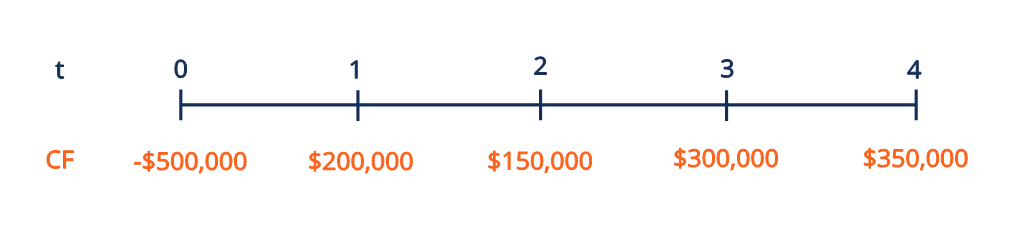
An investor comes across an investment opportunity with expected cash flows, as shown above. To finance the initial investment of $500,000, the investor can borrow at 6% interest. Should she invest?
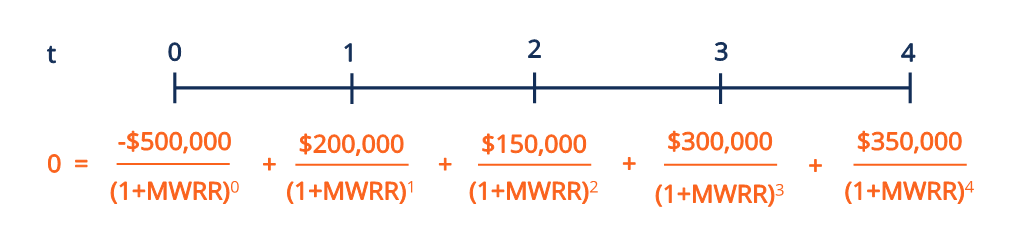
By inputting the cash flows into Excel or Sheets and using =IRR(), we arrive at an MWRR of 30%. Since her MWRR is greater than her cost of capital (6%), the project is quite profitable and should be pursued (with consideration of other factors).
Related Readings
CFI offers the Certified Banking & Credit Analyst (CBCA)®Program Page - CBCAGet CFI's CBCA™ certification and become a Commercial Banking & Credit Analyst. Enroll and advance your career with our certification programs and courses. certification program for those looking to take their careers to the next level. To keep learning and advance your career, the following resources will be helpful:
- Cost of CapitalCost of CapitalCost of capital is the minimum rate of return that a business must earn before generating value. Before a business can turn a profit, it must at least generate sufficient income to cover the cost of funding its operation.
- Discount RateDiscount RateIn corporate finance, a discount rate is the rate of return used to discount future cash flows back to their present value. This rate is often a company’s Weighted Average Cost of Capital (WACC), required rate of return, or the hurdle rate that investors expect to earn relative to the risk of the investment.
- Hurdle RateHurdle Rate DefinitionA hurdle rate, which is also known as minimum acceptable rate of return (MARR), is the minimum required rate of return or target rate that investors are expecting to receive on an investment. The rate is determined by assessing the cost of capital, risks involved, current opportunities in business expansion, rates of return for similar investments, and other factors
- Net Present Value (NPV) Net Present Value (NPV)Net Present Value (NPV) is the value of all future cash flows (positive and negative) over the entire life of an investment discounted to the present.
-
Understanding Swap Rate Curves: A Comprehensive Guide
The swap rate curve is a chart that depicts the relationship between swap rates and all available corresponding maturities. Essentially, it indicates the expected returnsExpected ReturnThe expected re
-

Annualized Rate of Return: Definition & Calculation
Annualized rate of return is a way of calculating investment returns on an annual basis. As we invest, we often want to know how much we are earning from our investments. When we calculate our investm
finance
- Rate of Return vs. Interest Rate: Understanding the Key Differences
- Understanding Forward Rates: A Comprehensive Guide
- Internal Rate of Return (IRR): Definition & Calculation
- MIRR: Understanding the Modified Internal Rate of Return
- Understanding the Overnight Interest Rate: A Comprehensive Guide
- Prime Rate Explained: Understanding Interest Rates for Businesses & Consumers
- Understanding Rate of Return: A Comprehensive Guide
- Nominal Rate of Return: Definition & Calculation
- Understanding the Required Rate of Return: A Key Finance Concept
-
 Nominal Interest Rate Explained: Definition & Implications
The nominal interest rate refers to the rate of interest before adjusting for inflationInflationInflation is an economic concept that refers to increases in the price level of goods over a set period ...
-
 Swap Rate Explained: Understanding Fixed Exchange Rates in Derivatives
The swap rate is the fixed rate of a swapSwapA swap is a derivative contract between two parties that involves the exchange of pre-agreed cash flows of two financial instruments. The cash flows a...