
MIRR: Understanding the Modified Internal Rate of Return
The modified internal rate of return (commonly denoted as MIRR) is a financial measure that helps to determine the attractiveness of an investment and that can be used to compare different investments. Essentially, the modified internal rate of return is a modification of the internal rate of return (IRR)Internal Rate of Return (IRR)The Internal Rate of Return (IRR) is the discount rate that makes the net present value (NPV) of a project zero. In other words, it is the expected compound annual rate of return that will be earned on a project or investment. formula, which resolves some issues associated with that financial measure.

The MIRR is primarily used in capital budgeting to identify the viability of an investment project. For instance, if the MIRR of a project is higher than its expected return,Expected ReturnThe expected return on an investment is the expected value of the probability distribution of possible returns it can provide to investors. The return on the investment is an unknown variable that has different values associated with different probabilities. an investment is considered to be attractive.
Conversely, it is not recommended to undertake a project if its MIRR is less than the expected return. In addition, the MIRR is commonly employed to compare several alternative projects that are mutually exclusive. In such a case, the project with the highest MIRR is the most attractive.
How to Calculate the Modified Internal Rate of Return
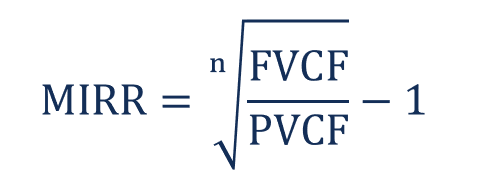
Calculating the MIRR considers three key variables: (1) the future value of positive cash flows discounted at the reinvestment rate, (2) the present value of negative cash flows discounted at the financing rate, and (3) the number of periods.
Mathematically, the calculation of the MIRR is expressed using the following equation:
Where:
- FVCF – the future value of positive cash flows discounted at the reinvestment rate
- PVCF – the present value of negative cash flows discounted at the financing rate
- n – the number of periods
Generally, the manual calculation of the MIRR is a tedious process that is prone to making mistakes. Alternatively, the MIRR can be easily calculated in spreadsheet applications such as Microsoft Excel. For example, in MS Excel, it can be calculated using the function called “=MIRR (cash flows, financing rate, reinvestment rate).”
MIRR vs. IRR
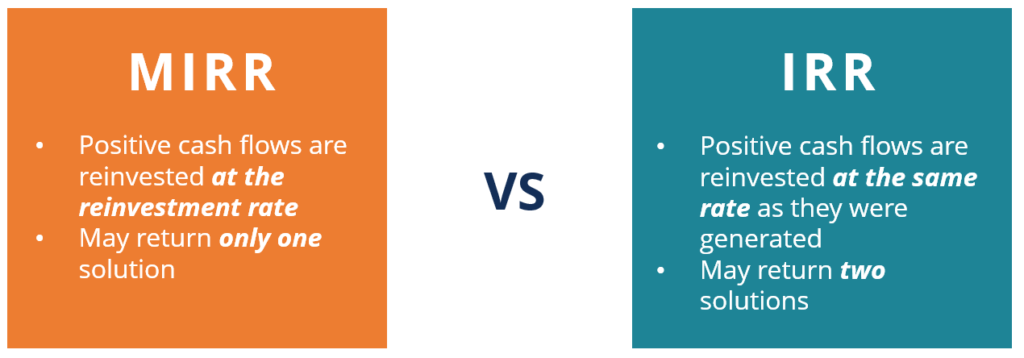
The modified internal rate of return (MIRR) and the internal rate of return (IRR) are two closely-related concepts. The MIRR was introduced to address a few problems associated with the IRR. For example, one of the main problems with the IRR is the assumption that the obtained positive cash flows are reinvested at the same rate at which they were generated. Alternatively, the MIRR considers that the proceeds from the positive cash flows of a project will be reinvested at the external rate of return. Frequently, the external rate of return is set equal to the company’s cost of capital.
Also, in some cases, the calculations of IRR may provide two solutions. This fact creates ambiguity and unnecessary confusion regarding the correct outcome. Unlike the IRR, the MIRR calculations always return a single solution.
The common view is that the MIRR provides a more realistic picture of the return on the investment project relative to the standard IRR. The MIRR is commonly lower than the IRR.
Example of MIRR
Let’s consider the following example. Company A wants to assess the investment viability of its upcoming project of building a new plant. The company must spend $200 million on the plant’s construction. At the same time, it expects that the new plant will generate revenues of $50 million in the first year, $100 million in the second year, and $150 million in the third year. Note that the cost of capital of Company A is 10%.
Using the information above, we may calculate the modified internal rate of return of the project. First, we need to calculate the future value of positive cash flows at the reinvestment rate. We may assume that the reinvestment rate equals the company’s cost of capitalCost of CapitalCost of capital is the minimum rate of return that a business must earn before generating value. Before a business can turn a profit, it must at least generate sufficient income to cover the cost of funding its operation..
The present value of negative cash flows discounted at the financing rate is simply $200 million because there is only one cash outflow occurring before the project. Therefore, we can use the variables to calculate the modified internal rate of return (MIRR):
The modified internal rate of return for the project is 17.02%. In order to determine the investment viability of the project, the figure may be later compared with the expected return of the project.
Related Readings
CFI is the official provider of the global Financial Modeling & Valuation Analyst (FMVA)™Become a Certified Financial Modeling & Valuation Analyst (FMVA)®CFI's Financial Modeling and Valuation Analyst (FMVA)® certification will help you gain the confidence you need in your finance career. Enroll today! certification program, designed to help anyone become a world-class financial analyst. To keep advancing your career, the additional CFI resources below will be useful:
- Cash Flow StatementCash Flow StatementA cash flow Statement contains information on how much cash a company generated and used during a given period.
- Due Diligence in Project FinanceDue Diligence in Project FinanceDue diligence in project finance involves managing and reviewing the aspects related to a deal. Proper due diligence ensures no surprises arise in regard to a financial transaction. The process involves a comprehensive examination of the transaction and preparation of a credit appraisal note.
- Return on Investment (ROI)Return on Investment (ROI)Return on Investment (ROI) is a performance measure used to evaluate the returns of an investment or compare efficiency of different investments.
- Required Rate of ReturnRequired Rate of ReturnThe required rate of return (hurdle rate) is the minimum return that an investor is expecting to receive for their investment. Essentially, the required rate of return is the minimum acceptable compensation for the investment’s level of risk.
-

Indexed Annuities: A Comprehensive Guide for Retirees
An indexed annuity is a financial product that pays out a return based on the performance of a linked index. The contract is backed by an insurance company and is popular among retirees because it pro
-

Nominal Interest Rate Explained: Definition & Implications
The nominal interest rate refers to the rate of interest before adjusting for inflationInflationInflation is an economic concept that refers to increases in the price level of goods over a set period
finance
- Understanding Forward Rates: A Comprehensive Guide
- Internal Rate of Return (IRR): Definition & Calculation
- Money-Weighted Rate of Return (MWRR) Explained: A Comprehensive Guide
- Understanding the Overnight Interest Rate: A Comprehensive Guide
- Understanding Rate of Return: A Comprehensive Guide
- Modified Dietz Return: Calculation & Investment Portfolio Analysis
- Nominal Rate of Return: Definition & Calculation
- Understanding the Required Rate of Return: A Key Finance Concept
- MIRR vs. IRR: Understanding the Modified Internal Rate of Return
-
 Federal Funds Rate: Understanding Interest Rates & Its Impact
In the United States, the federal funds rate refers to the interest rate that depository institutions (such as banks and credit unionsCredit UnionA credit union is a type of financial organization tha...
-
 H-Model Explained: A Quantitative Stock Valuation Method
The H-model is a quantitative method of valuing a company’s stock priceStock PriceThe term stock price refers to the current price that a share of stock is trading for on the market. Every publi...