
Perpetuity Explained: Understanding Infinite Cash Flows
Perpetuity in the financial system is a situation where a stream of cash flowValuationFree valuation guides to learn the most important concepts at your own pace. These articles will teach you business valuation best practices and how to value a company using comparable company analysis, discounted cash flow (DCF) modeling, and precedent transactions, as used in investment banking, equity research, payments continues indefinitely or is an annuity that has no end. In valuation analysisValuation MethodsWhen valuing a company as a going concern there are three main valuation methods used: DCF analysis, comparable companies, and precedent transactions, perpetuities are used to find the present value of a company’s future projected cash flow stream and the company’s terminal valueTerminal ValueTerminal Value (TV) is the estimated present value of a business beyond the explicit forecast period. TV is used in various financial tools. Essentially, a perpetuity is a series of cash flows that keep paying out forever.
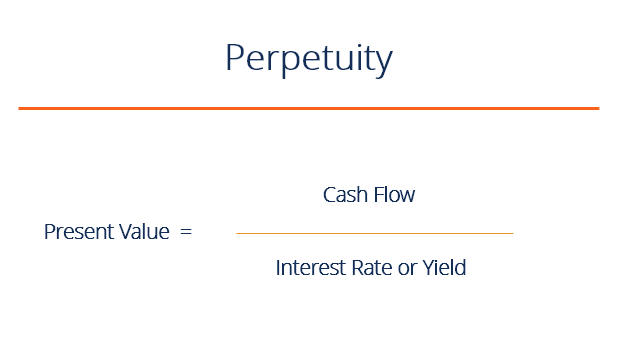
Finite Present Value of Perpetuity
Although the total value of a perpetuity is infinite, it comes with a limited present valueNet Present Value (NPV)Net Present Value (NPV) is the value of all future cash flows (positive and negative) over the entire life of an investment discounted to the present.. The present value of an infinite stream of cash flow is calculated by adding up the discounted values of each annuity and the decrease of the discounted annuity value in each period until it reaches close to zero.
An analyst uses the finite present value of perpetuity to determine the exact value of a company if it continues to perform at the same rate.
Real-life Examples
Although perpetuity is somewhat theoretical (can anything really last forever?), classic examples include businesses, real estate, and certain types of bonds.
One example of a perpetuity is the UK’s government bond known as a Consol. Bondholders will receive annual fixed coupons (interest payments) as long as they hold the amount and the government does not discontinue the Consol.
The second example is in the real-estate sector when an owner purchases a property and then rents it out. The owner is entitled to an infinite stream of cash flow from the renter as long as the property continues to exist (assuming the renter continues to rent).
Another real-life example is preferred stock, where the perpetuity calculation assumes the company will continue to exist indefinitely in the market and keep paying dividends.
Present Value of Perpetuity Formula
Here is the formula:
PV = C / R
Where:
- PV = Present value
- C = Amount of continuous cash payment
- r = Interest rate or yield
Example – Calculate the PV of a Constant Perpetuity
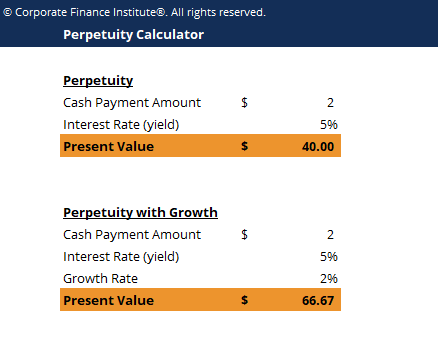
Company “Rich” pays $2 in dividends annually and estimates that they will pay the dividends indefinitely. How much are investors willing to pay for the dividend with a required rate of return of 5%?
PV = 2/5% = $40
An investor will consider investing in the company if the stock price is $40 or less.
Download the Free Template
Enter your name and email in the form below and download the free template now!
Perpetuity with Growth Formula
Formula:
PV = C / (r – g)
Where:
- PV = Present value
- C = Amount of continuous cash payment
- r = Interest rate or yield
- g = Growth Rate
Sample Calculation
Taking the above example, imagine if the $2 dividend is expected to grow annually by 2%.
PV = $2 / (5 – 2%) = $66.67
Importance of a Growth Rate
The growth model is important for some terminal value calculations in the discounted cash flow model. The last, or terminal year, in the DCF modelDCF Analysis InfographicHow discounted cash flow (DCF) really works. This DCF analysis infographic walks through the various steps involved in building a DCF model in Excel., will be assumed to grow at a constant rate forever. This, in essence, means that the terminal year cash flow is a continuous stream of cash flow.
Additional Resources
Thank you for reading this guide to perpetuities. CFI is the official provider of the Financial Modeling and Valuation Analyst (FMVA)®Become a Certified Financial Modeling & Valuation Analyst (FMVA)®CFI's Financial Modeling and Valuation Analyst (FMVA)® certification will help you gain the confidence you need in your finance career. Enroll today! certification, designed to transform anyone into a world-class financial analyst. To help on your journey, these additional CFI resources will be helpful:
- Valuation MethodsValuation MethodsWhen valuing a company as a going concern there are three main valuation methods used: DCF analysis, comparable companies, and precedent transactions
- Cost of Preferred StockCost of Preferred StockThe cost of preferred stock to a company is effectively the price it pays in return for the income it gets from issuing and selling the stock. They calculate the cost of preferred stock by dividing the annual preferred dividend by the market price per share.
- Market Risk PremiumMarket Risk PremiumThe market risk premium is the additional return an investor expects from holding a risky market portfolio instead of risk-free assets.
- Debt ScheduleDebt ScheduleA debt schedule lays out all of the debt a business has in a schedule based on its maturity and interest rate. In financial modeling, interest expense flows
-

Bitcoin Cash (BCH): A Comprehensive Overview - Features, History & Future
Bitcoin Cash (BCH) is a cryptocurrency created from a hard fork of Bitcoin. It is meant to have quicker transactions than Bitcoin. The fork occurred at block 478,559. At that block the Bitcoin bl
-
Ex-Post Analysis: Understanding Outcomes After Events
Ex-post is a Latin word that means “after the event,” and it is the opposite of the Latin word “ex-anteEx-AnteEx-ante is a Latin word that means “before the event.” The t
finance
- Understanding Cash Consideration in Mergers & Acquisitions
- Understanding Cash Flow: A Comprehensive Guide
- Cash Management: A Comprehensive Guide to Financial Stability
- Cash-on-Cash Return: Definition, Calculation & Importance
- Cash Ratio: Understanding Your Company's Short-Term Liquidity
- Cash Sweep: Reduce Debt & Maximize Earnings | [Your Company Name]
- Understanding Financial Denomination: A Comprehensive Guide
- Disbursement Explained: Definition, Impact & Accounting Implications
- Understanding Equity: A Comprehensive Guide for Investors
-
 Understanding Net Cash Value in Life Insurance: A Comprehensive Guide
Like many things in life, shopping for a life insurance policy is not a simple task. Without a full grasp of insurance terminology, policy types and riders, it's hard to identify a policy that bes...
-
 What is Value Date?
Value date refers to the date when a transaction takes place or when the value of assets or money becomes effective. it is also used to determine the present value of a product with a fluctuating pric...