
Pretax Margin Ratio: Definition & Analysis | Financial Insights
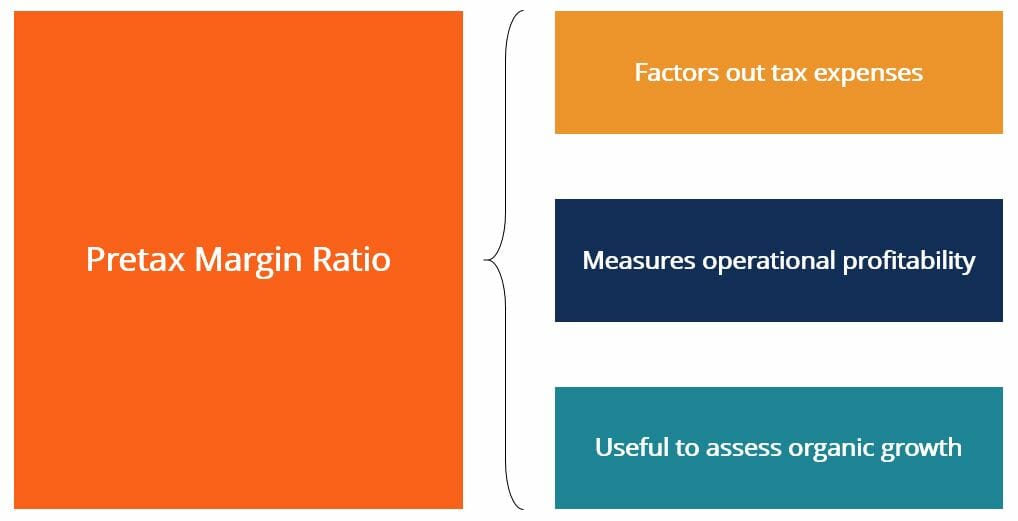
The Pretax Margin Ratio, also knows at the Earnings Before TaxEarnings Before Tax (EBT)Earnings before tax, or pre-tax income, is the last subtotal found in the income statement before the net income line item. EBT is found (EBT) ratio, is an operating profitability ratio used by market analysts and investors. This ratio is useful in analyzing the standalone profitability of a company’s operations, as it excludes tax expense. The pretax margin ratio is also useful in assessing the year-over-yearYoY (Year over Year)YoY stands for Year over Year and is a type of financial analysis used for comparing time series data. It is useful for measuring growth and detecting trends. organic growth that a company experiences, as it focuses on the intrinsic valueIntrinsic ValueThe intrinsic value of a business (or any investment security) is the present value of all expected future cash flows, discounted at the appropriate discount rate. Unlike relative forms of valuation that look at comparable companies, intrinsic valuation looks only at the inherent value of a business on its own. that the business generates.
How can we calculate the Pretax Margin Ratio?
The ratio can be calculated using the following equation:
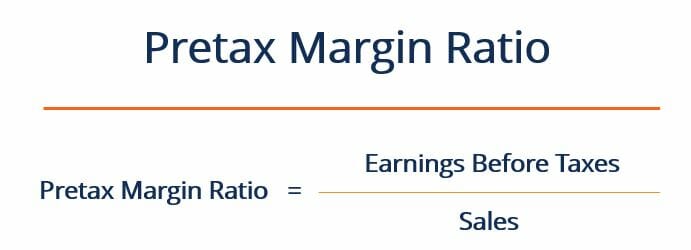
Where:
Earnings Before Taxes (EBT) = Net IncomeNet IncomeNet Income is a key line item, not only in the income statement, but in all three core financial statements. While it is arrived at through + Taxes (EBT can sometimes be found on the income statement)
Sales = Sales revenues recorded in the accounting period
A higher ratio indicates a company with a high degree of operational profitability. A lower ratio indicates poorer operational profitability. This means that the company is more dependent on a low-tax environment to ensure profitability.
The thinking behind using this ratio is that a company’s earnings growth should not be artificially penalized by high tax rates. The pretax margin ratio more clearly reveals how a company’s operations are actually performing. Also, a company’s operational profitability relative to a competitor may be overstated if the competitor operates in a higher tax environment. Thus, using the pretax margin ratio factors out extraneous tax effects on a company’s performance.
Pretax Margin Ratio Example
Jake’s Bakery just filed its financial statements for the current accounting year. Below is a simplified version of Jakes’ income statement for the past four years:
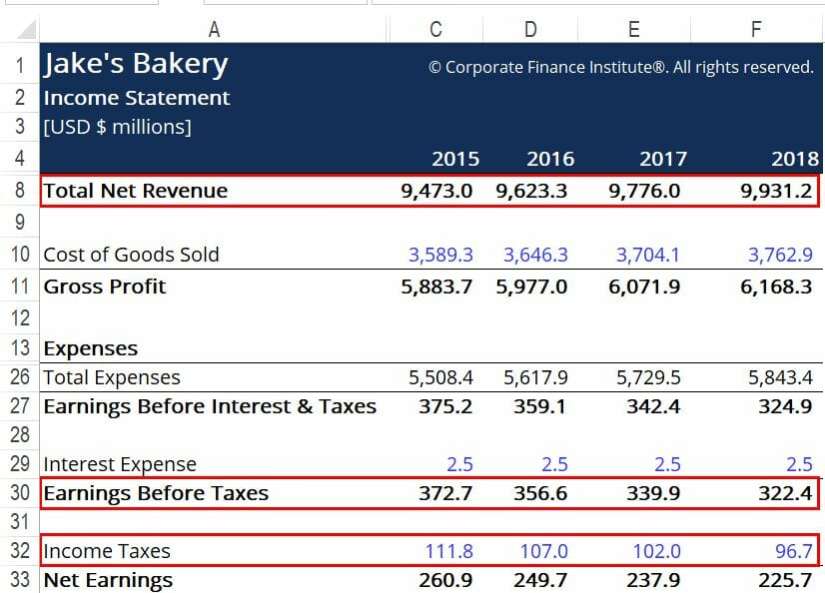
The red boxes highlight the company’s net revenue, earnings before taxes, and income tax expenses. These figures are relevant to the calculation of the pretax margin ratio. Using the formula explained earlier, we get the following ratios:
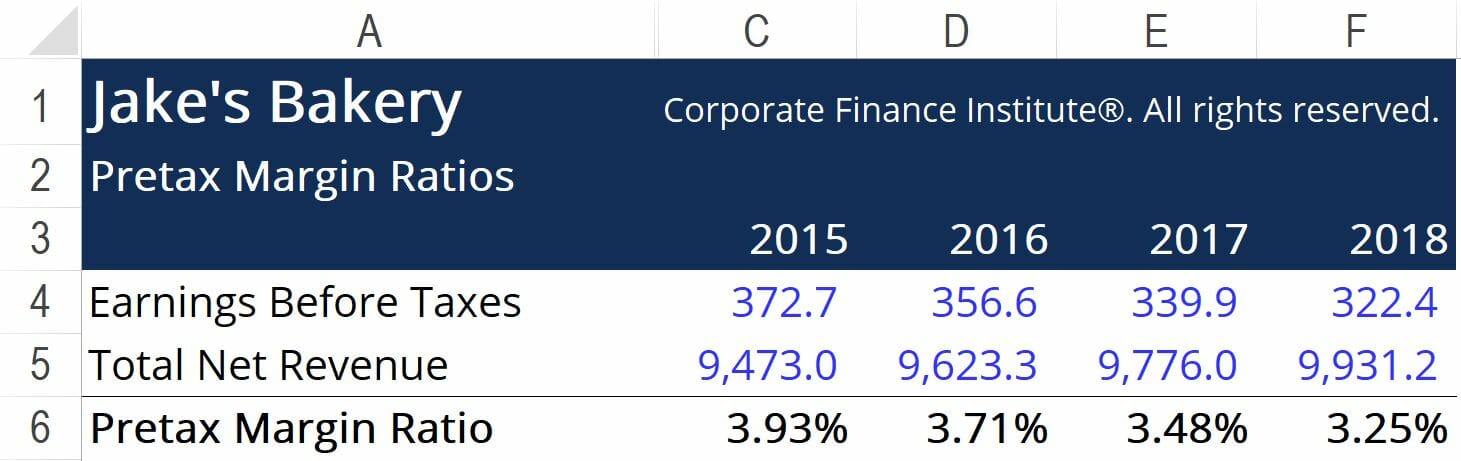
Looking at the numbers above, we can see that the bakery’s operational profitability slowly dropped each year from 2015-2018. While we also see that the company’s EBT is slowly declining, its total revenue is increasing year over year. This may indicate that the company’s expenses are growing faster than its revenues, meaning that the bakery’s future profitability may be in danger.
When using the pretax margin ratio, it is important to compare it against the ratios of competitors in the industry in order to draw additional insights. For instance, the rise in expenses that the bakery faces may be due to industry factors such as increasing costs of raw materials. This will negatively affect all companies in the industry.
Additional Resources
CFI offers the Financial Modeling & Valuation Analyst (FMVA)™Become a Certified Financial Modeling & Valuation Analyst (FMVA)®CFI's Financial Modeling and Valuation Analyst (FMVA)® certification will help you gain the confidence you need in your finance career. Enroll today! certification program for those looking to take their careers to the next level. To learn more about related topics, check out the following CFI resources:
- How to Calculate Debt Service Coverage RatioHow to Calculate Debt Service Coverage RatioThis guide will describe how to calculate the Debt Service Coverage Ratio. First, we will go over a brief description of the Debt Service Coverage Ratio, why it is important, and then go over step-by-step solutions to several examples of Debt Service Coverage Ratio Calculations.
- Current Portion of Long Term DebtCurrent Portion of Long-Term DebtThe current portion of long-term debt is the portion of long-term debt due that is due within a year’s time. Long-term debt has a maturity of
- Defensive Interval RatioDefensive Interval RatioThe defensive interval ratio (DIR) is a financial liquidity ratio that indicates how many days a company can operate without needing to tap into capital sources other than its current assets. It is also known as the basic defense interval ratio (BDIR) or the defensive interval period ratio (DIPR).
- ROAS (Return on Ad Spend)ROAS (Return on Ad Spend)ROAS (Return on Ad Spend) is an important eCommerce metric. ROAS measures revenue generated per dollar of marketing spent. It is a similar and alternative profitability metric to ROI, or "Return on Investment". ROAS is commonly used in eCommerce businesses to evaluate the effectiveness of a marketing campaign.
-

Advertising to Sales Ratio: Measuring Ad Effectiveness & ROI
The advertising to sales ratio, also called the “A to S” for short, measures the effectiveness, or how successful, a company’s advertising strategiesAIDA ModelThe AIDA model, which s
-

Fixed-Charge Coverage Ratio (FCCR): Definition & Importance
The Fixed-Charge Coverage Ratio (FCCR) is a measure of a company’s ability to meet fixed-charge obligations such as interest expensesInterest ExpenseInterest expense arises out of a company that
finance
- Acid-Test Ratio: Understanding Your Company's Short-Term Liquidity
- Asset Turnover Ratio: Definition & Calculation - Financial Analysis
- Debt-to-Asset Ratio: Definition, Calculation & Significance
- Defensive Interval Ratio (DIR): Understanding Company Liquidity
- Understanding the Envy Ratio in Private Equity
- Gross Margin Ratio: Definition & Calculation | [Your Brand/Website]
- Net Debt to EBITDA Ratio: Understanding Company Solvency
- Times Interest Earned (TIE) Ratio: Calculation & Interpretation
- Receivables Turnover Ratio: Definition, Calculation & Importance
-
 Sharpe Ratio: Calculate & Interpret Investment Performance
Named after American economist, William Sharpe, the Sharpe Ratio (or Sharpe Index or Modified Sharpe Ratio) is commonly used to gauge the performance of an investment by adjusting for its risk.The hig...
-
 Solvency Ratio: Understanding a Company's Financial Stability
A solvency ratio is a performance metric that helps us examine a company’s financial health. In particular, it enables us to determine whether the company can meet its financial obligations in t...