
Working Capital vs. Investing Capital: A Clear Distinction
In the performance of their duties, financial analysts often need to distinguish between working capital vs investing capital. Working capital, also referred to as net-working capital or NWC, represents the difference between an organization’s current assets (e.g., cash, inventory, accounts receivableAccounts ReceivableAccounts Receivable (AR) represents the credit sales of a business, which have not yet been collected from its customers. Companies allow) and its current liabilities (e.g., accounts payableAccounts PayableAccounts payable is a liability incurred when an organization receives goods or services from its suppliers on credit. Accounts payables are). Working capital serves as a measure of a company’s liquidity.
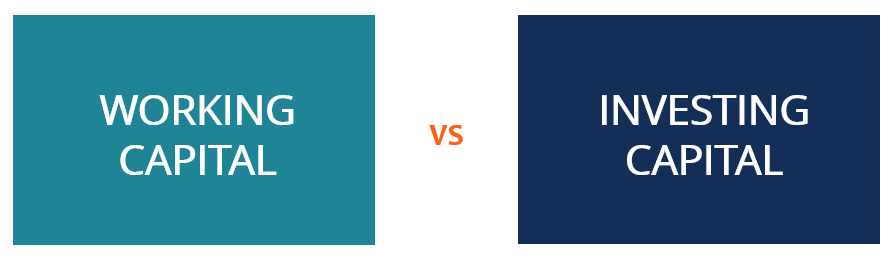
On the other hand, investing capital is an amount of money given to an organization to achieve its business objectives. The term also refers to the acquisition of tangible long-term assets, such as manufacturing plants, real estate, and machinery.
Summary
- Working capital (WC) is represented as the difference between an organization’s current assets (e.g., cash, inventories of raw materials and finished goods, accounts receivable) and its current liabilities (e.g., accounts payable).
- Current assets include cash, inventory, accounts receivable, and other assets that are expected to be turned into cash or liquidated in less than a year.
- Current liabilities contain taxes payable, accounts payable, wages, and the current portion of long-term debt.
What is Working Capital?
Working capital measures a business’s operational efficiency, liquidityLiquidityIn financial markets, liquidity refers to how quickly an investment can be sold without negatively impacting its price. The more liquid an investment is, the more quickly it can be sold (and vice versa), and the easier it is to sell it for fair value. All else being equal, more liquid assets trade at a premium and illiquid assets trade at a discount., and financial health in the short term. If a company shows enough positive working capital, then it can potentially grow and invest, using the capital at its disposal. If an organization’s current assets are less than its current liabilities, it may encounter challenges to pay back creditors or expand the business. Also, the company can even go bankrupt.
As mentioned earlier, the working capital is calculated by taking the company’s current assets and subtracting its current liabilitiesCurrent LiabilitiesCurrent liabilities are financial obligations of a business entity that are due and payable within a year. A company shows these on the. Current assets are assets that are expected to be turned into cash or liquidated in less than a year. Current liabilities are also due within twelve months.
Most major projects, such as expansion into new markets or in production, require a working capital investment. It reduces the company’s cash flow. Nevertheless, the cash level will also decrease if sales volumes are decreasing or money is being collected very slowly, which leads to a similar decline in accounts receivable.
What is Investing Capital?
The investing capital term is broadly used and can be defined in two different ways:
- An individual, a financial institution, or a venture capital group can make a capital investment in a company. A sum of money is provided in return for its repayment promise or profit shares down the road, or as a loan. In this context, capital is referred to as cash.
- Company executives can make a capital investment in the business. They acquire long-term assets that will help the business expand faster or run more efficiently. In this context, capital refers to physical assets.
In both cases, the money for investment capital must be provided from somewhere. A new enterprise may seek investing capital from different sources, including angel investorsAngel InvestorAn angel investor is a person or company that provides capital for start-up businesses in exchange for ownership equity or convertible debt. They may provide a one-time investment or an ongoing capital injection to help the business move through the difficult early stages., venture capital firms, and regular financial institutions. The capital will be further utilized to develop and market its products. When a new enterprise goes public, it is obtaining investing capital on a large scale from various investors.
An established organization may make a capital investment by seeking a loan from a bank or using its cash reserves. If it is a public company, it can consider issuing bonds to finance investing capital.
A decision by a company to make a capital investment is related to its long-term growth strategy. Investing capital is generally made to occupy a larger share in the market, increase operational capacity, and generate more revenues. The organization may make the investing capital in the form of an equity stake in another organization’s complementary operations for the same goals.
To measure whether the success of a capital investment, the return on invested capital ratio (ROIC) is used. The higher the ROIC is, the more a company profits on the amount initially invested. The formula for ROIC is given below:

If ROIC is more than the company’s WACCWACCWACC is a firm’s Weighted Average Cost of Capital and represents its blended cost of capital including equity and debt., then it creates value for its shareholders because it earns more than it borrows.
Additional Resources
CFI is the official provider of the global Commercial Banking & Credit Analyst (CBCA)™Program Page - CBCAGet CFI's CBCA™ certification and become a Commercial Banking & Credit Analyst. Enroll and advance your career with our certification programs and courses. certification program, designed to help anyone become a world-class financial analyst. To keep advancing your career, the additional resources below will be useful:
- Cash and Cash EquivalentsCash EquivalentsCash and cash equivalents are the most liquid of all assets on the balance sheet. Cash equivalents include money market securities, banker's acceptances
- Net Tangible AssetsNet Tangible AssetsNet Tangible Assets (NTA) is the value of all physical ("tangible") assets minus all liabilities in a business. In other words, NTA are the
- Return on Capital Employed (ROCE)Return on Capital Employed (ROCE)Return on Capital Employed (ROCE), a profitability ratio, measures how efficiently a company is using its capital to generate profits. The return on capital
- Venture Capital FundVenture Capital FundA venture capital fund is a type of investment fund that invests in early-stage startup companies that offer a high return potential but also come with a
-
Understanding Business Financing: A Comprehensive Guide
Financing refers to the methods and types of funding a business uses to sustain and grow its operations. It consists of debtSenior and Subordinated DebtIn order to understand senior and subordinated d
-

Fixed Capital: Definition, Examples & Importance
Fixed capital, or fixed assets or capital assets, refers to a company’s long-term assets, such as land, buildings, or equipment that is used in producing goods or services. SummaryFix
finance
- Basel I: Understanding Core Banking Regulations & Capital Requirements
- Understanding Capital: Types, Categories & Value Creation
- Capital Rationing: Definition, Strategy & Impact on Investment Decisions
- Cost of Capital: Definition, Calculation & Importance
- Net Working Capital (NWC): Definition, Calculation & Importance
- Venture Capital: Funding Startups & Understanding Equity
- Working Capital Management: A Comprehensive Guide
- Venture Capital Investing: A Comprehensive Guide
- Working Capital: Definition, Importance & Management
-
 Understanding Capital Structure: Debt vs. Equity
Capital structure refers to the amount of debtMarket Value of DebtThe Market Value of Debt refers to the market price investors would be willing to buy a companys debt at, which differs from the book ...
-
 Current Ratio: Definition, Calculation & Financial Health
The current ratio, also known as the working capitalNet Working CapitalNet Working Capital (NWC) is the difference between a companys current assets (net of cash) and current liabilities (net of debt)...