
Working Capital Management: A Comprehensive Guide
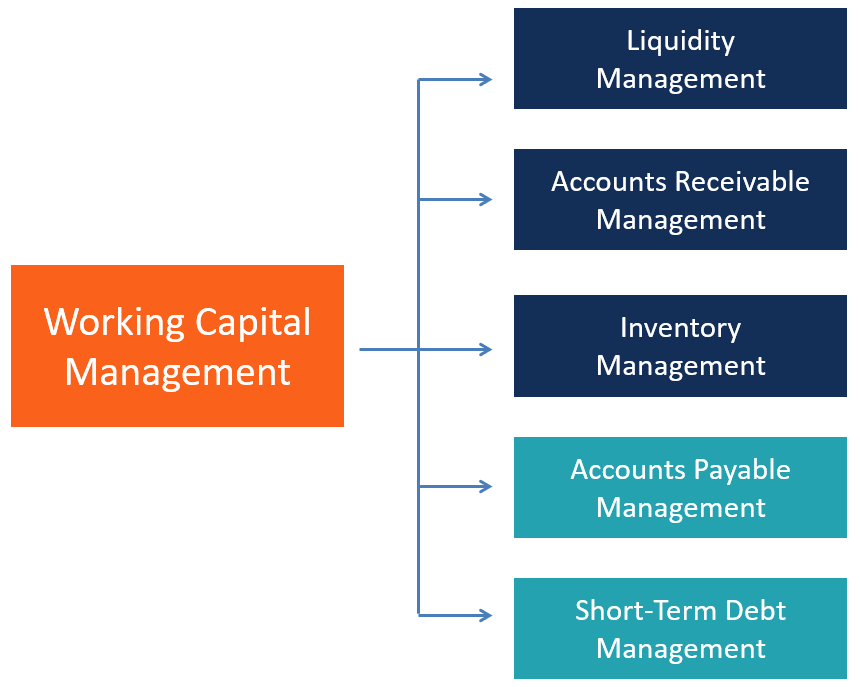
Working capital management refers to the set of activities performed by a company to make sure it got enough resources for day-to-day operating expensesOperating ExpensesOperating expenses, operating expenditures, or "opex," refers to the expenses incurred regarding a business’s operational activities. while keeping resources invested in a productive way.
Understanding Working Capital
Working capital is the difference between a company’s current assets and its current liabilities.
Current assets include cash, accounts receivable, and inventories.
Current liabilities include accounts payable, short-term borrowings, and accrued liabilitiesAccrued LiabilityAn accrued liability represents an expense a business has incurred during a specific period but has yet to be billed for. Accrued liabilities.
Some approaches may subtract cash from current assets and financial debt from current liabilities.
Why Working Capital Management is Important
Ensuring that the company possesses appropriate resources for its daily activities means protecting the company’s existence and ensuring it can keep operating as a going concern. Scarce availability of cash, uncontrolled commercial credit policies, or limited access to short-term financing can lead to the need for restructuring, asset sales, and even liquidation of the company.
Factors That Affect Working Capital Needs
Working capital needs are not the same for every company. The factors that can affect working capital needs can be endogenous or exogenous.
Endogenous factors include a company’s size, structure, and strategy.
Exogenous factors include the access and availability of banking services, level of interest rates, type of industry and products or services sold, macroeconomic conditions, and the size, number, and strategy of the company’s competitors.
Managing Liquidity
Properly managing liquidity ensures that the company possesses enough cash resources for its ordinary business needs and unexpected needs of a reasonable amount. It’s also important because it affects a company’s creditworthiness, which can contribute to determining a business’s success or failure.
The lower a company’s liquidity, the more likely it is going to face financial distress, other conditions being equal.
However, too much cash parked in low- or non-earning assets may reflect a poor allocation of resources.
Proper liquidity management is manifested at an appropriate level of cash and/or in the ability of an organization to quickly and efficiently generate cash resources to finance its business needs.
Managing Accounts Receivables
A company should grant its customers the proper flexibility or level of commercial credit while making sure that the right amounts of cash flow in via operations.
A company will determine the credit terms to offer based on the financial strength of the customer, the industry’s policies, and the competitors’ actual policies.
Credit terms can be ordinary, which means the customer generally is given a set number of days to pay the invoice (generally between 30 and 90). The company’s policies and manager’s discretion can determine whether different terms are necessary, such as cash before delivery, cash on delivery, bill-to-bill, or periodic billing.
Managing Inventory
Inventory management aims to make sure that the company keeps an adequate level of inventory to deal with ordinary operations and fluctuations in demand without investing too much capital in the asset.
An excessive level of inventory means that an excessive amount of capital is tied to it. It also increases the risk of unsold inventory and potential obsolescence eroding the value of inventory.
A shortage of inventory should also be avoided, as it would determine lost sales for the company.
Managing Short-Term Debt
Like liquidity management, managing short-term financing should also focus on making sure that the company possesses enough liquidity to finance short-term operations without taking on excessive risk.
The proper management of short-term financing involves the selection of the right financing instruments and the sizing of the funds accessed via each instrument. Popular sources of financing include regular credit lines, uncommitted lines, revolving credit agreements, collateralized loansCollateralized Loan Obligations (CLO)Collateralized loan obligations (CLO) are securities that are backed by a pool of loans. In other words, they are repackaged loans sold to investors., discounted receivables, and factoring.
A company should ensure there will be enough access to liquidity to deal with peak cash needs. For example, a company can set up a revolving credit agreement well above ordinary needs to deal with unexpected cash needs.
Managing Accounts Payable
Accounts payable arises from trade creditTrade CreditA trade credit is an agreement or understanding between agents engaged in business with each other that allows the exchange of goods and services granted by a company’s suppliers, mostly as part of the normal operations. The right balance between early payments and commercial debt should be achieved.
Early payments may unnecessarily reduce the liquidity available, which can be put to use in more productive ways.
Late payments may erode the company’s reputation and commercial relationships, while a high level of commercial debt could reduce its creditworthiness.
Summary
- Working capital management involves balancing movements related to five main items – cash, trade receivables, trade payables, short-term financing, and inventory – to make sure a business possesses adequate resources to operate efficiently.
- The levels of cash should be enough to deal with ordinary or small unexpected needs, but not so high to determine an inefficient allocation of capital.
- Commercial credit should be used properly to balance the need to maintain sales and healthy business relationships with the need to limit exposure to customers with low creditworthiness.
- Managing short-term debt and accounts payable should allow the company to achieve enough liquidity for ordinary operations and unexpected needs, without an excessive increase in financial risk.
- Inventory management should make sure there are enough products to sell and materials for its production processes while avoiding excessive accumulation and obsolescence.
More Resources
CFI is the official provider of the global Commercial Banking & Credit Analyst (CBCA)™Program Page - CBCAGet CFI's CBCA™ certification and become a Commercial Banking & Credit Analyst. Enroll and advance your career with our certification programs and courses. certification program, designed to help anyone become a world-class financial analyst. To keep advancing your career, the additional resources below will be useful:
- Accounts Payable vs Accounts ReceivableAccounts Payable vs Accounts ReceivableIn accounting, accounts payable and accounts receivable are sometimes confused with the other. The two types of accounts are very similar in
- Liquidity EventLiquidity EventA liquidity event is a process by which an investor liquidates their investment position in a private company and exchanges it for cash. The main purpose of a liquidity event is the transfer of an illiquid asset (an investment in a private company) into the most liquid asset – cash.
- Quality of Accounts ReceivablesQuality of Accounts ReceivableThe quality of accounts receivables is the likelihood that the cash flows that are owed to a company in the form of receivables are going to
- Working Capital vs Investing CapitalWorking Capital vs Investing CapitalIn the performance of their duties, financial analysts often need to distinguish between working capital vs investing capital. Working capital, also
-
Understanding Capital: Types, Categories & Value Creation
Capital is anything that increases one’s ability to generate value. It can be used to increase value across a wide range of categories, such as financial, social, physical, intellectualInterpers
-

Capital Rationing: Definition, Strategy & Impact on Investment Decisions
Capital rationing is a strategy used by companies or investors to limit the number of projects they take on at a time. If there is a pool of available investments that are all expected to be pro
finance
- Nominal Capital Explained: Definition & Importance for Businesses
- Contributed Capital: Definition & Understanding | [Your Company Name]
- Capital Employed: Definition, Calculation & Importance
- Capital Gains Yield (CGY): Definition & Formula | [Your Brand]
- Invested Capital: Definition & How It Fuels Business Growth
- Understanding Net Investment: A Key Metric for Business Growth
- ROIC: Understanding Return on Invested Capital - Definition & Calculation
- Working Capital vs. Investing Capital: A Clear Distinction
- Capital Rationing: Understanding Investment Constraints & Strategies
-
 Acquirer Definition: Understanding Corporate Acquisitions
An acquirer is a registered company that purchases a portion of, or all the rights to, another company. The acquiring company takes over the management of another company by obtaining a majority stake...
-
 Basel I: Understanding Core Banking Regulations & Capital Requirements
Basel I refers to a set of international banking regulations created by the Basel Committee on Bank Supervision (BCBS), which is based in Basel, Switzerland. The committee defines the minimum capital ...