
Holding Period Return (HPR): Definition & Calculation
The Holding Period Return (HPR) is the total return on an assetTypes of AssetsCommon types of assets include current, non-current, physical, intangible, operating, and non-operating. Correctly identifying and or investment portfolio over the period for which the asset or portfolio has been held. The holding period return can be realized if the asset or portfolio has been held, or expected if an investor only anticipates the purchase of the asset.
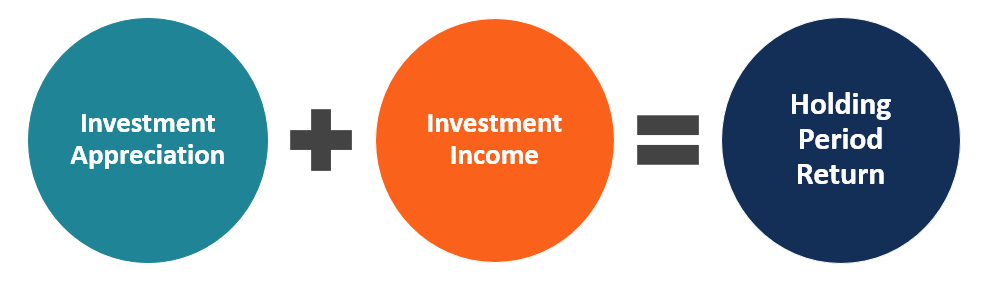
Generally, the HPR is expressed in percentages. Frequently, it is annualized to determine the rate of returnRate of ReturnThe Rate of Return (ROR) is the gain or loss of an investment over a period of time copmared to the initial cost of the investment expressed as a percentage. This guide teaches the most common formulas per year.
The Holding Period Return in Investment Management
The holding period return is a fundamental metric in investment management. The measure provides a comprehensive view of the financial performance of an asset or investment because it considers the appreciation of the investment, as well as the income distributions related to the asset (e.g., dividendsDividendA dividend is a share of profits and retained earnings that a company pays out to its shareholders. When a company generates a profit and accumulates retained earnings, those earnings can be either reinvested in the business or paid out to shareholders as a dividend. paid).
The HPR can be used to compare the performance of different investments or assets. In addition, this metric is used to identify the appropriate tax rate.
Formula for Calculating the Return
The general formula for calculating the HPR is:

Where:
- Income – the distributions or cash flows from the investment (e.g., dividends)
- Vn – the ending value of the investment
- V0 – the beginning value of the investment
If you need to calculate the annualized HPR, you can use the following formula:

Finally, the returns can be calculated quarterly. Using the formula below, you can translate the quarterly HPR into the annual HPR:

Where:
- r1, r2, r3, r4 – the quarterly holding period returns
Example of Holding Period Return
Three years ago, Fred invested $10,000 in the shares of ABC Corp. Each year, the company distributed dividends to its shareholders. Each year, Fred received $100 in dividends. Note that since Fred received $100 in dividends each year, his total income is $300. Today, Fred sold his shares for $12,000, and he wants to determine the HPR of his investment.
Using the HPR formula, we can find the following:

Thus, Fred’s investment in the shares of ABC Corp. earned 23% for the entire period of holding the investment.
More Resources
CFI offers the Financial Modeling & Valuation Analyst (FMVA)™Become a Certified Financial Modeling & Valuation Analyst (FMVA)®CFI's Financial Modeling and Valuation Analyst (FMVA)® certification will help you gain the confidence you need in your finance career. Enroll today! certification program for those looking to take their careers to the next level. To keep learning and advancing your career, the following resources will be helpful:
- Investment MethodsInvestment MethodsThis guide and overview of investment methods outlines they main ways investors try to make money and manage risk in capital markets. An investment is any asset or instrument purchased with the intention of selling it for a price higher than the purchase price at some future point in time (capital gains), or with the hope that the asset will directly bring in income (such as rental income or dividends).
- Money vs. Time-Weighted ReturnMoney vs. Time-Weighted ReturnMoney and time-weighted returns are rates of return typically used to assess the performance of a managed investment portfolio. Today, the time-weighted rate of return is the industry standard since it provides a fairer assessment of an investment manager's performance.
- Return on Equity (ROE)Return on Equity (ROE)Return on Equity (ROE) is a measure of a company’s profitability that takes a company’s annual return (net income) divided by the value of its total shareholders' equity (i.e. 12%). ROE combines the income statement and the balance sheet as the net income or profit is compared to the shareholders’ equity.
- Sharpe Ratio CalculatorSharpe Ratio CalculatorThe Sharpe Ratio Calculator allows you to measure an investment's risk-adjusted return. Download CFI's Excel template and Sharpe Ratio calculator. Sharpe Ratio = (Rx - Rf) / StdDev Rx. Where: Rx = Expected portfolio return, Rf = Risk free rate of return, StdDev Rx = Standard deviation of portfolio return / volatility
-

Korea Investment Corporation (KIC): A Comprehensive Overview
The Korea Investment Corporation (KIC) is a sovereign wealth fundTop 5 Sovereign Wealth FundsSovereign Wealth Funds (SWF) are pools of income – generally derived from staple commodities –
-

Dogs of the Dow: A Simple & Potentially Profitable Investment Strategy
The Dogs of the Dow investment strategy is one that was created by Michael Higgins and was first illustrated in his book called Beating the Dow. This investment strategy is one of the simplest s
invest
- Understanding Return on Investment (ROI): A Comprehensive Guide
- Understanding Portfolio Active Return: Definition & Calculation
- Annual Return: Definition, Calculation & Understanding
- Understanding Market Support: What is 'Holding the Market'?
- K-Ratio Explained: Measuring Investment Growth & Consistency
- Understanding the Modified Dietz Method (MDM) for Portfolio Returns
- Modified Dietz Return: Calculation & Investment Portfolio Analysis
- Understanding Return on Investment (ROI): A Comprehensive Guide
- Understanding Holding Period Return: A Comprehensive Guide
-
 Investment Returns: Key Factors Influencing Your Growth
A number of outside factors affect the stock market. When you invest, you do so in hopes that your money will grow over time. It is important, however, to understand the various factors that ...
-
 AIM Explained: Investing in High-Growth Companies on the London Stock Exchange
The Alternative Investment Market (AIM) was launched on June 19, 1995 as a sub-exchange market of the London Stock Exchange (LSE). The market was designed to help small, high-growth companies that are...