
Alternative Trading Systems (ATS): Definition & Key Features
An Alternative Trading System (ATS) is a trading venue that matches buyers and sellers for transactions. What is unique about it is that it is not regulated as an exchange like traditional stock exchangesStock ExchangeA stock exchange is a marketplace where securities, such as stocks and bonds, are bought and sold. Stock exchanges allow companies to raise capital and investors to make informed decisions using real-time price information. Exchanges can be a physical location or an electronic trading platform., but is registered as a broker-dealer, focusing on finding counterparties (buyers and sellers) for security transactions.
It should be noted that ATS is a North American term; in Europe, it is known as a Multilateral Trading Facility (MTF).
Summary
- Alternative Trading Systems (ATS) are a trading venue that matches buyers and sellers for transactions.
- ATS face less regulation compared to traditional stock exchanges and primarily focus on finding buyers and sellers of securitiesTrading SecuritiesTrading securities are securities purchased by a company for the purpose of realizing a short-term profit. The securities are issued within the company's industry,.
- Trading conducted on ATS is not publicly available, which is especially popular for traders, such as institutional investors who wish to trade large amounts of securities altogether.
What Do Alternative Trading Systems Do?
Alternative Trading Systems play an important role in public markets as an alternative to traditional stock exchanges to access market liquidity or how quickly an asset can be sold for goods or servicesProducts and ServicesA product is a tangible item that is put on the market for acquisition, attention, or consumption while a service is an intangible item, which arises from.
An ATS is particularly useful for those who are conducting large quantities of trading, such as investors and professional traders, since the skewing of the market price can be avoided as with regular stock exchanges. It is because trading conducted on ATS is not publicly available and does not appear on national exchange order books. There are also fewer rules involved, other than those governing conduct.
Alternative Trading Systems – Examples
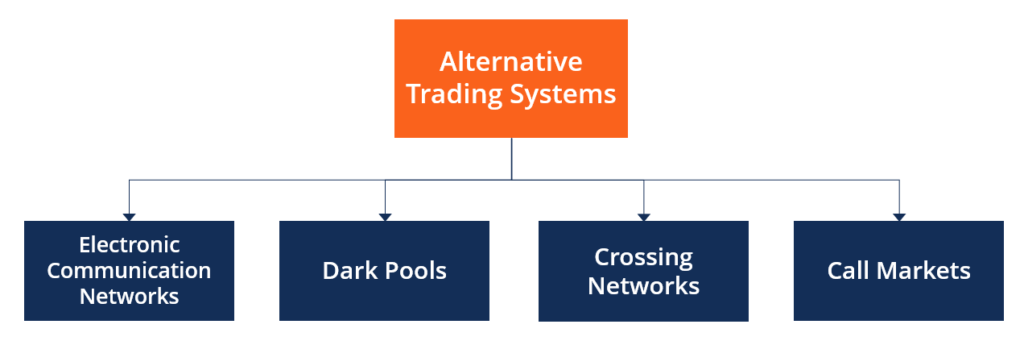
Some examples of ATS include electronic communication networks, dark pools, crossing networks, and call markets.
1. Electronic Communication Networks
Electronic Communication Networks (ECN) are a type of ATS that enables major brokeragesBrokerageA brokerage provides intermediary services in various areas, e.g., investing, obtaining a loan, or purchasing real estate. A broker is an intermediary who and individual traders to trade securities directly without going through a middleman. Thus, traders from different geographical areas of the world can conduct trades easily.
The system allows trades to happen outside the traditional trading hours associated with stock exchanges, which means that traders can make trades based on after-hours news. An ECN makes money by charging a fee for each transaction through access fees and commissions, which is a downside for traders since per-transaction charges quickly add up.
2. Dark Pools
Dark pools are another type of Alternative Trading Systems that are considered controversial since the trades are done out of the public eye, clouding the transactions.
Trading that is done through the private exchanges often involves a large volume of securities conducted through block trades by institutional investorsInstitutional InvestorAn institutional investor is a legal entity that accumulates the funds of numerous investors (which may be private investors or other legal entities) to (organizations that invest money on behalf of others), such as mutual funds, pension funds, and insurance companies. Sometimes, such investors are known as the “Whales on Wall Street.”
3. Crossing Networks
Similar to dark pools, crossing networks allow trades to happen outside of the public eye. Since the details of the trade are not relayed through public channels, the security price is not affected and does not appear on order books.
Often, the accounts in which the trades are conducted can be anonymous, which is highly advantageous for traders. It should be noted that dark pools and crossing networks are legal, although they’ve undergone scrutiny by the financial press and news outlets in recent years.
4. Call Markets
Call markets are a subset of ATS that group together orders until a specific number is reached before conducting the transaction. As such, trades are done at predetermined time intervals. A call market, therefore, determines the market-clearing price (the equilibrium value of a traded security) based on the number of securities offered and bid on by the sellers and buyers, respectively.
A key component of call markets are auctioneers, who are responsible for matching the supply and demand for a traded security before arriving at an equilibrium clearing price, which is the price at which market orders are traded.
In contrast to call markets are auction markets, which conduct trades as soon as a buyer and a seller are found who agree upon a specified price for the security.
Regulators and Alternative Trading Systems
All Alternative Trading Systems need to obtain the approval of the U.S. Securities and Exchange Commission (SEC), the federal agency responsible for facilitating the operations of the securities market to protect investors and ensure the fairness of transactions.
Since an ATS is governed by fewer regulations than stock exchanges, they are more susceptible to allegations of rules violations and subsequent enforcement action by regulators. Examples of infractions in Alternative Trading Systems include trading against customer order flow or making use of confidential customer trading information.
Lack of transparency is a common issue with ATS, especially when dealing with dark pools. Common allegations against dark pools include illegal front-running, which occurs when institutional traders place orders in front of a customer’s order to capitalize on the uptick in share prices.
More Resources
CFI is the official provider of the global Commercial Banking & Credit Analyst (CBCA)™Program Page - CBCAGet CFI's CBCA™ certification and become a Commercial Banking & Credit Analyst. Enroll and advance your career with our certification programs and courses. certification program, designed to help anyone become a world-class financial analyst. To keep advancing your career, the additional CFI resources below will be useful:
- Investing: A Beginner’s GuideInvesting: A Beginner's GuideCFI's Investing for Beginners guide will teach you the basics of investing and how to get started. Learn about different strategies and techniques for trading
- Order BookOrder BookAn order book is a list of orders that presents different offers from buyers and sellers for a specific security. It shows the prices and volumes
- Stock Investing: Guide to Value InvestingStock Investing: A Guide to Value InvestingSince the publication of "The Intelligent Investor" by Ben Graham, what is commonly known as "value investing" has become one of the most widely respected and widely followed methods of stock picking.
- Trading MechanismsTrading MechanismsTrading mechanisms refer to the different methods by which assets are traded. The two main types of trading mechanisms are quote driven and order driven trading mechanisms
-
Circuit Breakers: Understanding Trading Halts & Market Stability
A circuit breaker is a regulatory instrument that halts the trading of a securityStockWhat is a stock? An individual who owns stock in a company is called a shareholder and is eligible to claim part o
-

Understanding Commodities: A Beginner's Guide to Investing
Commodities are another class of assets just like stocks and bondsBondsBonds are fixed-income securities that are issued by corporations and governments to raise capital. The bond issuer borrows capit
invest
- CFD Trading Explained: A Comprehensive Guide for Investors
- Day Trading Explained: Strategies, Risks & How It Works
- Proprietary Trading: A Comprehensive Guide for Investors
- Quantitative Trading: A Deep Dive into Models & Analysis
- Spread Trading: A Comprehensive Guide to Relative Value Trading
- Trading Authorization: Empowering Your Broker & Account Security
- Trading Channels: Understanding Uptrends & Downtrends
- Trading Plan: A Comprehensive Guide to Successful Trading
- Alternative Trading Systems (ATS): Definition & Key Features
-
 After Hours Trading Explained: A Comprehensive Guide
After hours trading refers to the time outside regular trading hours when an investor can buy and sell securities. The main exchanges in the United States, NASDAQ and NYSENew York Stock Exchange (NYSE...
-
 Basis Trading: Definition, Strategy & How It Works
Basis trading is a financial arbitrage trading strategy that involves the trading of a financial instrument, such as a financial derivative or a commodityCommoditiesCommodities are another class of as...