
Equity Futures Contracts: Definition, Types & Uses
An equity futures contract is a financial arrangement between two counterparties to buy or sell equity at a specified date, amount, and price. They are regulated on derivative exchanges and used for speculative and hedging purposes. The most common equity futures contract types are index futuresStock Index FuturesStock index futures, also referred to as equity index futures or just index futures, are futures contracts based on a stock index. Futures contracts are an and stock futures.

Summary
- An equity futures contract is a financial arrangement between two counterparties to buy or sell equity at a specified date, amount, and price. The contracts settled daily using margins and mark-to-market.
- They are regulated on derivative exchanges and used for speculative and hedging purposes.
- Equity futures contracts are a zero-sum game; the profits of one party are the losses of the other.
How Equity Futures Contract Works
In a futures contract, there are two counterparties that have opposing expectations of the future value of an equity. The bullish party seeks to buy the equity, while the bearish party seeks to sell it. Therefore, the two parties enter into a futures contract to lock in the price and exchange the equity in the future.
An equity futures contract must contain the following components that are agreed upon between the counterparties:
1. Underlying equity
- Must specify what is to be transacted
- Examples include indexes such as the S&P 500S&P 500 IndexThe Standard and Poor’s 500 Index, abbreviated as S&P 500 index, is an index comprising the stocks of 500 publicly traded companies in the or individual stocks
2. Specified date
- Must specify the settlement/expiration date of the contract
- On the specified date, all cash flows are settled, and the final profit/loss is realized
3. Specified amount
- Must specify the amount of the underlying equity that is to be transacted, i.e., 100 shares
4. Specified delivery price
- Must specify the price at which the underlying equity is to be transacted
5. Margin
- An amount set aside by each party as security over the duration of the contract
Speculation and Hedging
Futures contracts are used for two purposes: speculation and hedging. Speculators predict the future value of the equity and use futures to lock in the price. For example, if an investor is bullish on a stock, they may enter a futures contract to buy the stock in the future. If the speculation was right, the investor would use the contract to buy the stock for less than its market value.
The second purpose of hedging is to mitigate the potential losses of investment. For example, an investor currently holds an index but worries that it may drop in value in the future. They can enter a futures contract to sell the index to hedge against a price drop. If the index ends up losing value, the investor would’ve already locked in a delivery price and can sell the stock for more than its market value.
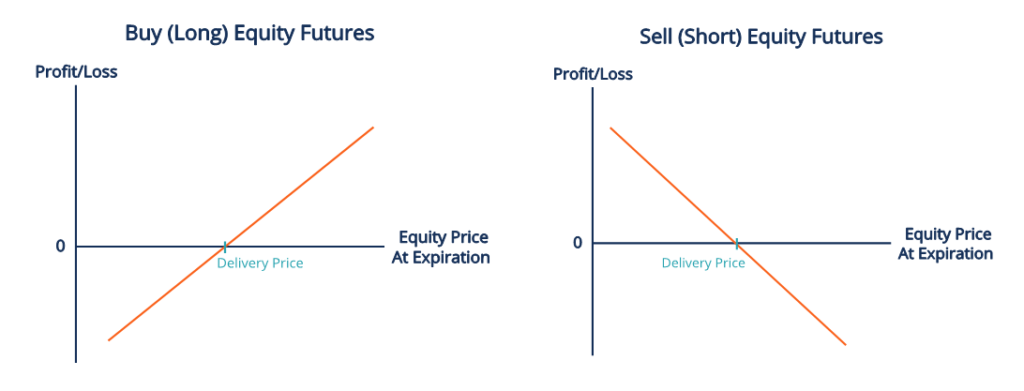
Futures are a zero-sum gameZero Sum Game (and Non Zero Sum)A zero sum game is a situation where losses incurred by a player in a transaction result in an equal increase in gains of the opposing player, so there is bound to be a winner and a loser. The above graph illustrates the idea.
For the party buying the equity, they make a profit if the equity’s market price at expiration is greater than the delivery price – meaning that they can buy the equity for cheaper than the market value. However, if the equity’s market price falls below the delivery price, they end up having to pay more than the market price for the equity.
This is the exact opposite for the seller. The profits realized from one party are the losses from the other party (minus any fees taken from intermediaries).
Margins and Mark-to-Market
The margin is the money that each party must put up over the duration of the contract for security. The notional value of the contract is exchanged at the settlement date instead of upfront. Margins decrease the risk of counterparties walking away from the contract.
Margins are settled daily, meaning that the margin amount fluctuates with the market value of the underlying equity – this is known as mark-to-market (MTM). The contract delivery price is adjusted daily to reflect the market value of the equity, while the margins also change to reflect the original contract agreements.
For example, if the delivery price is $100 and the market value rises to $110, the contract delivery price will be adjusted to $110. Then, because the buyer must pay $10 more at the settlement date, they will receive $10 added to their margin today, taken from the seller’s margin.
There are two margins in a futures contract:
1. Initial margin
- The initial margin is the amount of money that each party must put up to enter the contract.
- It is typically a percentage of the notional value of the contract.
2. Maintenance margin
- The maintenance margin is the minimum amount that must be maintained over the duration of the contract.
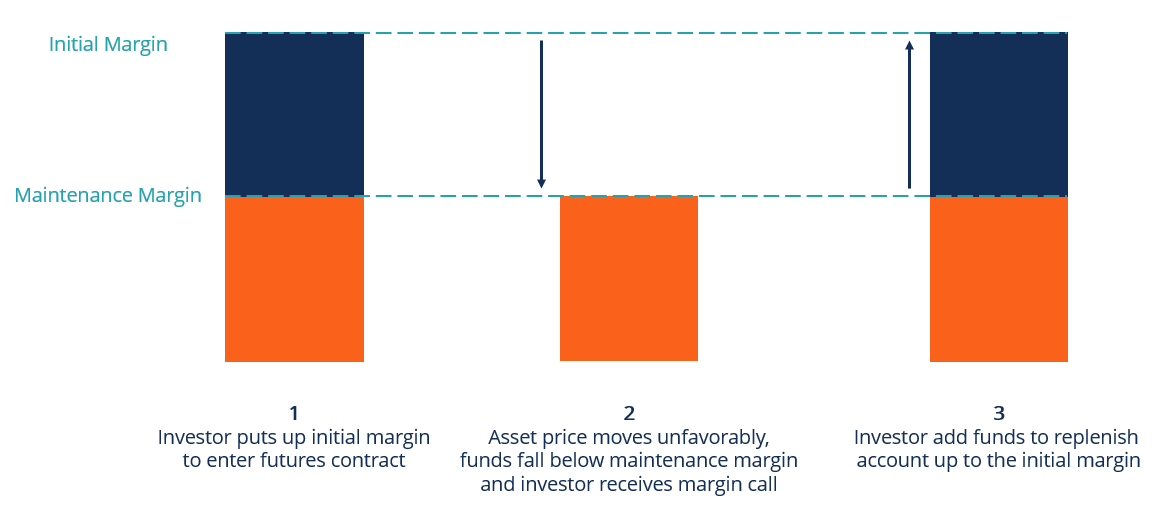
- If a party’s funds fall below the maintenance margin, they will receive a margin call – a requirement to add funds back to the initial margin.
Practical Example
Two parties enter an equity futures contract to exchange 1,000 shares six months from today. They also agree on a delivery price of $500,000, an initial margin of 10%, and a maintenance margin of 5% of the notional valueNotional ValueNotional value (also known as notional amount or notional principal amount) is the face value on which the calculations of payments on a financial.
At the start of the agreement, both parties put up (500,000 x 10%) = $50,000 as the initial margin. Now, suppose that the shares fall $30,000 in value. The new delivery price is adjusted to (500,000 – 30,000) = $470,000.
Because the buyer gets to buy the shares for a cheaper delivery price in the future, the difference is accounted for in the margin today. $30,000 is taken from the buyer’s margin: (50,000 – 30,000) = 20,000.
The buyer’s margin account now falls below the maintenance margin of 5% (500,000 x 5% = $25,000). Therefore, the buyer receives a margin call to replenish their account up to the initial margin. The $30,000 taken from the buyer’s margin is placed into the seller’s margin.
Additional Resources
CFI is the official provider of the Capital Markets & Securities Analyst (CMSA)®Program Page - CMSAEnroll in CFI's CMSA® program and become a certified Capital Markets &Securities Analyst. Advance your career with our certification programs and courses. certification program, designed to transform anyone into a world-class financial analyst.
To keep learning and developing your knowledge of financial analysis, we highly recommend the additional resources below:
- Hedging ArrangementHedging ArrangementHedging arrangement refers to an investment whose aim is to reduce the level of future risks in the event of an adverse price movement of an asset. Hedging provides a sort of insurance cover to protect against losses from an investment.
- Maintenance MarginMaintenance MarginMaintenance margin is the total amount of capital that must remain in an investment account in order to hold an investment or trading position and avoid a
- Mark to MarketMark to MarketThe term mark to market refers to a method under which the fair values of accounts that are subject to periodic fluctuations can be measured
- Underlying SecurityUnderlying SecurityUnderlying security is a term in investing that denotes the negotiable financial instrument upon which a financial derivative, such as an
-

Managed Futures: A Comprehensive Guide for Diversified Investing
Managed futures is a subclass of alternative investment strategies used by large funds and institutional investors to achieve both portfolio and market diversification. With the ability to take both l
-

Private Equity Crowdfunding: A Comprehensive Guide for Investors
Private equity crowdfunding refers to the practice of generating funding through the sale of securities such as shares, debts, and convertible notes. It is a new and increasingly popular way for entre
invest
- Understanding Futures Contracts: A Comprehensive Guide
- Commodity Futures Contracts: Understanding & Investing
- Backstop: Understanding Financial Safety Nets and Contingency Funding
- Equity Swap Contracts: Definition, Mechanics & Applications
- Futures Contracts: A Comprehensive Guide for Investors
- E-mini Futures: A Comprehensive Guide to Electronic Trading
- Equity Futures Contracts: Definition, Types & Uses
- Growth Equity: Investing in Expanding Businesses | [Your Company Name]
- Understanding Futures Contracts: A Guide for Investors
-
 Equity Funds: A Comprehensive Guide to Investing in Stocks
An equity fund refers to an investment fund that is primarily invested in equities or stocks. It is usually categorized by different investment styles, market capitalizationMarket CapitalizationMarket...
-
 Understanding the Equity Market: A Comprehensive Guide
An equity market is a hub in which shares of companies are issued and traded. The market comes in the form of an exchange – which facilitates the trade between buyers and sellers – or over...