
Calmar Ratio: Measuring Risk-Adjusted Investment Performance
The Calmar ratio is a formula that measures the performance of an investment fund – such as a hedge fundHedge FundA hedge fund, an alternative investment vehicle, is a partnership where investors (accredited investors or institutional investors) pool – compared to its risk. It is commonly used by investors as a risk-adjusted measure in the selection of investments.
The Calmar ratio indicates the relationship between risk and returnRisk and ReturnIn investing, risk and return are highly correlated. Increased potential returns on investment usually go hand-in-hand with increased risk. Different types of risks include project-specific risk, industry-specific risk, competitive risk, international risk, and market risk.. It is a function of the expected annual rate of return and the maximum drawdown over the previous three years. It is used to assess the success of various hedge funds and make investment decisions. A high ratio implies that it has higher returns on a risk-adjusted basis over the specified timeframe, usually set at 36 months.
Summary
- The Calmar ratio measures the performance of an investment fund – such as a hedge fund – compared to its risk.
- It aims to demonstrate the amount of risk required to obtain a return. It will help investors to balance their risk appetite with their investment decisions.
- The ratio is also useful for analyzing trading strategies or models using historical data, which is called backtesting.
Calculating the Calmar Ratio
The Calmar ratio is determined by taking the investment fund’s estimated annual rate of return, usually for a three-year term, and dividing it by its maximum drawdown.
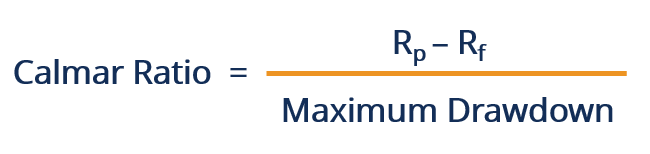
Where:
Rp = Portfolio return
Rf = Risk-free rate
Rp – Rf = Annual rate of return
The annual rate of return shows how the hedge fund has been doing over a year. It indicates the degree to which the fund’s portfolio has increased or decreased in value, calculated as a percentage.
The maximum drawdown is characterized as a fund’s maximum loss from peak to trough over a given investment period. It is determined by subtracting the fund’s lowest value from its highest value and then dividing the result by the fund’s peak value.
Importance of the Calmar Ratio
The Calmar ratio calculates the efficiency of an Investment on a risk-adjusted basis. A high ratio suggests that the return of the investment was not at risk of significant drawdowns. On the other hand, a low ratio indicates that the risk of drawdown is greater.
The Calmar ratio is a useful tool for comparing the return of two separate funds. For example, assume that Fund A has a higher rate of return than Fund B. However, Fund A has a higher Calmar ratio than Fund B. It implies that Fund B is a riskier option. Although an investor stands to earn more if he/she invests in fund B, he/she also stands to risk more.
The Calmar ratio aims to demonstrate the amount of risk required to obtain a return. Since investors have different risk tolerances, the ratio will help investors balance their risk appetite with their investment decisions.
The Calmar ratio smooths out over-achievements and under-achievements in a fund portfolio. Since the performance results are smoothed appropriately, it attracts long-term investment prospects. It can also act as a cautionary signal. If the Calmar ratio is a downtrend, investors must review their portfolio to decide if the downturn is due to increased uncertainty, diminished returns, or other causes.
A major change in the Calmar ratio will highlight the effect of actions made in favor of or against the investment fund. A sudden increase in the ratio is a good indicator of the fund, as it is less vulnerable to risk and price fluctuations and has begun to perform well.
On the contrary, a sudden decrease in the ratio implies that the fund’s performance is affected by either the maximum drawdown for the last three years or the annual rate of return.
The Calmar ratio is also a useful ratio for the backtesting of trading strategies. Also, investors can use the Calmar ratio in combination with the Sterling ratio and Sharpe ratioSharpe RatioThe Sharpe Ratio is a measure of risk-adjusted return, which compares an investment's excess return to its standard deviation of returns. The Sharpe Ratio is commonly used to gauge the performance of an investment by adjusting for its risk.. However, the Calmar ratio cannot be adjusted to various time horizons; hence, portfolios must have the same period of backtesting while using the ratio.
More Resources
CFI is the official provider of the global Capital Markets & Securities Analyst (CMSA)®Program Page - CMSAEnroll in CFI's CMSA® program and become a certified Capital Markets &Securities Analyst. Advance your career with our certification programs and courses. certification program, designed to help anyone become a world-class financial analyst. To keep advancing your career, the additional resources below will be useful:
- Coupon RateCoupon RateA coupon rate is the amount of annual interest income paid to a bondholder, based on the face value of the bond.
- Expected ReturnExpected ReturnThe expected return on an investment is the expected value of the probability distribution of possible returns it can provide to investors. The return on the investment is an unknown variable that has different values associated with different probabilities.
- Investment HorizonInvestment HorizonInvestment horizon is a term used to identify the length of time an investor is aiming to maintain their portfolio before selling their securities for a profit. An individual’s investment horizon is affected by several different factors. However, the primary determining factor is often the amount of risk that the investor
- Risk-Free RateRisk-Free RateThe risk-free rate of return is the interest rate an investor can expect to earn on an investment that carries zero risk. In practice, the risk-free rate is commonly considered to equal to the interest paid on a 3-month government Treasury bill, generally the safest investment an investor can make.
-

Understanding the CAPE Ratio: A Guide to Cyclically Adjusted P/E
The CAPE Ratio (also known as the Shiller P/E or PE 10 Ratio) is an acronym for the Cyclically-Adjusted Price-to-Earnings Ratio. The ratio is calculated by dividing a company’s stock price by th
-
Debt-to-Assets Ratio: Definition, Calculation & Risk Assessment
The Debt to Assets Ratio is a leverage ratioLeverage RatiosA leverage ratio indicates the level of debt incurred by a business entity against several other accounts in its balance sheet, income statem
invest
- Calmar Ratio: A Risk-Adjusted Performance Metric Explained
- Current Ratio: Definition, Calculation & Financial Health
- Expense Ratios: Understanding Investment Fund Fees
- Understanding Management Expense Ratio (MER): A Comprehensive Guide
- Operating Ratio: Definition, Calculation & Importance
- Quick Ratio: Understanding Your Business's Short-Term Liquidity
- Reserve Ratio Explained: Understanding Bank Reserves
- Vice Fund: Understanding Investments in Controversial Industries
- Understanding the Information Ratio: A Guide for Investors
-
 Acid-Test Ratio: Understanding Your Company's Short-Term Liquidity
The Acid-Test Ratio, also known as the quick ratioQuick RatioThe Quick Ratio, also known as the Acid-test, measures the ability of a business to pay its short-term liabilities with assets readily conv...
-
 Advertising to Sales Ratio: Measuring Ad Effectiveness & ROI
The advertising to sales ratio, also called the “A to S” for short, measures the effectiveness, or how successful, a company’s advertising strategiesAIDA ModelThe AIDA model, which s...