
Understanding Capital Markets: An Introduction to Investing & Economic Growth
Capital markets education is an undertaking that involves understanding how capital markets work, their products, and the role they play in the economy and investing.
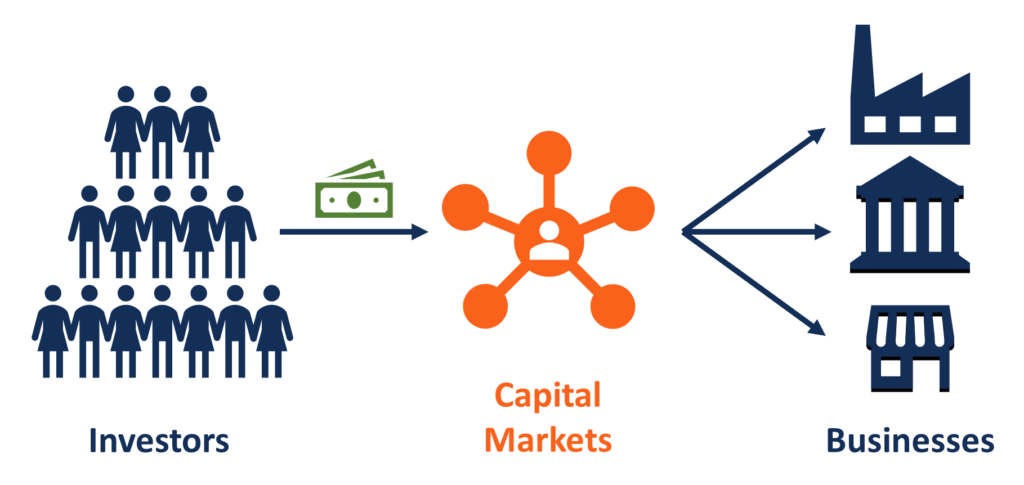
Capital markets are the exchange system that moves capital from people looking to invest for a return to the users of capital who require the capital to finance various projects or business operations. They are the most important way the economy grows and functions effectively.

Learning about capital markets is essential for everyone – from people who wish to begin a career within the capital markets to those who want to learn more about how the economy functions and how to make more informed personal investing decisions.
However, learning about capital markets is a complex undertaking, as there are many different functions and products within capital markets.
Many people enroll in higher education to understand the basics of how capital markets work because it is so large and complex. The theories and concepts extend from bachelor’s degrees all the way to doctorate degrees.
What are Capital Markets?
Entrepreneurs and businesses know how to generate money; however, to expand their business, they need money. On the other hand, investors have money available that they would like to earn a return on.
The capital markets facilitate the transfer of money between the two parties in an effective manner. It is the most vital function that allows a market-based economyMarket EconomyMarket economy is defined as a system where the production of goods and services are set according to the changing desires and abilities of to grow over time.
Capital markets add efficiency to an economy. Instead of investors having to search for places to invest their money, and instead of businesses seeking out individual investors, capital markets provide a central hub that facilitates these transactions.
Capital Market Products
Capital market products include:
- Debt securitiesDebt SecurityA debt security is any debt that can be bought or sold between parties in the market prior to maturity. Its structure represents a debt owed
- Equity securities
- Forex
- Commodities
- Derivatives
Each of the products above is traded in different markets and exchanges. Trading provides different risks and different returns for investors.
There are many differences among the securities. Some securities are sold on exchanges that are centralized, such as equity securities, forex, and some derivative securities.
Others are decentralized and are traded “over-the-counter” (OTC)Over-the-Counter (OTC)Over-the-counter (OTC) is the trading of securities between two counter-parties executed outside of formal exchanges and without the supervision of an exchange regulator. OTC trading is done in over-the-counter markets (a decentralized place with no physical location), through dealer networks. between market participants without an exchange or a broker, such as debt securities, commodities, and other derivatives.
Derivatives can get complicated, but they represent a huge market as well. They are versatile and can be structured and created to tailor features such as risk and return for other securities.
Why Learn About Capital Markets?
Capital markets are the most vital function in a market-based economy. As such, it is a dynamic and exciting career path for many. It deals with current evolving trends happening in the world, from technology to healthcare and other industries. It also provides a lucrative way to make a living through investing and trading securities.
To be successful in investing in capital markets, it takes skill, knowledge, and experience to navigate the complex markets. However, building an underlying foundation of skills and knowledge is the most important way to start a career in this field.
The skills and experience can be gained over time, but the basics need to be understood. To succeed, people in the early stages of their careers should possess at least a good understanding of the basics of:
- Mathematical theory
- Economic theory
- Finance theory
Furthermore, it is important to learn about the different products within capital markets. It’s important to understand what the products are, in addition to the risks and returns of investing in each. Some of the products and asset classes include:
- Equity productsEquityIn finance and accounting, equity is the value attributable to a business. Book value of equity is the difference between assets and liabilities
- Fixed-income products
- Foreign exchange
- Alternative productsAlternative InvestmentAn alternative investment is an investment in assets different from cash, stocks, and bonds. Alternative investments can be investments in tangible assets such as precious metals or wine. In addition, they can be investments in financial assets such as private equity, distressed securities, and hedge funds. (hybrids, trusts, convertibles)
- Commodities
- Derivative products
Learning about the different financial products and asset classes does not only apply to people who wish to work within capital markets as a career path. Any person who wants to make informed investment decisions with their own personal finances should learn about capital markets as well.
People can manage their personal finances more effectively, implement their own trading strategies, and make investments without worrying about entrusting a financial institution with their life savings.
Lastly, learning about capital markets gives a better understanding of the world in general. You can understand what is going on in the news and how it relates to and impacts the markets. Understanding capital markets can enhance your ability to interpret modern-day society.
Additional Resources
To keep advancing your career, the additional CFI resources below will be useful:
- Capital FlowsCapital FlowsCapital flows are transactions involving financial assets between international entities. Potential financial assets to be included could be
- Fixed-Income Products
- Capital Investment ModelCapital Investment ModelA capital investment model helps company calculate key valuation metrics of a capital investment including the cash flows, NPV, IRR, and payback period.
- Foreign Exchange
-

Contributed Capital: Definition & Understanding | [Your Company Name]
Contributed capital is one part of the owner's equity portion of a balance sheet. It is a measure of the amount of money initially invested in a company through the purchase of stock directly from
-

Capital Appropriation: Definition, Process & Examples
Appropriation is the process of allocating capital for specific purposes. Companies, governments, and individuals all appropriate capital for specific objectives. The budgeting process involves approp
invest
- Basel I: Understanding Core Banking Regulations & Capital Requirements
- Understanding Capital: Types, Categories & Value Creation
- Capital Rationing: Definition, Strategy & Impact on Investment Decisions
- Cost of Capital: Definition, Calculation & Importance
- Venture Capital: Funding Startups & Understanding Equity
- Understanding Capital Losses: Definition, Calculation & Examples
- Capital Markets Explained: Investing in Equity & Debt
- Understanding Mispricing: Market Prices vs. True Value
- Understanding Intellectual Capital: Definition & Value
-
 Nominal Capital Explained: Definition & Importance for Businesses
Learn financial terms. Nominal capital, also known as authorized capital, represents the securities that are designated for shareholders. Companies that release nominal capital to shareholder...
-
Understanding Emerging Markets: Opportunities and Risks
Emerging markets are areas that are very important to certain types of investors. These markets are in a transition period going from underdeveloped to more modernized. Here are a few things to ...