
Celebrity Bonds: Investing in Fame & Intellectual Property
A celebrity bond is a type of asset-backed securityFixed Income SecuritiesFixed income securities are a type of debt instrument that provides returns in the form of regular, or fixed, interest payments and repayments of the issued by a holder of fame-based intellectual property rights. Issuers of celebrity bonds receive money upfront from investors in exchange for proceeds from future royalties from the works of art, which are covered by intellectual property rights listed in the security.

Celebrity bonds can be backed by any type of work of art that generates royalties. One example of asset-backed securities is music-based bonds.
Generally, issuers of music-backed celebrity bonds tend to put together the intellectual property of one or more artists whose songs or albums have already stood the test of time. The owner of the artwork obtains money upfront but forfeits the royalties on its intellectual property until the expiration of the securities. However, the owner of the intellectual property retains the ownership of its work.
Bowie Bonds
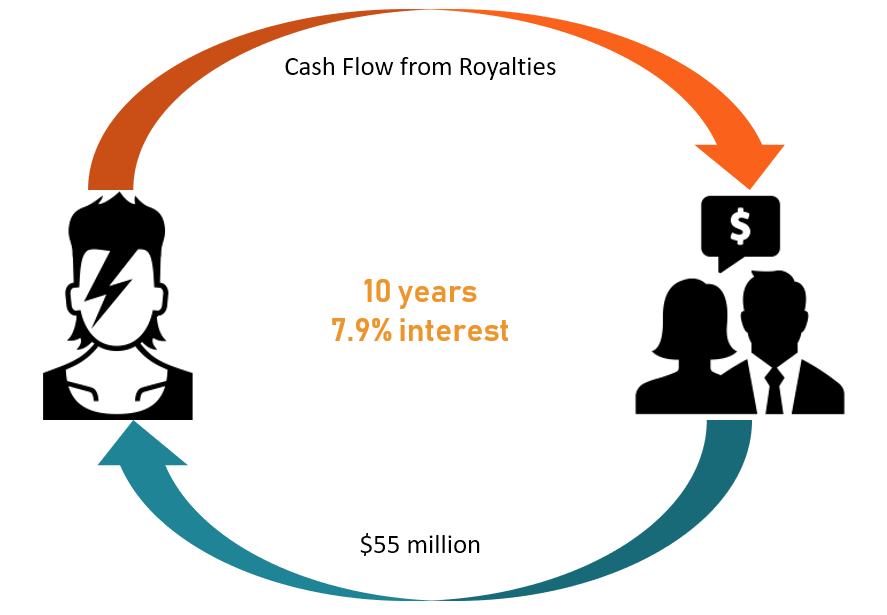
The most notable example of celebrity bonds is Bowie bonds. The Bowie bonds were issued in 1997 by investment banker David Pullman and were backed by royalties from 25 albums (287 songs) that English singer David Bowie recorded before 1990. Bowie forfeited the royalties from the albums for the life of the bondsBondsBonds are fixed-income securities that are issued by corporations and governments to raise capital. The bond issuer borrows capital from the bondholder and makes fixed payments to them at a fixed (or variable) interest rate for a specified period.. However, he kept ownership of the albums.
The bonds were issued for 10 years with an interest rate of 7.9%. Prudential Financial purchased the bonds for $55 million. Royalties from the albums generated the cash flows to shoulder the interest payments.
Ratings for Bowie Celebrity Bonds
Moody’s, Standard & Poor’s, and Fitch all rated the Bowie bonds. At the time of the issuance, the credit rating agencies gave the highest rating to the bonds. However, in 2004, Moody’s downgraded them to Baa3, just one level above the level of junk bondsJunk BondsJunk Bonds, also known as high-yield bonds, are bonds that are rated below investment grade by the big three rating agencies (see image below). Junk bonds carry a higher risk of default than other bonds, but they pay higher returns to make them attractive to investors.. The rating agency attributed the downgrade to lower-than-expected revenues due to a decline in album sales.
Despite the downgrade from Moody’s and lower album sales, the Bowie celebrity bonds did not default and were liquidated in 2007 according to the initial plan. Upon their expiration, the legal rights on the royalties were transferred back to David Bowie.
More Resources
Thank you for reading CFI’s explanation of celebrity bonds. CFI is the official provider of the global Financial Modeling & Valuation Analyst (FMVA)™Become a Certified Financial Modeling & Valuation Analyst (FMVA)®CFI's Financial Modeling and Valuation Analyst (FMVA)® certification will help you gain the confidence you need in your finance career. Enroll today!certification program, designed to help anyone become a world-class financial analyst. To keep advancing your career, check out the additional resources below:
- Bond IssuersBond IssuersThere are different types of bond issuers. These bond issuers create bonds to borrow funds from bondholders, to be repaid at maturity.
- Bond PricingBond PricingBond pricing is the science of calculating a bond's issue price based on the coupon, par value, yield and term to maturity. Bond pricing allows investors
- Fixed Income GlossaryFixed Income GlossaryThis fixed income glossary covers the most important bond terms and definitions required for financial analysts. These terms are covered in detail in CFI's Fixed Income Fundamentals Course.. Constant Perpetuity, Correlation, Coupon Rate, Covariance, Credit Spread
- Investing: A Beginner’s GuideInvesting: A Beginner's GuideCFI's Investing for Beginners guide will teach you the basics of investing and how to get started. Learn about different strategies and techniques for trading
-

Profit Sharing Bonds: Understanding Investment Income & Potential
A profit sharing bond is a fixed income security whereby the holder receives regular interest payments and a share in the profits or dividends of the bond-issuing company. Other Nam
-

Understanding Term to Maturity: A Key Bond Concept
Term to maturity is the remaining life of a bond or other type of debt instrument. The duration ranges between the time when the bond is issued until its maturity date when the issuer is required to r
invest
- Understanding Bonds: A Comprehensive Guide for Investors
- Callable Bonds: Understanding Issuer Redemption Rights
- Convertible Bonds: A Comprehensive Guide for Investors
- Green Bonds: Financing a Sustainable Future | [Your Company Name]
- High-Yield Bonds: Understanding Risk & Potential Returns
- Kangaroo Bonds: A Guide to Australian Dollar Debt
- L Bonds: Understanding Unrated Life Insurance Bonds
- Municipal Bonds: A Comprehensive Guide for Investors
- Understanding Bonds: A Comprehensive Guide for Investors
-
 General Obligation Bonds (GO Bonds): A Comprehensive Guide
A general obligation (GO) bond is a type of municipal bond in which the bond repayments (interest and principalPrincipal PaymentA principal payment is a payment toward the original amount of a loan th...
-
 Understanding High-Yield Bond Spreads: A Comprehensive Guide
A high-yield bond spread, also known as a credit spread, is the difference in yields between multiple high-yield bonds, expressed in basis points or percentage points. A high-yield bond is a term that...