
Understanding the CDS Payout Ratio: A Comprehensive Guide
The CDS Payout Ratio is the proportion of the insured amount that the holder of the credit default swapCredit Default SwapA credit default swap (CDS) is a type of credit derivative that provides the buyer with protection against default and other risks. The buyer of a CDS makes periodic payments to the seller until the credit maturity date. In the agreement, the seller commits that, if the debt issuer defaults, the seller will pay the buyer all premiums and interest is paid by the seller of the swap if the underlying asset defaults.

How It Works
Suppose an investor holds €10,000,000 worth of 5-year Spanish government bonds. The bonds pay a coupon interestCoupon RateA coupon rate is the amount of annual interest income paid to a bondholder, based on the face value of the bond. of 5% per annum. The investor is worried about his exposure (suppose there is a recession in Spain) and buys credit default swaps for his bonds from a bank. The CDS requires an upfront premium of 2% and yearly premiums of 1% of the insured amount (€10,000,000).
Therefore, the investor pays €200,000 upfront to the bank and pays €100,000 a year for the next 5 years (duration of the bonds). Suppose there is a major financial scandal in Spain, and the Spanish Government defaults on all bond holdings over €2,500,000. The investor receives €2,500,000 from the Spanish Government and €7,500,000 from the seller of the CDS (the bank). The CDS payout ratio is computed below:

What are Credit Default Swaps?
Credit default swaps are credit derivatives that are used to hedge against the risk of default. They can be viewed as an income-generating pseudo-insurance. A CDS is an exchange of a fixed (or variable) coupon against the payment of a loss caused by the default of a specific security.
Consider the following example: An investor holds a large amount of Greek government bonds. However, due to Greece’s economic situation, the investor is worried about his exposure and the risk of the Greek government defaulting. The investor, therefore, enters into a default swap agreement with a bank. The investor will pay the bank a fixed (or variable – based on the exact agreement) coupon payment as long as the Greek government is solvent.
In the event of the Greek government defaulting, the bank will pay the investor the loss amount. A credit default swap is basically a fixed income (or variable income) instrument that allows two agents, who have opposing views about some other traded security, to trade with each other without having to own that security.
Illustrative Example
A bank loaned out $80,000,000 at 10% for 15 years to a large construction company that would use the money to build high-end condominiums. As the bank is required by law to insure all loans greater than $10,000,000, it purchases a credit default swap at 2% of the insured principal amount. Therefore, the bank pays the CDS seller 4% of the insured principal amount (4% of $80,000,000) every year for the next 15 years.
In return, the CDS seller will cover the unpaid amount in case the construction company defaults. If the construction company defaults (there is a recession and no one can afford high-end condominiums) and can only return $30,000,000 of the initial principal, the bank can claim the rest from the CDS seller. The payout ratio of the CDS is $50,000,000/$80,000,000 = 62.5%. Credit default swaps are usually used to insure the principal amount, and in this case, the bank still faces the possibility of losing out on the interest payments.
Related Readings
CFI offers the Financial Modeling & Valuation Analyst (FMVA)™Become a Certified Financial Modeling & Valuation Analyst (FMVA)®CFI's Financial Modeling and Valuation Analyst (FMVA)® certification will help you gain the confidence you need in your finance career. Enroll today! certification program for those looking to take their careers to the next level. To keep learning and advancing your career, the following resources will be helpful:
- Credit RiskCredit RiskCredit risk is the risk of loss that may occur from the failure of any party to abide by the terms and conditions of any financial contract, principally,
- Currency Swap ContractCurrency Swap ContractA currency swap contract (also known as a cross-currency swap contract) is a derivative contract between two parties that involves the
- Long and Short PositionsLong and Short PositionsIn investing, long and short positions represent directional bets by investors that a security will either go up (when long) or down (when short). In the trading of assets, an investor can take two types of positions: long and short. An investor can either buy an asset (going long), or sell it (going short).
- Total Return SwapTotal Return SwapA Total Return Swap is a contract between two parties who exchange the return from a financial asset between them. In this agreement, one party makes payments based on a set rate while the other party makes payments based on the total return of an underlying asset.
-
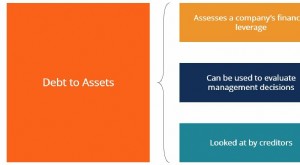
Debt-to-Assets Ratio: Definition, Calculation & Risk Assessment
The Debt to Assets Ratio is a leverage ratioLeverage RatiosA leverage ratio indicates the level of debt incurred by a business entity against several other accounts in its balance sheet, income statem
-
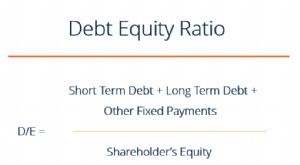
Debt-to-Equity Ratio: Definition, Calculation & Importance
The Debt to Equity ratio (also called the “debt-equity ratio”, “risk ratio”, or “gearing”), is a leverage ratioLeverage RatiosA leverage ratio indicates the le
invest
- Current Ratio: Definition, Calculation & Financial Health
- Operating Ratio: Definition, Calculation & Importance
- Quick Ratio: Understanding Your Business's Short-Term Liquidity
- Reserve Ratio Explained: Understanding Bank Reserves
- Calmar Ratio: Measuring Risk-Adjusted Investment Performance
- Portfolio Turnover Ratio: Definition, Calculation & Significance
- Put-Call Ratio (PCR): Understanding Market Sentiment & Options Trading
- Short Interest Ratio: Understanding Investor Sentiment & Market Risk
- Sortino Ratio: A Comprehensive Guide to Downside Risk
-
 Understanding the CAPE Ratio: A Guide to Cyclically Adjusted P/E
The CAPE Ratio (also known as the Shiller P/E or PE 10 Ratio) is an acronym for the Cyclically-Adjusted Price-to-Earnings Ratio. The ratio is calculated by dividing a company’s stock price by th...
-
 Credit Default Swaps (CDS): A Comprehensive Guide
A credit default swap (CDS) is a type of credit derivative that provides the buyer with protection against defaultKnowledgeCFI self-study guides are a great way to improve technical knowledge of finan...