
Currency Options: A Comprehensive Guide for Investors
A currency option refers to a derivative contract that gives the buyer the right but not the obligation to sell or buy currencies at a specified exchange rate within a specified time frame. They are useful for investors to hedge against unfavorable movements in exchange rates.
Summary
- A currency option refers to a derivative contract that gives the buyer the right but not the obligation to purchase or sell currencies at a given exchange rate and within a specified time frame.
- Currency options are used to hedge against unfavorable exchange rate movements.
- Essential currency option elements include a strike price, expiration date, contract size, and premium.
Currency Options Terminology and Elements
Spot Rate
The spot rate is the current exchange rateExchange RateAn exchange rate is the rate at which one currency can be exchanged for another between nations or economic zones. It is used to determine the.
Strike Price
The strike price is the exchange rate at which the contract can be exercised.
Call Option and Put Option
A call option provides the buyer with the right to buy a currency at the strike price.
A put option provides the buyer with the right to sell a currency at the strike price.
Buying a call on USD is the same as buying a put on the CAD because in both cases, the buyer is selling CAD for USD.
Expiration Date
An expiration date provides the time frame in which the option contract is valid.
Contract Size
The contract size is an essential element that determines how much currency is being settled.
American vs. European
American options can be exercised by the buyer at any point prior to and on the expiration dateExpiration Date (Derivatives)The expiration date refers to the date in which options or futures contracts expire. It is the last day of the validity of the derivatives contract..
European options are limited only to be exercised on the expiration date.
In-the-Money and Out-of-the-Money
In-the-money occurs when the option can be exercised, allowing the buyer to buy at the strike price that is better than the spot rate.
Out-of-the-money occurs when the option will not be exercised because it is more expensive than buying at the spot rate.
Premium
The premium is the amount paid by the buyer to the seller for the options contract. The premium amount is determined by supply and demand, as well as if the strike price is in-the-money or out-of-the-money.
Understanding Currency Options

The diagram above represents the profit/loss based on the spot rate at the option’s expiration or time of exercise.
In the example above, the buyer wants to sell CADCanadian Dollar (CAD)The Canadian Dollar refers to Canada’s domestic currency and is abbreviated as CAD. A Canadian dollar consists of 100 cents and is also and buy USD but expects the CAD to depreciate relative to the USD in the future. To hedge against the depreciation of the CAD (or vice versa, the appreciation of the USD), the buyer purchases a call on the USD.
The strike price is set at 1.2 USD/CAD, giving the buyer the right to sell CAD at 1.2 USD/CAD before expiration. If the CAD depreciates more than 1.2 USD/CAD to the right, the buyer will exercise the option because it is in-the-money. At the strike price, the buyer is indifferent between exercising or not, ignoring any potential exercising fees. However, if the CAD appreciates against the USD to the left of the strike, the option is worthless because it is out-the-money, and the buyer incurs a loss of the total premium paid for the option.
The total premium is calculated as the premium multiplied by the contract size. With a contract size of 50,000 USD and a premium of 0.1 CAD, the total premium paid is 0.1*50,000 = 5,000 CAD. This amount also represents the maximum loss on the contract.
The breakeven spot rate is calculated as the strike price + the premium. In this example, the breakeven = 1.2 + 0.1 = 1.3 USD/CAD. We can think of this breakeven rate as the spot rate needed to earn back the total premium paid.
At the breakeven, the buyer will exercise the call and sell CAD at 1.2 USD/CAD while the market is at 1.3 USD/CAD. The gain is the difference between the strike price and spot rate, multiplied by the contract size. The buyer gains (1.3-1.2)*50,000 = 5,000 CAD. The gain is the exact amount to offset the total premium incurred for the contract.
Any spot rate between the strike and breakeven still incurs an overall loss because the gains are not enough to offset the total premium. Consequently, for the buyer to make money from the contract, they must expect that the CAD will depreciate past the breakeven of 1.3 USD/CAD.
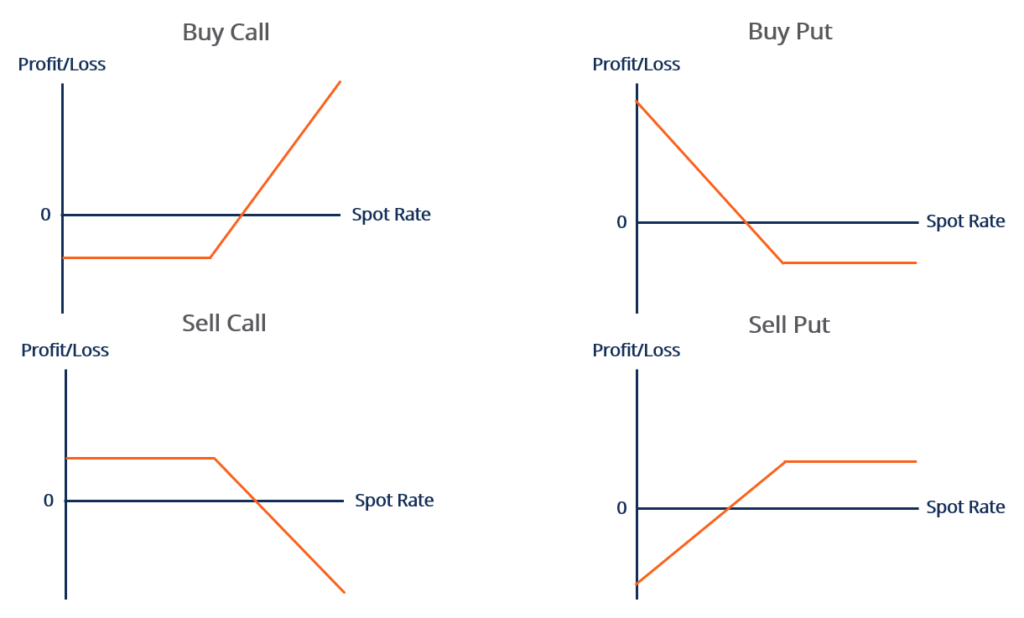
The same concept applies to other currency options, as shown above.
Option contracts are a zero-sum gameZero Sum Game (and Non Zero Sum)A zero sum game is a situation where losses incurred by a player in a transaction result in an equal increase in gains of the opposing player. When the buyer exercises their in-the-money option, their profits come from the losses of the seller. If the buyer does not exercise their out-the-money option, the seller makes profits from the premium paid by the buyer. While the buyer can choose whether or not to exercise the option, the seller is left with no choice and is obligated to honor the buyer’s choice.
Additional Resources
CFI is the official provider of the global Commercial Banking & Credit Analyst (CBCA)™Program Page - CBCAGet CFI's CBCA™ certification and become a Commercial Banking & Credit Analyst. Enroll and advance your career with our certification programs and courses. certification program, designed to help anyone become a world-class financial analyst. To keep advancing your career, the additional CFI resources below will be useful:
- At The Money (ATM)At The Money (ATM)At the money (ATM) describes a situation when the strike price of an option is equal to the underlying asset's current market price. It is a concept of
- American vs. European vs. Bermudan OptionsAmerican vs European vs Bermudan OptionsThere are different types of options that differ in terms of their exercise restrictions. Let’s explore American vs European vs Bermudan options to find out
- Canadian Dollar (CAD)Canadian Dollar (CAD)The Canadian Dollar refers to Canada’s domestic currency and is abbreviated as CAD. A Canadian dollar consists of 100 cents and is also
- Spot MarketSpot MarketA spot market is a financial market where financial instruments and commodities are traded for instantaneous delivery. Delivery refers to the
-

Understanding Interest Rates: A Comprehensive Guide
An interest rate refers to the amount charged by a lender to a borrower for any form of debtCurrent DebtOn a balance sheet, current debt is debts due to be paid within one year (12 months) or less. It
-
Key Currencies: Definition, Importance & Global Impact
Key currency is a currency that does not fluctuate too broadly, helps in setting exchange rates, and supports global transactions. The term “key currency” can also be used to define promin
invest
- Barrier Options: Understanding and Trading Strategies
- Cross Rates Explained: Understanding Currency Valuation
- Currency Option Bonds: Understanding Flexible Investments
- Understanding Currency Risk: A Comprehensive Guide
- Understanding Dividend Yield: A Comprehensive Guide
- Ex-Ante: Understanding Predictions in Finance
- Understanding Gamma in Finance: A Comprehensive Guide
- Interest Rate Call Options: Understanding & Benefits
- USD/CAD Currency Pair: Understanding the US Dollar to Canadian Dollar Exchange
-
 Understanding Hard Currencies: Stability and Global Trade
A hard currency refers to a currency that is generally issued by developed countries, globally traded, and seen as politically and economically stable. International investors put their confidence and...
-
 Hurdle Rate: Definition, Calculation & Importance for Investors
A hurdle rate, which is also known as minimum acceptable rate of return (MARR), is the minimum required rate of return or target rate that investors are expecting to receive on an investment. The rate...