
Understanding Market Support: What is 'Holding the Market'?
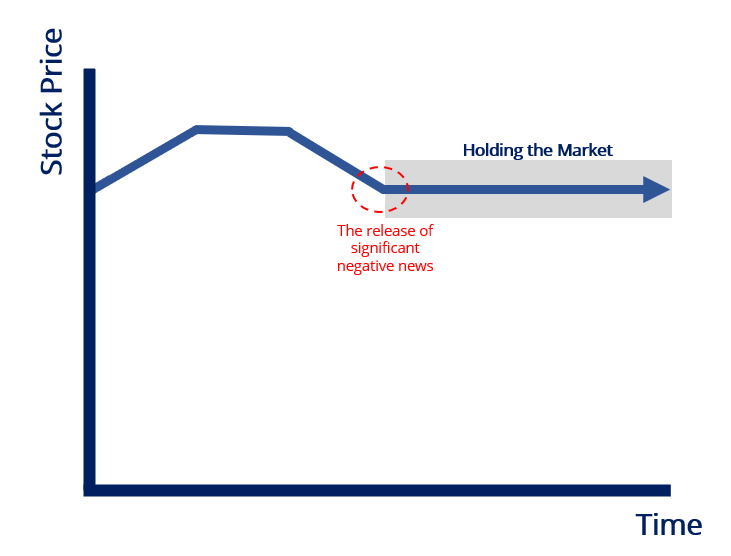
Holding the market refers to a market participant (or participants) that places or maintains buy orders for a security whose price is expected to fall rapidly – or is in the process of – typically due to bad news. The purpose of holding the market is to help maintain an artificial stock price and stabilize a downtrend.
Summary
- Holding the market refers to placing or maintaining buy orders for a security whose price is expected to fall rapidly – or is in the process of – typically due to bad news.
- Holding the market is used to maintain an artificial stock price.
- The practice is extremely high risk and results in losses for the purchaser if the share price does not rebound.
The Legality of Holding the Market
When material negative news regarding a public company is released, market participants react by selling that company’s stock, resulting in a depressed share price. Holding the market is considered illegal (unless mandated by the relevant securities regulatorsSecurities and Exchange Commission (SEC)The US Securities and Exchange Commission, or SEC, is an independent agency of the US federal government that is responsible for implementing federal securities laws and proposing securities rules. It is also in charge of maintaining the securities industry and stock and options exchanges) in numerous jurisdictions and can be viewed as market manipulation.
For example, if a company releases an earnings reportEarnings ReportAn earnings report is an official financial document issued by a public company that shows expenses, earnings, and overall profit of the company for a that completely falls below expectations, but its share price remains steady, or even increases, with above-average trading volume, it may be due to a group of investors attempting to mislead other market participants by placing buy orders to keep the stock price up artificially.
With that said, not every instance of placing buy orders for a security and helping maintain its price in the wake of negative news is considered illegal. The key consideration is whether the buy orders were done to maintain an artificial stock price. There may be buy orders placed by investors for legitimate reasons, such as rebalancing their portfolio, hedging, etc.
Holding the Market as a High-Risk Practice
The practice of holding the market is extremely high risk and results in losses for the purchaser if the share price does not rebound. For example, if a market participant holds the market for a company that just announced its intentions to file for bankruptcyBankruptcyBankruptcy is the legal status of a human or a non-human entity (a firm or a government agency) that is unable to repay its outstanding debts, even if the market participant can hold the share price of that company on the day of the negative news, the share price is likely to slide in subsequent days as more investors execute sell orders. The market participant would need to have extremely deep pockets to be able to “hold” the share price.
Example of Holding the Market
Background: John is the CEO of Company A, whose share price closed at $40 today. Company A is based in the United States and is to release its quarterly earnings report tomorrow, which includes a management discussion and analysisManagement Discussion and Analysis (MD&A)Management discussion and analysis, or MD&A, is a section that can be found in the annual report of a company. The MD&A section provides key information section outlining the company’s recent loss of a major customer that comprised 40% of its total revenue over the last quarter.
John anticipates that the share price of Company A will plummet once the report is disseminated. To prevent the anticipated share price slide and create an artificial stock price for Company A, John and other senior management members all agree to place significant buy orders at $40 before releasing the earnings report.
Question: Would you consider what John and his senior management team plan to do to be legal?
Answer: The basis of John and his management team in placing buy orders at $40 on Company A is to maintain an artificial stock price in the wake of a substantial share price decrease. It is considered market manipulation and, under the U.S. Securities Exchange Act of 1934, is illegal.
More Resources
CFI offers the Capital Markets & Securities Analyst (CMSA)®Program Page - CMSAEnroll in CFI's CMSA® program and become a certified Capital Markets &Securities Analyst. Advance your career with our certification programs and courses. certification program for those looking to take their careers to the next level. To keep learning and advancing your career, the following resources will be helpful:
- Earnings GuidanceEarnings GuidanceAn earnings guidance is the information provided by the management of a publicly traded company regarding its expected future results, including estimates
- Insider InformationInsider InformationInsider information, also called inside information, refers to non-public facts regarding a publicly traded company that can provide a financial advantage in the markets. In other words, insider information is knowledge and information on the operations, products/services pipeline
- Market ManipulationMarket ManipulationMarket manipulation, also known as price manipulation or stock manipulation, refers to artificial inflation or deflation of the price of a security.
- Trade Order TimingTrade Order Timing - TradingTrade order timing refers to the shelf-life of a specific trade order. The most common types of trade order timing are market orders, GTC orders,
-

Understanding Quoted Prices: A Comprehensive Guide
The quoted price is the most recent – or last – price at which a financial assetFinancial AssetsFinancial assets refer to assets that arise from contractual agreements on future cash flows
-

Understanding the S&P 500: A Comprehensive Guide
The Standard and Poor’s 500 Index, abbreviated as S&P 500 index, is an index comprising the stocks of 500 publicly traded companies in the U.S. with the highest values of market capitalizati
invest
- Black-Scholes Model: Understanding Stock Option Pricing
- Understanding the Call Market: Trading Hours & Price Determination
- Understanding Dealer Markets: How Market Makers Function
- Depth of Market (DOM): Understanding Real-Time Order Book Data
- Double Top Pattern: Definition, Trading Signals & Analysis
- Understanding the Money Market: Short-Term Debt & Lending
- NASDAQ Explained: A Comprehensive Guide to the Stock Market Exchange
- Price Takers: Understanding Market Influence & Investor Types
- Understanding Cryptocurrency Price Drivers: A Comprehensive Guide
-
 Understanding Offering Price: A Guide for Investors
The offering price is the per share price of publicly issued securities set by an underwriter and at which the shares are available for purchase. Although the term is mostly used in the context of the...
-
 Understanding the Primary Market: A Comprehensive Guide
The primary market is the financial market where new securitiesPublic SecuritiesPublic securities, or marketable securities, are investments that are openly or easily traded in a market. The securitie...