
ISDA: Understanding the International Derivatives Trade Association
The International Swaps and Derivatives Association (ISDA) is a trade collective made up of more than 800 participants from almost 60 countries around the world. In 1992, the association developed a standardized contract called the ISDA Master Agreement for derivatives transactions. The group works to establish and oversee policies and legal statutes surrounding the trading of derivativesDerivativesDerivatives are financial contracts whose value is linked to the value of an underlying asset. They are complex financial instruments that are.
The ISDA’s participants include individuals and entities that work with over-the-counter (OTC)Over-the-Counter (OTC)Over-the-counter (OTC) is the trading of securities between two counter-parties executed outside of formal exchanges and without the supervision of an exchange regulator. OTC trading is done in over-the-counter markets (a decentralized place with no physical location), through dealer networks. derivatives, namely dealers, service providers, and those who use derivatives at the end of the line. The group is also responsible for overseeing the standards and language used to talk about and sell derivatives – the financial products markup language (FpML).
Derivatives
The ISDA is concerned with derivatives, so in order to gain a better understanding of exactly what the ISDA focuses on, it’s critical to understand derivatives.
Derivatives are contracts that get their value from an underlying index, interest rateInterest RateAn interest rate refers to the amount charged by a lender to a borrower for any form of debt given, generally expressed as a percentage of the principal., or asset. Derivatives are used for:
- Opening up exposure to price fluctuations, so speculation is easier
- Insurance or hedging against price movements
- Providing lines of access to assets and markets that are more difficult to trade
There are a variety of derivatives available for use. They include:
- Swaps
- FuturesFutures ContractA futures contract is an agreement to buy or sell an underlying asset at a later date for a predetermined price. It’s also known as a derivative because future contracts derive their value from an underlying asset. Investors may purchase the right to buy or sell the underlying asset at a later date for a predetermined price.
- Forwards
- OptionsOptions: Calls and PutsAn option is a derivative contract that gives the holder the right, but not the obligation, to buy or sell an asset by a certain date at a specified price.
- Variations on any of the above (i.e., collateralized debt obligationsCollateralized Debt Obligation (CDO)A Collateralized Debt Obligation (CDO) is a synthetic investment product that represents different loans bundled together and sold by the lender in the market. The holder of the collateralized debt obligation can, in theory, collect the borrowed amount from the original borrower at the end of the loan period.)
FpML
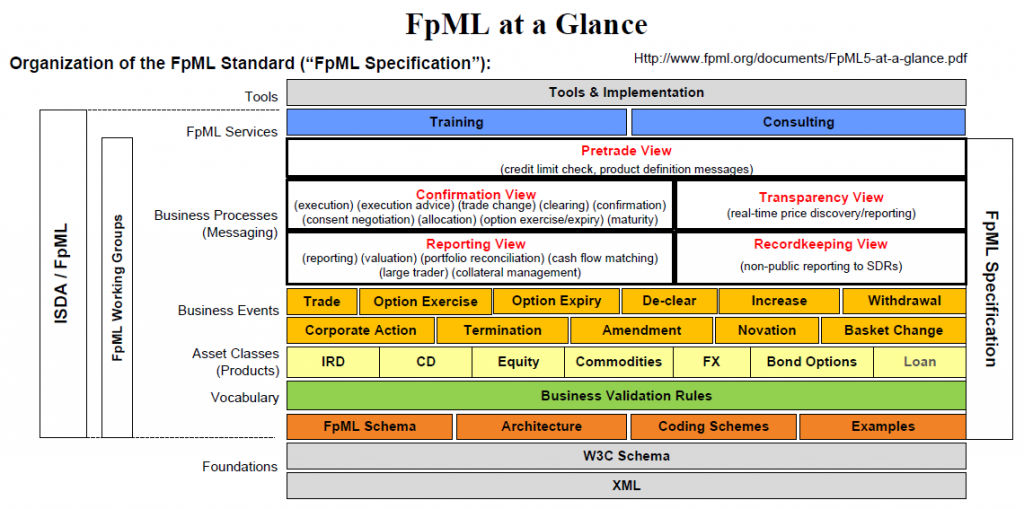
As mentioned above, the ISDA trademarked a language used to trade and sell derivatives, namely an electronic language known as the FpML. The application is an open-source XML standard used to process OTC derivatives and is the standard for the language used throughout the derivatives industry when sharing information.
The FpML is trademarked by the ISDA; but because it is open source, it is free to all and can be contributed to by any professional or entity within the ISDA or the derivatives industry. Any changes or additions to the FpML must go through the FpML Standards Committee, which is also established by the ISDA.
The image below – taken from the ISDA’s website – provides a breakdown of the FpML:
History and Accomplishments of the ISDA
Established in 1985, the ISDA is headquartered in New York. The organization was created to standardize the derivatives industry, putting in place the infrastructure necessary to effectively trade and sell derivatives, as well as to offer functional risk management processes that can be put into practice by any company or individual trading, selling, buying, or using derivatives.
Along with the creation of the FpML discussed above, the ISDA’s other notable addition to the derivatives industry occurred in 1992 when the organization developed the very first master agreement – as well as additional documentation – that standardized a contract that could be used for every derivative transaction. The said contract was put in place to help mitigate risks associated with derivative transactions, including any potential legal risks.
The ISDA is an important entity, working to create a standard for those operating within the derivatives market. The organization – and all of its participants – work collectively to institute and uphold a set of standards that define and maintain a safe space for derivative traders and users to operate in.
Related Readings
CFI is the official provider of the Capital Markets & Securities Analyst (CMSA)®Program Page - CMSAEnroll in CFI's CMSA® program and become a certified Capital Markets &Securities Analyst. Advance your career with our certification programs and courses. certification program, designed to transform anyone into a world-class financial analyst.
To keep learning and developing your knowledge of financial analysis, we highly recommend the additional resources below:
- Guide to Commodity TradingGuide to Commodity Trading SecretsSuccessful commodity traders know the commodity trading secrets and distinguish between trading different types of financial markets. Trading commodities is different from trading stocks.
- New York Mercantile Exchange (NYMEX)New York Mercantile Exchange (NYMEX)The New York Mercantile Exchange (NYMEX) is a commodity futures exchange located in Manhattan, New York City. It is owned by CME Group, one of the largest
- Spot PriceSpot PriceThe spot price is the current market price of a security, currency, or commodity available to be bought/sold for immediate settlement. In other words, it is the price at which the sellers and buyers value an asset right now.
- Trading MechanismsTrading MechanismsTrading mechanisms refer to the different methods by which assets are traded. The two main types of trading mechanisms are quote driven and order driven trading mechanisms
-
DTCC: Understanding the Depository Trust & Clearing Corporation
The Depository Trust and Clearing Corporation (DTCC) is a US-based corporation that acts as a centralized clearing and settlement company for different asset classes. It provides its market participan
-

Hong Kong Exchanges and Clearing (HKEX): A Comprehensive Overview
The Hong Kong Exchanges and Clearing Limited (HKEx) was established in 2000, and it operates as a futures market and stock market in Hong Kong. After the merger of the Hong Kong Securities Clearing Co
invest
- Understanding Derivatives: A Comprehensive Overview
- Eurex Exchange: European Derivatives Market Overview
- Fear & Greed Index: Understanding Investor Sentiment | CNN Business
- LIFFE: Understanding the London International Financial Futures Exchange
- NAIC/BetterInvesting: Demystifying Investment Clubs & Resources
- Understanding the NASD: History and Role in Securities Regulation
- NCDEX: India's Leading Agricultural Commodity Exchange | Overview
- National Futures Association (NFA): Understanding Derivatives Regulation
- NASAA: Protecting Investors in the U.S. - Mission & Overview
-
 Dow 30 Explained: Understanding the Dow Jones Industrial Average
The Dow 30, or Dow Jones Industrial Average, is a stock index that tracks the performance of the 30 biggest companies listed on the stock indices in the United States. Despite being used by analysts t...
-
![Rule of 72: Calculate Investment Doubling Time | [Your Brand Name]](https://www.etffin.com/article/uploadfiles/202110/2021100815281678_S.png) Rule of 72: Calculate Investment Doubling Time | [Your Brand Name]
Rule of 72: Calculate Investment Doubling Time | [Your Brand Name]In finance, the Rule of 72 is a formula that estimates the amount of time it takes for an investment to double in value, earning a fixed annual rate of returnRate of ReturnThe Rate of Return (ROR) is ...