
Understanding Secular Markets: Long-Term Trends & Investment Strategies
A secular market is predominantly driven and impacted by elements or forces that are likely to be present in the foreseeable future. The forces can impact the price or value of a financial assetFinancial AssetsFinancial assets refer to assets that arise from contractual agreements on future cash flows or from owning equity instruments of another entity. A key or investment and can cause the price to increase or decrease over a long-term period. A simplified definition is that a secular market is “a market that is for all intents and purposes captive to broader economic forces or traumas.”

Secular markets or economies are normally influenced by global and national trends that may arise in parallel or conjunction with one another. Markets, including equities and bonds, tend to fluctuate according to long-term trends. A secular market can last for several years.
Secular markets can be classified as secular bull markets (lower interest rates, high corporate incomes, and increases in share prices) or secular bear markets (stagnant economy, declining corporate incomes, and increased pressure to sell shares – increased supply of shares in the market).
A bearishBullish and BearishProfessionals in corporate finance regularly refer to markets as being bullish and bearish based on positive or negative price movements. A bear market is typically considered to exist when there has been a price decline of 20% or more from the peak, and a bull market is considered to be a 20% recovery from a market bottom. market depicts the existence of skepticism, uncertainty, and anticipation that economic development and markets are likely to weaken in the future. In such a market scenario, share or stock prices are anticipated to see a consistent twenty percent (20%) drop.
In contrast, a bullish market depicts the existence of optimism among investors and anticipation that economic development and markets are likely to strengthen in the future. In such a scenario, share or stock prices are anticipated to see a consistent twenty percent (20%) increase.
Summary
- A secular market is predominantly driven and impacted by elements or forces that are likely to be present in the foreseeable future.
- The forces can impact the price or value of a financial asset or investment and can cause the price to increase or decrease over a long-term period.
- Secular markets or economies are normally influenced by global and national trends that may arise in parallel or conjunction with one another. Markets, including equities and bonds, tend to fluctuate according to long-term trends.
How a Secular Market Operates
To illustrate how a secular market works, a comprehensive example is given below.
Consider the attack that occurred in the United States on September 11, 2001. An event of that magnitude would result in a secular market. The 9/11 attacks resulted in significant sales of equities and other instruments (increased supply in the market = bearish secular market) because investors followed the sentiment that consumers would travel less during such uncertain and “unsafe” times.
The “sell-off” resulted in certain stock prices declining, especially for companies in the travel and tourism industries, and transportation sectors. As a result of the downward spiral caused by continuous market instability, several adjacent segments of the economy were caught in the panic selling until the whole economy had dropped nearly 10%.
Secular Bull Markets and How to Invest in Them
In secular bull markets, the prices of equities are likely to increase more than decline, and commonly, any short-term decreases in the prices are compensated for by the general growth in the prices over time. A well-known secular bull market occurred during one of the U.S.’ most renowned economic expansions between 1983 and 2000.
Another notable expansion occurred in June 2009, likely resulting from the nation’s quantitative easing monetary policies. The economic growth was measured with the GDP (Gross Domestic Product)GDP FormulaGross Domestic Product (GDP) is the monetary value, in local currency, of all final economic goods and services produced in a country during a.
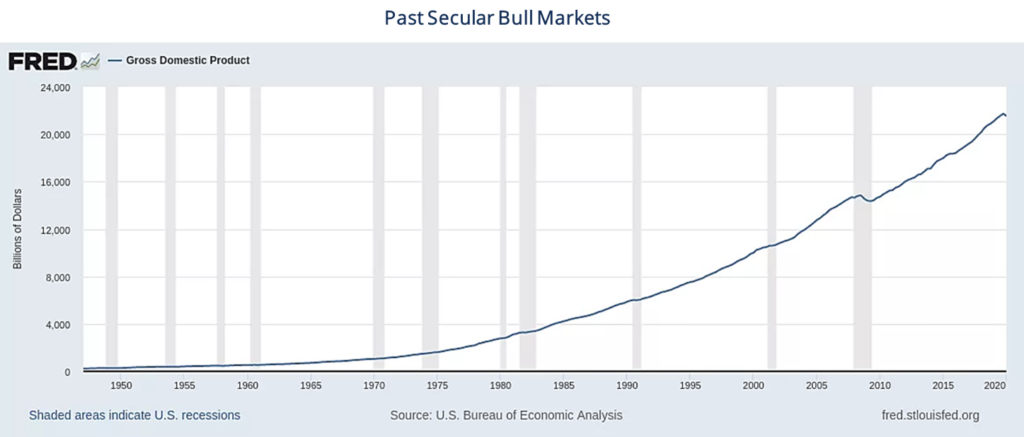
Secular bull markets tend to outlast secular bear markets, making them simpler to invest in. Investing in a bull market typically comprises purchasing equities and other financial instruments such as derivatives, commoditiesCommoditiesCommodities are another class of assets just like stocks and bonds. Most commodities are products that come from the earth that possess, and mutual funds. Investors are likely to purchase high-risk instruments in this market, hoping for higher returns.
Secular Bear Markets and How to Invest in Them
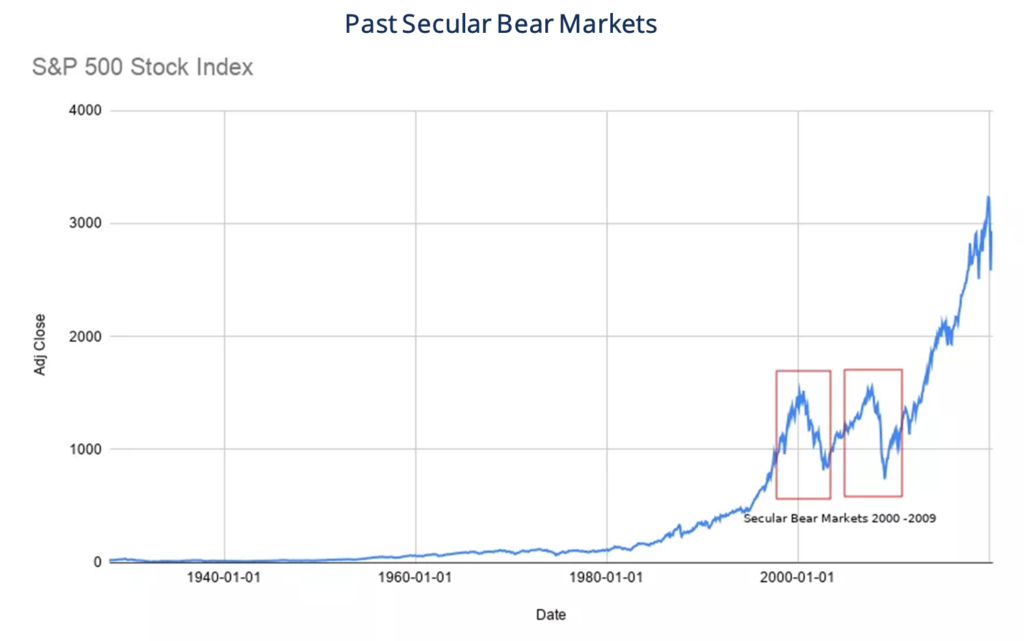
In secular bear markets, a decline in wealth is likely to occur, resulting from the decrease in purchasing power of equities and other financial assets. Secular bear markets typically present challenges to investors, as they result in the decline of equity prices. Despite their negative nature, secular bear markets can offer lucrative investment opportunities because businesses’ share prices and value tend to be lower than they would be in a bull market.
Hence, investors can identify financial assets that they can purchase at the lowered prices and valuations and hold the investment until the market reverses to follow a bullish trend. Investors tend to be risk-averse in bearish markets and tend to sell off some of their stocks’ positions to invest in government bonds or Treasuries.
Related Readings
CFI is the official provider of the global Capital Markets & Securities Analyst (CMSA)®Program Page - CMSAEnroll in CFI's CMSA® program and become a certified Capital Markets &Securities Analyst. Advance your career with our certification programs and courses. certification program, designed to help anyone become a world-class financial analyst. To keep advancing your career, the additional resources below will be useful:
- Quantitative EasingQuantitative EasingQuantitative easing (QE) is a monetary policy of printing money, that is implemented by the Central Bank to energize the economy. The Central Bank creates
- Risk AverseRisk Averse DefinitionSomeone who is risk averse has the characteristic or trait of preferring avoiding loss over making a gain. This characteristic is usually attached to investors or market participants who prefer investments with lower returns and relatively known risks over investments with potentially higher returns but also with higher uncertainty and more risk.
- SelloffSelloffA selloff is the selling of a large volume of securities within a short time, causing a corresponding decline in its price. It occurs when a
- Trading PsychologyTrading PsychologyTrading psychology refers to the mental state and emotions of a trader that determines the success or failure of a trade. It represents the
-
Trading Volume: Understanding & Significance
The term “volume” in trading refers to the total number of shares that are traded during a given period of time. The volume of trade is measured on all types of financial commodities, incl
-
Understanding Bear Markets: What Investors Need to Know
The securities market can’t climb forever. Eventually prices will begin to fall. We call this period of decline a “bear market.” It’s not the end of the world for investors, but it’s a concept you sho
invest
- Understanding Auction Markets: How Prices Are Determined
- Doji Candlestick Pattern: Meaning & Trading Signals
- Understanding Frothy Markets: Risks & Opportunities
- Understanding Inefficient Markets: Causes & Implications
- Understanding Market Cycles: Trends & Economic Environments
- Understanding Market Depth: A Guide for Traders
- Understanding Market Exposure: Risk & Portfolio Allocation
- Understanding Market Indexes: A Comprehensive Guide
- Understanding Market Makers: How They Fuel Liquidity
-
 Sensex Explained: Understanding India's Key Stock Market Index
Sensex, also known as the S&P BSE Sensex Index, is the benchmark index that tracks India’s Bombay Stock Exchange (BSE). The Sensex is composed of the 30 largest and most-traded stocks within...
-
 Understanding Algorithmic Trading Spoofing: Definition & Impact
Spoofing is a disruptive algorithmic trading practice that involves placing bids to buy or offers to sell futures contractsFutures ContractA futures contract is an agreement to buy or sell an underlyi...