
Understanding Algorithmic Trading Spoofing: Definition & Impact
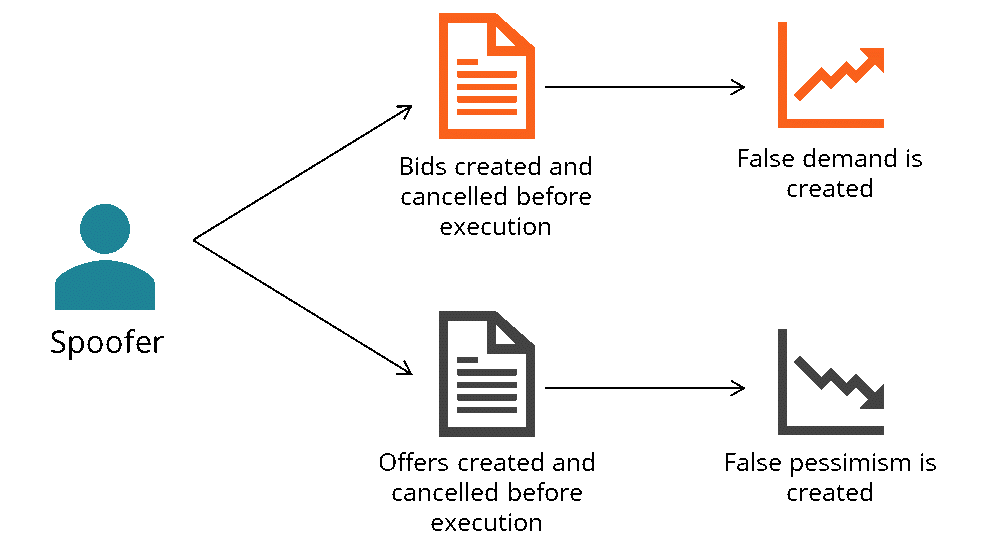
Spoofing is a disruptive algorithmic trading practice that involves placing bids to buy or offers to sell futures contractsFutures ContractA futures contract is an agreement to buy or sell an underlying asset at a later date for a predetermined price. It’s also known as a derivative because future contracts derive their value from an underlying asset. Investors may purchase the right to buy or sell the underlying asset at a later date for a predetermined price. and canceling the bids or offers prior to the deal’s execution. The practice intends to create a false picture of demand or false pessimism in the market.
By creating a false sentiment in the market, a trader can manipulate the actions of other market participants and change the price of a security. Subsequently, by reacting to the fluctuations, a spoofer can earn a profit. Therefore, spoofing is considered a form of market manipulation.

Spoofing became prominent with the rise of high-frequency trading (HFT)High-Frequency Trading (HFT)High-frequency trading (HFT) is algorithmic trading characterized by high speed trade execution, an extremely large number of transactions,. High-frequency trading allows the execution of large trade orders in a very short time. Given the advantages of HFT, spoofing gains an immense scope that provides opportunities for moving the prices of the securities to a larger extent and earning higher profits.
Spoofing and Legislation
Since spoofing is considered a form of market manipulation, the practice is considered illegal. In the United States, it is considered an illegal activity and a criminal offense under the 2010 Dodd-Frank ActDodd-Frank ActThe Dodd-Frank Act, or the Wall Street Reform and Consumer Protection Act of 2010, was enacted into law during the Obama administration as a response to the financial crisis of 2008. It sought to introduce significant changes to financial regulation and create new government agencies tasked with implementing the various clauses in the law.. The U.S. Commodity Futures Trading Commission (CFTC) is an independent agency that monitors such activities in futures markets.
Despite the accompanying criminal liability, some large financial institutions continue to engage in the illegal practice. For example, in January 2018, three European banks – UBS, Deutsche Bank, and HSBC – were accused of market manipulation using spoofing schemes and were fined by the Commodity Futures Trading Commission (CFTC).
Spoofing in the 2010 Flash Crash
The 2010 Flash Crash2010 Flash CrashThe 2010 Flash Crash is the market crash that occurred on May 6, 2010. During the 2010 crash, leading US stock indices, including the Dow erased almost $1 trillion in market value in U.S. stock markets. The market crash was characterized by a rapid decline in the stock markets and their quick partial rebound within an hour.
Following a series of investigations, market manipulation using spoofing schemes was determined as one of the primary triggers of the Flash Crash. In 2015, the U.S. Department of Justice filed charges against a London-based trader, Navinder Singh Sarao. He was accused of market manipulation after placing a large order for E-Mini S&P 500 stock index futures contracts with the intent to cancel the order prior to execution.
Additional Resources
Thank you for reading CFI’s explanation of spoofing. CFI is the official provider of the Financial Modeling and Valuation Analyst (FMVA)™Become a Certified Financial Modeling & Valuation Analyst (FMVA)®CFI's Financial Modeling and Valuation Analyst (FMVA)® certification will help you gain the confidence you need in your finance career. Enroll today! certification program, designed to transform anyone into a world-class financial analyst. To keep learning and developing your knowledge of financial analysis, we highly recommend the additional resources below:
- Algorithms (Algos)Algorithms (Algos)Algorithms (Algos) are a set of instructions that are introduced to perform a task. They automate trading to generate profits at a frequency impossible to a human trader.
- Hedging ArrangementHedging ArrangementHedging arrangement refers to an investment whose aim is to reduce the level of future risks in the event of an adverse price movement of an asset. Hedging provides a sort of insurance cover to protect against losses from an investment.
- Momentum InvestingMomentum InvestingMomentum investing is an investment strategy aimed at purchasing securities that have been showing an upward price trend or short-selling securities that
- Trading MechanismsTrading MechanismsTrading mechanisms refer to the different methods by which assets are traded. The two main types of trading mechanisms are quote driven and order driven trading mechanisms
-
Trading Volume: Understanding & Significance
The term “volume” in trading refers to the total number of shares that are traded during a given period of time. The volume of trade is measured on all types of financial commodities, incl
-
Understanding Bear Markets: What Investors Need to Know
The securities market can’t climb forever. Eventually prices will begin to fall. We call this period of decline a “bear market.” It’s not the end of the world for investors, but it’s a concept you sho
invest
- Understanding Auction Markets: How Prices Are Determined
- Doji Candlestick Pattern: Meaning & Trading Signals
- Understanding Frothy Markets: Risks & Opportunities
- Understanding Inefficient Markets: Causes & Implications
- Understanding Market Cycles: Trends & Economic Environments
- Understanding Market Depth: A Guide for Traders
- Understanding Market Exposure: Risk & Portfolio Allocation
- Understanding Market Indexes: A Comprehensive Guide
- Understanding Market Makers: How They Fuel Liquidity
-
 Understanding Secular Markets: Long-Term Trends & Investment Strategies
A secular market is predominantly driven and impacted by elements or forces that are likely to be present in the foreseeable future. The forces can impact the price or value of a financial assetFinanc...
-
 Sensex Explained: Understanding India's Key Stock Market Index
Sensex, also known as the S&P BSE Sensex Index, is the benchmark index that tracks India’s Bombay Stock Exchange (BSE). The Sensex is composed of the 30 largest and most-traded stocks within...