
MSCI Emerging Markets Index: Definition & Key Facts
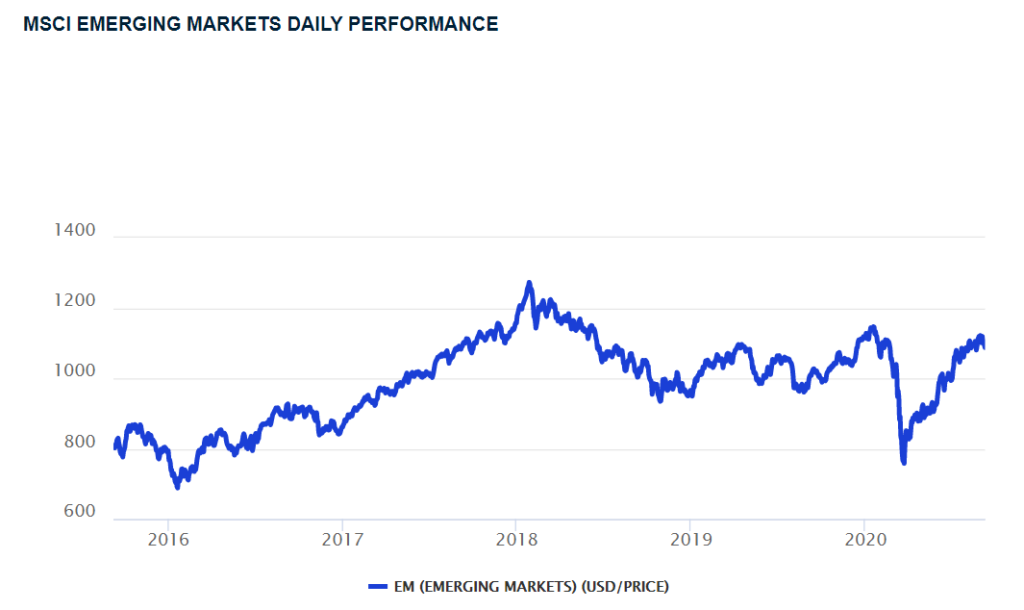
The MSCI Emerging Markets Index is used to measure the stock market performance within emerging countries. Established in the 1960s, It is one of many indexes created by Morgan Stanley Capital International (MSCI)MSCI Inc. (Morgan Stanley Capital International)MSCI Inc. is an American investment research firm with an extensive global presence, serving clients worldwide. In particular, MSCI Inc.. The index captures mid to large-cap companies across over 12 emerging countries. It also represents over 13% of global capitalization.
Summary
- The MSCI Emerging Market Index is used to measure the performance of equity markets within emerging countries. It captures mid-cap to large-cap companies in 26 countries across Europe and Asia.
- Investors can purchase the index through the MSCI Emerging Market ETF.
- As of July 2020, there are approximately 1,385 constituents that make up the index, with China, Taiwan, and Korea leading as the top 3 geographies that yield companies that contribute to a substantial portion of the index.
Understanding the MSCI Emerging Markets Index
The MSCI Emerging Markets Index includes companies that span across 26 developing countries. The countries include Argentina, Brazil, Colombia, Egypt, Chile, China, Czech Republic, Greece, India, Hungary, Korea, and Taiwan. In the past, the index originally consisted of 10 countries. Due to its success, the MSCI is often perceived as a performance benchmark for mutual funds.
Investing in the MSCI Emerging Markets Index
The MSCI Emerging Markets Index can be purchased through an investor’s ETF. Generally speaking, emerging markets are known to be a risky investment due to the political and monetary risks that they incur. Investors who intend to invest in the emerging markets will likely face volatile returns.
In theory, with higher risk and volatilityVolatilityVolatility is a measure of the rate of fluctuations in the price of a security over time. It indicates the level of risk associated with the price changes of a security. Investors and traders calculate the volatility of a security to assess past variations in the prices, this ETF yields higher returns and potential losses as well – it is dependent on the current economic landscape at that time. In a sense, many investors invest in the emerging markets for diversification purposes, as their current portfolio may be heavily composed of companies or indexes within developed markets such as North American equities.
Identifying an ETF
An exchange-traded fund (ETF)Exchange Traded Fund (ETF)An Exchange Traded Fund (ETF) is a popular investment vehicle where portfolios can be more flexible and diversified across a broad range of all the available asset classes. Learn about various types of ETFs by reading this guide. is a financial security that simulates and tracks an underlying index. In other words, an ETF bundles a collection of securities similar to that of any other index and is traded on an exchange, like a stock.
Exchange-traded funds are similar to mutual funds; however, one of the primary exceptions is that they are listed on exchanges and yield significantly lower expense fees. ETFs are capable of bundling multiple types of investments beyond equities – such as commodities, like gold and silver – or a collection of bonds.
Examples of renown ETFs include:
- The SPDR S&P 500 (SPY)SPDR S&P 500 ETF (SPY)The Standard and Poor Depositary Receipts (SPDR) S&P 500 ETF is an exchange-traded fund that tracks the S&P 500 stock market index., which tracks the S&P 500 index
- iShares Russell 2000 (IWM), which tracks the Russell 2000 small-cap index
- SPDR Dow Jones Industrial Average (DIA), which represents the 30 stocks that are held in the Dow Jones Industrial Average
- Invesco QQQ (QQQ), which tracks the Nasdaq 100 – this index focuses on technology stocks
MSCI Emerging Markets Portfolio Composition
As of August 20, 2020, the top 10 MSCI Emerging Market’s holding companies and their respective weighted average include the following:
- Alibaba Group (7.55%)
- Tencent Holdings (5.76%)
- Taiwan Semiconductor Manufacturing – TSM (5.52%)
- Samsung Electronics (3.6%)
- Meituan Dianping (1.63%)
- Reliance Industries (1.25%)
- Naspers Limited (1.18%)
- China Construction Bank Corp (1.13%)
- Pingan Insurance Group (1%)
- com ADR Representing Inc (0.95%)
In terms of geography breakdown, the fund is allocated as mentioned:
- China (40.84%)
- Taiwan (12.53%)
- Korea (11.71%)
- India (8.16%)
- Brazil (4.87%)
- South Africa (3.49%)
- Russian Federation (3.09%)
- Saudi Arabia (2.53%)
- Thailand (1.93%)
- Malaysia (1.69%)
- Mexico (1.67%)
- Indonesia (1.4%)
The five-largest sector distributions are:
- Consumer discretionary (18.33%)
- Financials (18.02%)
- Information Technology (17.66%)
- Communication (12.56%)
- Materials (7.05%)
When the MSCI Emerging Markets Index is Reviewed
The MSCI Emerging Markets Index is re-evaluated and reviewed four times per year – during February, May, August, and November. The reviews are meant to reflect the ongoing changes that occur within the emerging equity markets. Rebalancing is conducted during May and November. During the rebalancing process, both mid and large-cap companies are recalculated.
More Resources
CFI is the official provider of the Commercial Banking & Credit Analyst (CBCA)™Program Page - CBCAGet CFI's CBCA™ certification and become a Commercial Banking & Credit Analyst. Enroll and advance your career with our certification programs and courses. certification program, designed to transform anyone into a world-class financial analyst.
In order to help you become a world-class financial analyst and advance your career to your fullest potential, these additional resources will be very helpful:
- Emerging Market Bond Index (EMBI)Emerging Market Bond Index (EMBI)The Emerging Market Bond Index (EMBI) is a benchmark index that measures the bond performance of emerging countries and their respective
- Debt/Bond FundDebt/Bond FundA debt fund or a bond fund is a pool of investments, usually a mutual fund or an exchange-traded fund, that invests in fixed-income
- MSCI All Country World Index (ACWI)MSCI All Country World Index (ACWI)The MSCI All Country World Index (ACWI) is a global equity index that measures the equity performance in both the developed and emerging markets. By the end
- Capitalization-Weighted IndexCapitalization-Weighted IndexThe Capitalization-Weighted Index (cap-weighted index, CWI) is a type of stock market index in which each component of the index is weighted relative to its total market capitalization. In a capitalization-weighted index, companies with larger market capitalization exert a greater impact on the index value.
-
DMI: Understanding the Directional Movement Index for Trading
The Directional Movement Index (DMI) is an indicator that helps in determining the direction the asset price is moving and the strength of the price movement. It does so by comparing the current price
-
Fear & Greed Index: Understanding Investor Sentiment | CNN Business
The Fear and Greed Index, developed by CNNMoney, is used to gauge whether investors are too bullish or bearish on the stock market. The index ranges from 0 (extreme fear) to 100 (extreme greed).
invest
- EAFE Index: Understanding Developed Market Performance
- Understanding the EMBI: A Guide to Emerging Market Bond Performance
- MSCI ACWI Index: Understanding Global Equity Performance
- Nikkei Index: Understanding Japan's Top Stock Market Indicator
- Price-Weighted Index Explained: How It Works & Examples
- Understanding the S&P 500: Top Holdings & Long-Term Performance
- Understanding Emerging Markets: Opportunities and Risks
- Understanding the MSCI Emerging Markets Index: A Comprehensive Guide
- MSCI Emerging Markets Index: Tracking Growth in Developing Economies
-
 Capitalization-Weighted Index (CWI): Explained
The Capitalization-Weighted Index (cap-weighted index, CWI) is a type of stock market index in which each component of the index is weighted relative to its total market capitalizationMarket Capitaliz...
-
Russell 2000 Index: Definition, Performance & Significance
The Russell 2000 Index tracks the performance of roughly 2,000 of the smallest publicly traded companies in the U.S. The Russell 2000 is actually a subset of the Russell 3000 Index, which is much bro...