
MSCI ACWI Index: Understanding Global Equity Performance
The MSCI All Country World Index (ACWI) is a global equity index that measures the equity performance in both the developed and emerging marketsEmerging MarketsEmerging markets is a term that refers to an economy that experiences considerable economic growth and possesses some, but not all,. By the end of 2019, it covers more than 3,000 stocks globally. It is a market capitalization-weighted index developed by MSCI Inc., a publicly-traded U.S. financial company.
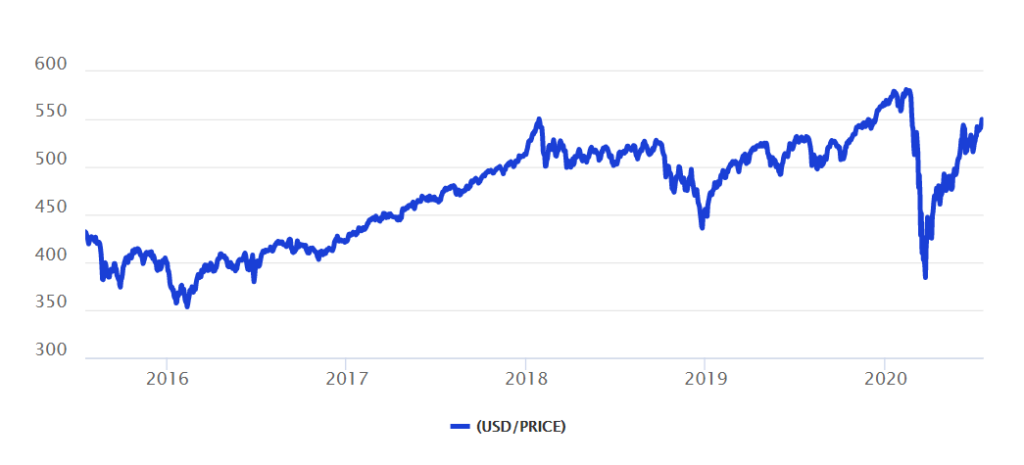
In addition to the ACWI, MSCI also publishes many other indices that cover different geographical regions and sectors. The EAFE (Europe, Australasia, and the Far East) Index and the GCC (Gulf Cooperation Council) countries index are some of MSCI’s indices.
Summary
- The MSCI All Country World Index (ACWI) measures the equity performance of more than 3,000 stocks from both developed and emerging markets.
- The MSCI ACWI can be used as a benchmark to evaluate the performance of a global equity portfolio.
- Some ETFs track the performance of the MSCI ACWI, which allows investors to invest globally with low costs.
Understanding the MSCI All Country World Index (ACWI)
The MSCI All Country World Index covers the large-cap and mid-cap stocks from 23 developed markets and 26 emerging markets across 11 sectors. It comprises the markets form both the MSCI World Index and the MSCI Emerging Market Index. Thus, the MSCI provides a more comprehensive observation of the global equity market as a whole, which makes the index one of the most widely used global equity indices.
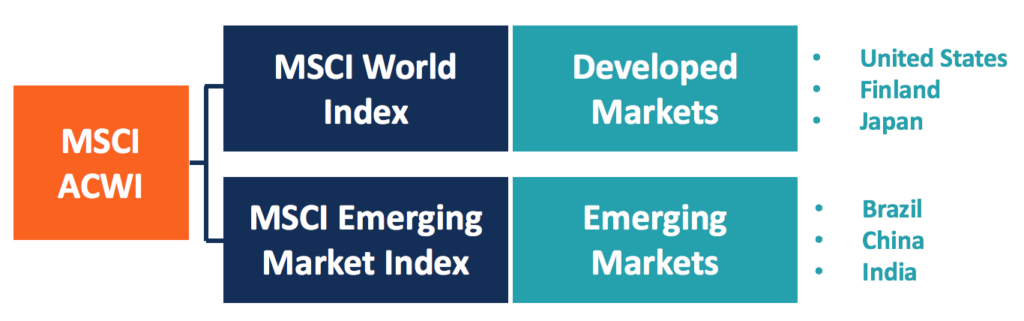
The MSCI ACWI consists of around 85% of the free-float market capitalizationMarket CapitalizationMarket Capitalization (Market Cap) is the most recent market value of a company’s outstanding shares. Market Cap is equal to the current share price multiplied by the number of shares outstanding. The investing community often uses the market capitalization value to rank companies of every market that it covers. The wide coverage and carefully-designed methodology support the index to reflect the fluctuations among different sectors, sizes, styles, and geographical areas.
MSCI World Index and MSCI Emerging Market Index
Similar to the MSCI ACWI, the MSCI World Index is also a global equity index that comprises stocks across different countries and sectors. The major difference is that the World Index focuses on the developed markets. It covers more than 1,600 stocks from 23 developed countries and regions, such as Australia, Canada, Hong Kong, Finland, and Japan.
With a relatively lower correlation between the performance of the emerging market and the developed market, emerging market equity investing provides the benefit of diversificationDiversificationDiversification is a technique of allocating portfolio resources or capital to a variety of investments.The goal of diversification is to mitigate losses. Some emerging markets also have high growth potentials, as the countries are developing rapidly.
The MSCI Emerging Market Index measures the equity performance of the emerging markets around the world. It covers more than 1,100 stocks from 26 countries, including China, Russia, Mexico, South Africa, India, and some other developing countries. The MSCI Emerging Market Index is mostly made up of the markets of China, Korea, and Taiwan, weighted by 33%, 12%, and 11%, respectively.
Use of MSCI All Country World Index (ACWI)
Investing globally is one of the effective methods that investors can use to diversify their portfolios. By holding multiple stocks with low correlation among them in the same market, investors can lower the firm-specific risk (unsystematic risk), but the systematic riskSystematic RiskSystematic risk is that part of the total risk that is caused by factors beyond the control of a specific company or individual. Systematic risk is caused by factors that are external to the organization. All investments or securities are subject to systematic risk and therefore, it is a non-diversifiable risk. remains.
Getting exposure to foreign equities can further diversify portfolios and reduce systematic risk. Thus, investors and portfolio managers seek investment opportunities in different countries. Market participants consider MSCI ACWI as an important tool for global investment.
The MSCI ACWI is often used as the benchmark to evaluate the performance of a global equity portfolio, especially for passive investments. A portfolio manager can compare the return and volatility of the portfolio with the index. Active returnActive ReturnActive return refers to the gains or losses from a portfolio that are directly related to the decisions made by the portfolio manager. The active return can, information ratio, and tracking error are some of the gauges that can be used to evaluate how the portfolio performs relative to its benchmark.
Despite the diversification benefits of global investment, purchasing stocks from different countries and sectors can be costly and complex, especially for individual investors. It makes an exchange-traded fund (ETF) a favorable choice.
The iShares MSCI ACWI ETF (ACWI) tracks the performance of the MSCI ACWI. It holds around 2,200 stocks out of the more than 3,000 stocks from the index. Investors can receive the investment result of the MSCI ACWI with a small amount of capital and low costs by holding iShares’ ETF.
More Resources
CFI offers the Commercial Banking & Credit Analyst (CBCA)™Program Page - CBCAGet CFI's CBCA™ certification and become a Commercial Banking & Credit Analyst. Enroll and advance your career with our certification programs and courses. certification program for those looking to take their careers to the next level. To keep learning and advancing your career, the following resources will be helpful:
- Capitalization-Weighted Index Capitalization-Weighted IndexThe Capitalization-Weighted Index (cap-weighted index, CWI) is a type of stock market index in which each component of the index is weighted relative to its total market capitalization. In a capitalization-weighted index, companies with larger market capitalization exert a greater impact on the index value.
- Information RatioInformation RatioThe information ratio measures the risk-adjusted returns of a financial asset or portfolio relative to a certain benchmark. This ratio aims to show excess returns relative to the benchmark, as well as the consistency in generating the excess returns.
- Tracking ErrorTracking ErrorTracking error is a measure of financial performance that determines the difference between the return fluctuations of an investment portfolio and the return fluctuations of a chosen benchmark. The return fluctuations are primarily measured by standard deviations.
- Volatility Index (VIX)VIXThe Chicago Board Options Exchange (CBOE) created the VIX (CBOE Volatility Index) to measure the 30-day expected volatility of the US stock market, sometimes called the "fear index". The VIX is based on the prices of options on the S&P 500 Index
-
Herrick Payoff Index: Understanding Derivative Market Trends
The Herrick Payoff Index is a forward-looking technical analysis tool used to identify trends in derivative markets. Using price, volume, and open interest, the index provides an overview of money flo
-
Negative Volume Index (NVI): A Comprehensive Guide
The Negative Volume Index (NVI) is a technical indicator used to identify trends in a market. It is a cumulative indicator, which means that all changes to the indicator accumulate. Put another way, t
invest
- Advance-Decline Line: Understanding Market Sentiment & Trends
- Arms Index (TRIN): Understanding Short-Term Market Sentiment
- DAX Index: Your Guide to Germany's Top 30 Companies
- EAFE Index: Understanding Developed Market Performance
- MSCI Emerging Markets Index: Definition & Key Facts
- Nikkei Index: Understanding Japan's Top Stock Market Indicator
- Price-Weighted Index Explained: How It Works & Examples
- Understanding the S&P 500: Top Holdings & Long-Term Performance
- MSCI ACWI Index: A Comprehensive Guide to Global Equity Markets
-
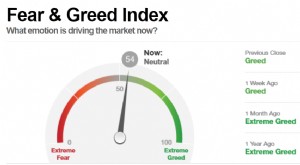 Fear & Greed Index: Understanding Investor Sentiment | CNN Business
The Fear and Greed Index, developed by CNNMoney, is used to gauge whether investors are too bullish or bearish on the stock market. The index ranges from 0 (extreme fear) to 100 (extreme greed). ...
-
 Hang Seng Index (HSI): A Comprehensive Guide to Hong Kong's Stock Market
The Hang Seng Index (HSI) is a stock market index in Hong Kong. It records and monitors the daily changes in stock prices of the 50 largest Hong Kong stock market companies. As the companies represent...