
Spot Price Explained: Understanding Immediate Market Values
The spot price is the current market price of a securityPublic SecuritiesPublic securities, or marketable securities, are investments that are openly or easily traded in a market. The securities are either equity or debt-based., currency, or commodity available to be bought/sold for immediate settlement. In other words, it is the price at which the sellers and buyers value an asset right now.
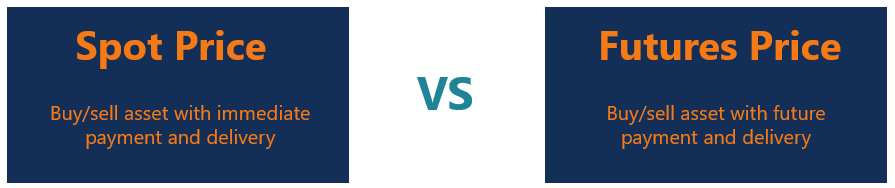
Although spot prices can vary by time and geographic regions, the prices are fairly homogenous in financial markets. The uniformity of prices across different financial markets does not allow market participants to exploit arbitrageArbitrageArbitrage is the strategy of taking advantage of price differences in different markets for the same asset. For it to take place, there must be a situation of at least two equivalent assets with differing prices. In essence, arbitrage is a situation that a trader can profit from opportunities from significant price disparities for the same asset in different markets.
Most frequently, spot prices are considered in the context of forwards and futures contractsFutures and ForwardsFuture and forward contracts (more commonly referred to as futures and forwards) are contracts that are used by businesses and investors to hedge against risks or speculate.. One of the reasons for the creation of such financial contracts is to “lock in” the desired spot price of a commodity at some future date because prices constantly change due to fluctuations in supply and demandSupply and DemandThe laws of supply and demand are microeconomic concepts that state that in efficient markets, the quantity supplied of a good and quantity.
The spot price is a key variable in determining the price of a futures contract. It can indicate expectations about fluctuations in future commodity prices.

Spot Price vs. Future Price
The main difference between spot and futures prices is that spot prices are for immediate buying and selling, while futures contracts delay payment and delivery to predetermined future dates.
The spot price is usually below the futures price. The situation is known as contango. Contango is quite common for non-perishable goods with significant storage costs.
On the other hand, there is backwardation, which is a situation when the spot price exceeds the futures price.
In either situation, the futures price is expected to eventually converge with the current market price.
More resources
CFI offers the Financial Modeling & Valuation Analyst (FMVA)™Become a Certified Financial Modeling & Valuation Analyst (FMVA)®CFI's Financial Modeling and Valuation Analyst (FMVA)® certification will help you gain the confidence you need in your finance career. Enroll today! certification program for those looking to take their careers to the next level. To learn more about related topics, check out the following resources:
- Contracts for Difference (CFD)Contract for Difference (CFD)Contract for Difference (CFD) refers to a contract that enables two parties to enter into an agreement to trade on financial instruments based on the price difference between the entry prices and closing prices.
- Futures ContractsFutures ContractA futures contract is an agreement to buy or sell an underlying asset at a later date for a predetermined price. It’s also known as a derivative because future contracts derive their value from an underlying asset. Investors may purchase the right to buy or sell the underlying asset at a later date for a predetermined price.
- Hedging AgreementHedging ArrangementHedging arrangement refers to an investment whose aim is to reduce the level of future risks in the event of an adverse price movement of an asset. Hedging provides a sort of insurance cover to protect against losses from an investment.
- Options: Calls and PutsOptions: Calls and PutsAn option is a derivative contract that gives the holder the right, but not the obligation, to buy or sell an asset by a certain date at a specified price.
-

Call Warrants: Understanding Rights & Investment Potential
A call warrant gives the holder of the investment the right, not the obligation, to purchase the underlying financial securities at a specific price on or before a certain date.If the holder does not
-

Commodity Valuation: Understanding Intrinsic Value & Market Pricing
Commodity valuation is the process of deriving the intrinsic value of a commodity under optimal market conditions. In a perfectly competitive free market, the price of a commodity reflects the intrins
invest
- Understanding Divergence in Technical Analysis: A Guide
- Understanding Forward Prices: Definition & How They Work
- Understanding Hedging Strategies: A Comprehensive Guide
- Understanding Slippage in Trading: Causes & Impact
- Spot Price Explained: Understanding Immediate Market Values
- Understanding Strangle Options: A Comprehensive Guide
- Understanding Volatility: A Key Indicator of Investment Risk
- Understanding Oil Price Fluctuations: A Historical and Economic Overview
- Understanding Spot Prices: Definition & How They Work
-
 Call Options: A Comprehensive Guide for Investors
A call option, commonly referred to as a “call,” is a form of a derivatives contract that gives the call option buyer the right, but not the obligation, to buy a stockStockWhat is a stock?...
-
 Understanding Call Prices: Callable Bonds & Preferred Stocks
A call price refers to the price that a preferred stock or bond issuer would pay to buyers if they chose to redeem the callable security before the maturity date. The price is set during the issuance ...