
Understanding Bear Markets: What Investors Need to Know
The securities market can’t climb forever. Eventually prices will begin to fall. We call this period of decline a “bear market.” It’s not the end of the world for investors, but it’s a concept you should understand as you grow your retirement savings.
Wealthsimple Invest is an automated way to grow your money like the world's most sophisticated investors. Get started and we'll build you a personalized investment portfolio in a matter of minutes.What is a bear market?
A bear market is a condition that describes a declining investment climate. It’s when securities prices fall 20% or more from their 52-week high. It comes with widespread pessimism and negative sentiment from investors.
Experts typically associate bear markets with declines in an overall market index or a generally safe index like the S&P 500, but it can also apply to individual securities. Investors can be “bearish” on a particular security, which means they expect it to trend downward for some time, but that doesn’t mean their low confidence applies to the rest of the market.
Twenty percent is just the threshold we use to identify bear markets. During the course of a bear market, securities usually plummet far more than 20%. Their descent may slow from time to time, and occasionally rise a bit, but the general trend is downward.
Bear markets can be secular or cyclical. A secular bear market can last from 10 to 20 years. It’s characterized by prolonged below average returns. Secular bear markets can have slight rallies, but the gains aren’t retained and prices continue to fall. Cyclical bear markets are similar, but last for just a few weeks or for several years. The last prolonged bear market in the United States occurred around the 2008 financial crisis. It lasted for nearly two years.
Does a bear market mean everyone loses money? Not at all. In fact, some investors look forward to bear markets for their money-making potential. Short selling, put options, and inverse ETFs are just a few ways investors can profit from a bear market.
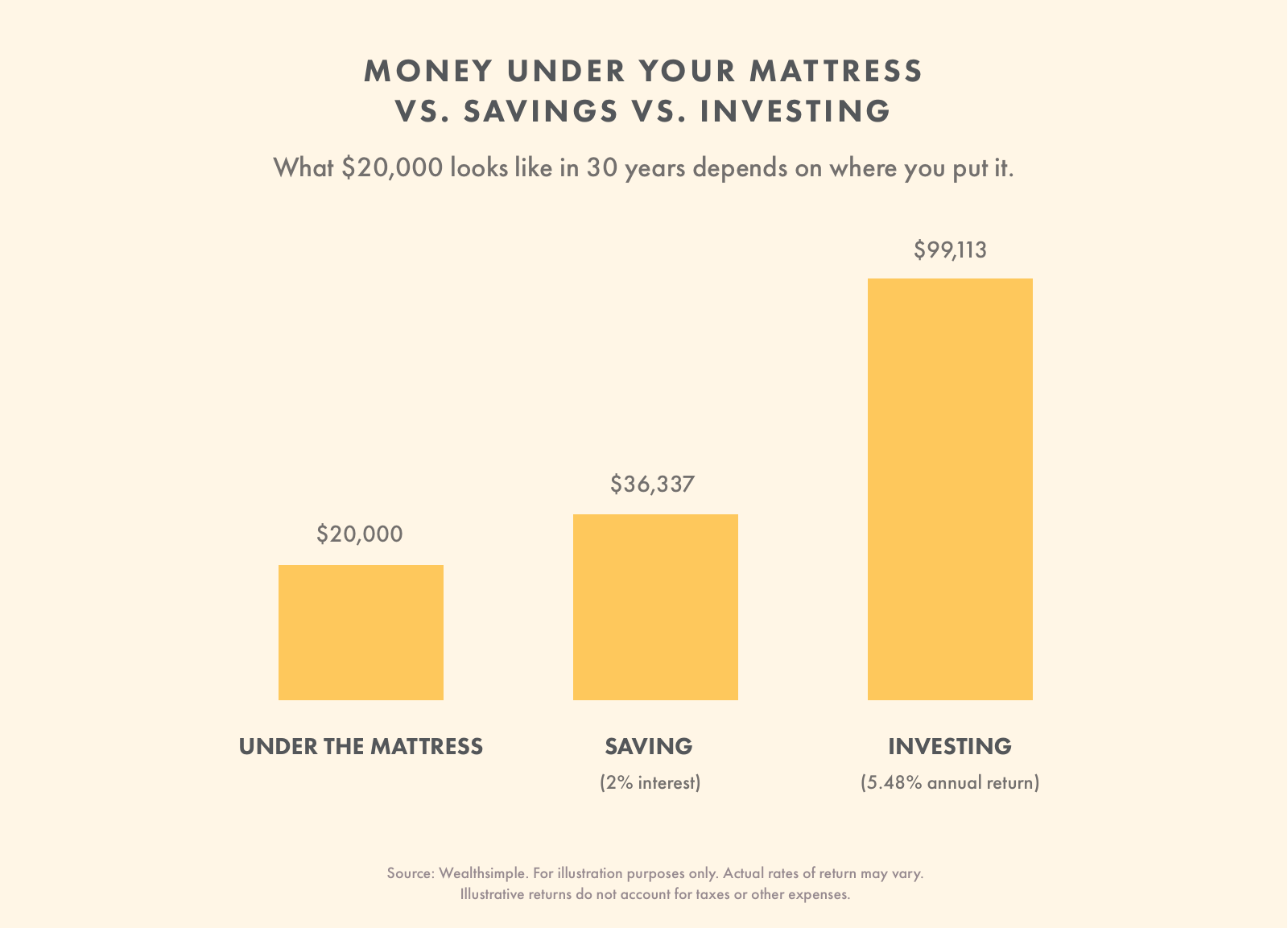
Furthermore, it’s worth pointing out that it’s smart to start an investment portfolio even if you think a bear market is coming. You have high chances of making money over any 30-year period, even if there’s a bear market in there. At the very least, you should open a high interest savings account.
Origin of the name
The origin of the phrase “bear market” is murky. Some people say it comes from the way bears swipe downward when they attack. The bear market’s opposite, the bull market, is supposedly named after the bull that sweeps upwards when it attacks. This is poetic, but there’s no evidence for this claim.
The term most likely originated from a proverb that cautions traders against the temptation to “sell the bear’s skin before one has caught the bear.” In the 18th century, middlemen would sell bearskins they hadn’t purchased yet. They would speculate on the future price of the bearskin, hopping the trappers would lower their prices. These middlemen earned the pejorative “bearskin jobbers” because they benefited from a poor economy. The slur was eventually shortened to just “bears.”
The bear market’s opposite is the bull market. The phrase “bull market” doesn’t have an organic story of its own. At the time, bears and bulls were widely considered opposites due to a popular British bloodsport of bull-and-bear fights.
Causes of bear markets
Economies are complex, so it’s rarely easy to point to a single factor that causes bear markets. There’s often a variety of factors at play. But in general, a bear market is caused by low investor confidence. Investors lose confidence when they believe the economy is weak or slowing down. Here are some signs that tell investors the economy is slowing:
Low disposable income
Low employment
Weak productivity
Decline in business profits
Certain government interventions
During a bear market, investors tend to view market news pessimistically. They disregard good news and focus on the bad, which ultimately drives prices—and everyone’s confidence—even lower.
Interestingly, none of those signs have to actually appear to trigger a bear market. Investors need only believe they will appear. If investors have low confidence in the market, they will resist buying more assets and they will sell holdings before their value falls. This can actually trigger a bear market.
Bear market vs. correction
It’s important not to confuse a bear market with a correction. A correction is a short-term trend that lasts fewer than two months. During this period, securities that were substantially overvalued fall to their proper value. When a broad correction occurs throughout the market, some investors panic and start to cry “bear market” early.
A correction is a great time for investors to enter into the market because it identifies the “bottom” of a particular security. A bear market, however, is a poor entry point for investors because there’s no telling how far the security will fall. This is why breaking out of a bear market is so challenging. No one wants to invest until prices begin to rise, which doesn’t happen until people invest.
Identifying bear markets
It’s always easy to identify a bear market years later, but much harder to tell when you’re at the beginning of one. There’s no way to look at the market and declare, “This is the top. It must go down from here.”
Furthermore, the beginning of a bear market always looks like a simple and healthy correction. Even the most pessimistic investors hold on to their assets during a small drop, hoping they will rally and increase again.
Federal interest rates are the most telling sign of a bear market because they affect so much of the economy. Federal banks lower interest rates in response to lagging economies in order to encourage investment. If they didn’t expect a downturn, they wouldn’t be lowering rates. (Keep in mind that’s a very basic explanation of federal interest rates.)
Bull vs. bear market
The opposite of a bear market is a bull market. Whereas bear markets represent market declines, bull markets represent sustained market climbs. Bull markets are measured the same way as bear markets. We’re in a bull market once we have 20% growth or more from its 52-week high.
During a bull market, investors feel optimistic that their investments will improve, which encourages more investment, thus investment improve. Just like a bear market is a self-propagating cycle downward, a bull market self-propagates upward until something scares investors to start selling their holdings.
Current climate
As of January 2020, we are in a bull market that began in 2009. 2019 was an especially positive year for investors. Securities have recovered remarkably since the financial crisis of 2008.
When will the bull market become a bear market? That’s hard to predict. There’s always someone claiming that a bear market (and even a recession) is just around the corner. We heard it around the European debt crisis in 2010, the U.S. debt-ceiling fight in 2011, and the devaluation of China’s yuan in 2015. Today, doomsayers predict a bear market due to everything from the U.S.-China trade deal to U.K.’s Brexit to other world events.
However, there is one ominous sign of a bear market: the inverted yield curve. This concept relates short-term bonds to long-term bonds. In most circumstances, rates for long-term bonds are higher, meaning you get more profit for lending money (by buying bonds) for longer periods of time.
At the moment, however, the typical curve has inverted. There’s more money in lending for shorter periods of time. This means investors are anxious about the future and unwilling to commit their money for long periods of time. That’s exactly the kind of low confidence that triggers bear markets.
Do we know a bear market is coming for sure? Nope. We won’t be sure we’re in a bear market until we’re deep into one. What we know is that there will be a bear market at some point. The market doesn’t have a ceiling, so there’s no telling how high it will go, but it will turn down eventually.
Bear market history
The easiest way to track bear markets is to look at a reliable index such as the S&P 500. The S&P has had numerous dips and corrections over the last hundred years, but only nine bear markets.
The bottom line
If you aren’t a professional investor, the big takeaway here is that bear markets are natural occurrences. Yes, they’re tough to withstand, but they aren’t permanent. The market will almost certainly improve eventually.
-

Understanding Secular Markets: Long-Term Trends & Investment Strategies
A secular market is predominantly driven and impacted by elements or forces that are likely to be present in the foreseeable future. The forces can impact the price or value of a financial assetFinanc
-
Sensex Explained: Understanding India's Key Stock Market Index
Sensex, also known as the S&P BSE Sensex Index, is the benchmark index that tracks India’s Bombay Stock Exchange (BSE). The Sensex is composed of the 30 largest and most-traded stocks within
invest
- Understanding Auction Markets: How Prices Are Determined
- Bull vs. Bear Market: Understanding Market Trends & Investor Sentiment
- Doji Candlestick Pattern: Meaning & Trading Signals
- Understanding Frothy Markets: Risks & Opportunities
- Understanding Inefficient Markets: Causes & Implications
- Understanding Market Cycles: Trends & Economic Environments
- Understanding Market Depth: A Guide for Traders
- Understanding Market Exposure: Risk & Portfolio Allocation
- Understanding Bear Markets: Causes, Characteristics & Impact
-
 Understanding Quote-Driven Markets: A Guide for Investors
A quote-driven market is a type of secondary market trading structure where investors trade with dealers. Nearly all bonds, currenciesCurrencyCurrency refers to money, that which is used as a medium o...
-
 Understanding Stock Rallies: Definition & What Causes Them
A rally refers to a period of continuous increase in the prices of stocks, indexes or bondsBondsBonds are fixed-income securities that are issued by corporations and governments to raise capital. The ...