
Understanding Quote-Driven Markets: A Guide for Investors
A quote-driven market is a type of secondary market trading structure where investors trade with dealers. Nearly all bonds, currenciesCurrencyCurrency refers to money, that which is used as a medium of exchange for goods and services in an economy. Before the concept of currency was introduced, goods and services were exchanged for other goods and services under the barter system., and spot commodities are traded in quote-driven markets. Such markets are also commonly known as price-driven markets or dealer markets.

Summary
- A quote-driven market is a secondary market trading structure where investors interact with dealers.
- Bonds, currencies, and spot commodities are primarily traded in quote-driven markets.
- Quote-driven markets are more liquid than other forms of secondary market trading structures due to the presence of dealers (who act as market makers).
Understanding a Quote-Driven Market
A quote-driven market is among one of three main types of secondary market trading structures, with the other two being an order-driven market and a brokered-market.
In a quote-driven market, trades are all executed electronically through dealers. The dealers act as market makers (essentially the middleman) by posting bid and ask prices for traders and keeping an inventory of securities. As a result:
- The ask price is the lowest price that a dealer is willing to sell the underlying securityUnderlying SecurityUnderlying security is a term in investing that denotes the negotiable financial instrument upon which a financial derivative, such as an to buyers; and
- The bid price is the highest price that a dealer is willing to buy the underlying security from sellers.
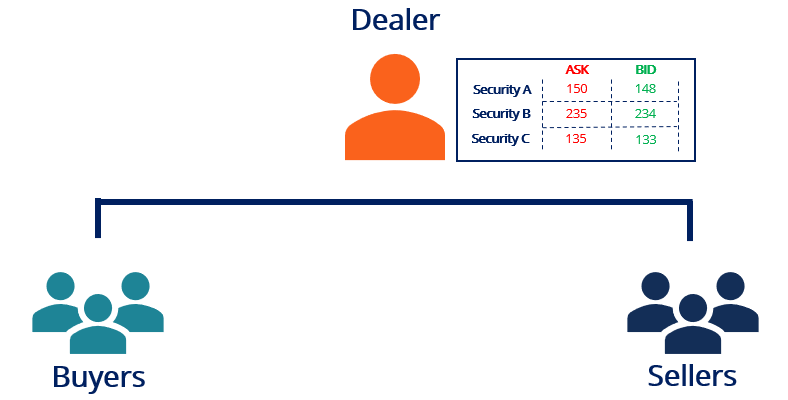
In a quote-driven market, the dealers are the sole provider of liquidity and generate profit from the bid-ask spread.
A quote-driven market is more liquid than other forms of secondary market trading structures due to the presence of market makers (dealers). However, it is not as transparent compared to an order-driven market in that the market orders and prices that traders are willing to buy or sell at are not available to the counterparty.
Special Considerations
- Traders in a quote-driven market may accept the prices posted by the dealer or try to negotiate for a better price through the use of their own broker or agent.
- Dealers in a quote-driven market can choose not to execute a trade for a specific client.
- Situations may arise where there is more than one dealer for the underlying security. As such, traders can choose their preferred dealer.
Quote-Driven Market vs. Order-Driven Market and Brokered-Market
The three main types of secondary market trading structures are:
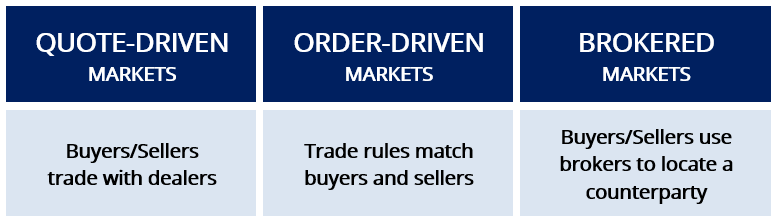
Below, we contrast a quote-driven market to the other two main types of secondary market structures – an order-driven market and a brokered-market.
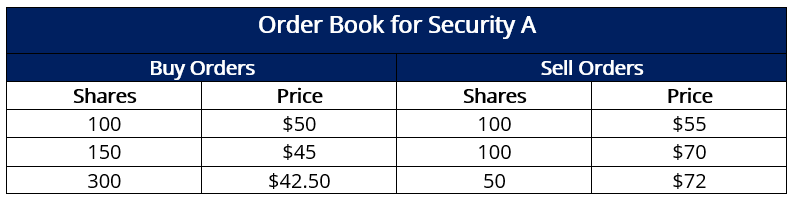
In an order-driven market, trades are executed using trade rules. Both buyers’ and sellers’ orders are all displayed on an order bookOrder BookAn order book is a list of orders that presents different offers from buyers and sellers for a specific security. It shows the prices and volumes, and trades are only executed when the bid and ask prices are matched. In an order-driven market, dealers are not involved; instead, traders buy and sell to each other directly.
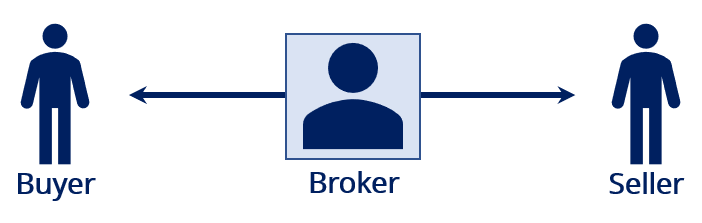
In a brokered market, brokers help their clients find a counterparty that is willing to execute a trade. Brokered markets are primarily used for unique and/or illiquid assets, such as real estateReal EstateReal estate is real property that consists of land and improvements, which include buildings, fixtures, roads, structures, and utility systems. Property rights give a title of ownership to the land, improvements, and natural resources such as minerals, plants, animals, water, etc., antiques, large blocks of shares, etc. Such assets attract limited buyers/sellers and are not sufficient for dealers to create a market with them.
Practical Example
An individual is looking to sell an extremely valuable painting.
Question: What type of secondary marketing trading structure given above should she use?
Answer: Due to the illiquidity of the valuable painting, it would not be suitable for a quote-driven market or an order-driven market. The individual should use a brokered market.
Related Readings
CFI offers the Capital Markets & Securities Analyst (CMSA)®Program Page - CMSAEnroll in CFI's CMSA® program and become a certified Capital Markets &Securities Analyst. Advance your career with our certification programs and courses. certification program for those looking to take their careers to the next level. To keep learning and developing your knowledge base, please explore the additional relevant resources below:
- LiquidityLiquidityIn financial markets, liquidity refers to how quickly an investment can be sold without negatively impacting its price. The more liquid an investment is, the more quickly it can be sold (and vice versa), and the easier it is to sell it for fair value. All else being equal, more liquid assets trade at a premium and illiquid assets trade at a discount.
- Market MakerMarket MakerMarket maker refers to a firm or an individual that engages in two-sided markets of a given security. It means that it provides bids and asks in tandem with
- Secondary MarketSecondary MarketThe secondary market is where investors buy and sell securities from other investors. Examples: New York Stock Exchange (NYSE), London Stock Exchange (LSE).
- Trade OrderTrade OrderPlacing a trade order seems intuitive – a “buy” button to initiate a trade and a “sell” button to close a trade.
-

Trading Volume: Understanding & Significance
The term “volume” in trading refers to the total number of shares that are traded during a given period of time. The volume of trade is measured on all types of financial commodities, incl
-
Understanding Bear Markets: What Investors Need to Know
The securities market can’t climb forever. Eventually prices will begin to fall. We call this period of decline a “bear market.” It’s not the end of the world for investors, but it’s a concept you sho
invest
- Understanding Auction Markets: How Prices Are Determined
- Doji Candlestick Pattern: Meaning & Trading Signals
- Understanding Frothy Markets: Risks & Opportunities
- Understanding Inefficient Markets: Causes & Implications
- Understanding Market Cycles: Trends & Economic Environments
- Understanding Market Depth: A Guide for Traders
- Understanding Market Exposure: Risk & Portfolio Allocation
- Understanding Market Indexes: A Comprehensive Guide
- Understanding Market Makers: How They Fuel Liquidity
-
 Sensex Explained: Understanding India's Key Stock Market Index
Sensex, also known as the S&P BSE Sensex Index, is the benchmark index that tracks India’s Bombay Stock Exchange (BSE). The Sensex is composed of the 30 largest and most-traded stocks within...
-
 Understanding Algorithmic Trading Spoofing: Definition & Impact
Spoofing is a disruptive algorithmic trading practice that involves placing bids to buy or offers to sell futures contractsFutures ContractA futures contract is an agreement to buy or sell an underlyi...