
Accounts Payable Turnover Ratio: Definition & Interpretation
The accounts payable turnover ratio, also known as the payables turnover or the creditor’s turnover ratio, is a liquidity ratioFinancial RatiosFinancial ratios are created with the use of numerical values taken from financial statements to gain meaningful information about a company that measures the average number of times a company pays its creditors over an accounting period. The ratio is a measure of short-term liquidity, with a higher payable turnover ratio being more favorable.

Accounts Payable Turnover Ratio Formula
The formula for the accounts payable turnover ratio is as follows:
In some cases, cost of goods sold (COGS)Cost of Goods Sold (COGS)Cost of Goods Sold (COGS) measures the “direct cost” incurred in the production of any goods or services. It includes material cost, direct is used in the numerator in place of net credit purchases. Average accounts payable is the sum of accounts payableAccounts PayableAccounts payable is a liability incurred when an organization receives goods or services from its suppliers on credit. Accounts payables are at the beginning and end of an accounting period, divided by 2.
Example of Accounts Payable Turnover Ratio
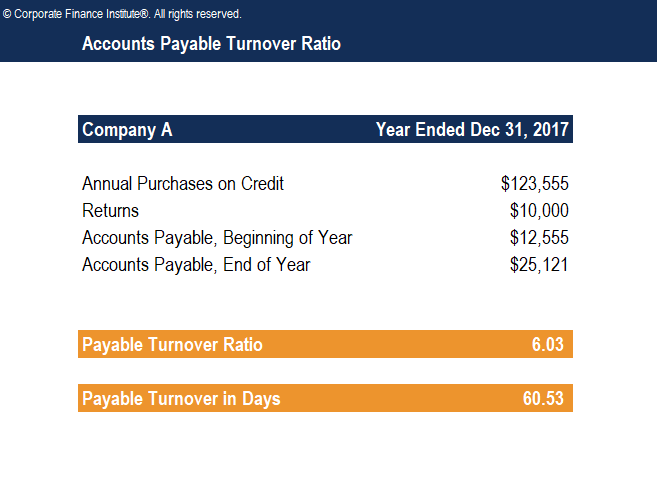
Company A reported annual purchases on credit of $123,555 and returns of $10,000 during the year ended December 31, 2017. Accounts payable at the beginning and end of the year were $12,555 and $25,121, respectively. The company wants to measure how many times it paid its creditors over the fiscal yearFiscal Year (FY)A fiscal year (FY) is a 12-month or 52-week period of time used by governments and businesses for accounting purposes to formulate annual.

Therefore, over the fiscal year, the company’s accounts payable turned over approximately 6.03 times during the year. The turnover ratio would likely be rounded off and simply stated as six.
Accounts Payable Turnover in Days
The accounts payable turnover in days shows the average number of days that a payable remains unpaid. To calculate the accounts payable turnover in days, simply divide 365 days by the payable turnover ratio.
Payable Turnover in Days = 365 / Payable Turnover Ratio
Determining the accounts payable turnover in days for Company A in the example above:
Payable Turnover in Days = 365 / 6.03 = 60.53
Therefore, over the fiscal year, the company takes approximately 60.53 days to pay its suppliers.
Download the Free Template
Enter your name and email in the form below and download the free template now!
Interpretation of Accounts Payable Turnover Ratio
The accounts payable turnover ratio indicates to creditors the short-term liquidity and, to that extent, the creditworthiness of the company. A high ratio indicates prompt payment is being made to suppliers for purchases on credit. A high number may be due to suppliers demanding quick payments, or it may indicate that the company is seeking to take advantage of early payment discounts or actively working to improve its credit rating.
A low ratio indicates slow payment to suppliers for purchases on credit. This may be due to favorable credit terms, or it may signal cash flow problems and hence, a worsening financial condition. While a decreasing ratio could indicate a company in financial distress, that may not necessarily be the case. It might be that the company has successfully managed to negotiate better payment terms which allow it to make payments less frequently, without any penalty.
The accounts payable turnover ratio of a company is often driven by the credit terms of its suppliers. For example, companies that obtain favorable credit terms usually report a relatively lower ratio. Large companies with bargaining power who are able to secure better credit terms would result in lower accounts payable turnover ratio (source).
Although a high accounts payable turnover ratio is generally desirable to creditors as signaling creditworthiness, companies should also be taking advantage of the credit terms extended by suppliers, as doing so will result in discounts on purchases.
As with most financial metrics, a company’s turnover ratio is best examined relative to similar companies in its industry. For example, a company’s payables turnover ratio of two will be more concerning if virtually all of its competitors have a ratio of at least four.
Use in Financial Modeling
In financial modelingWhat is Financial ModelingFinancial modeling is performed in Excel to forecast a company's financial performance. Overview of what is financial modeling, how & why to build a model., the accounts payable turnover ratio (or turnover days) is an important assumption for creating the balance sheet forecast. As you can see in the example below, the accounts payable balance is driven by the assumption that cost of goods sold (COGS) takes approximately 30 days to be paid (on average). Therefore, COGS in each period is multiplied by 30 and divided by the number of days in the period to get the AP balance.
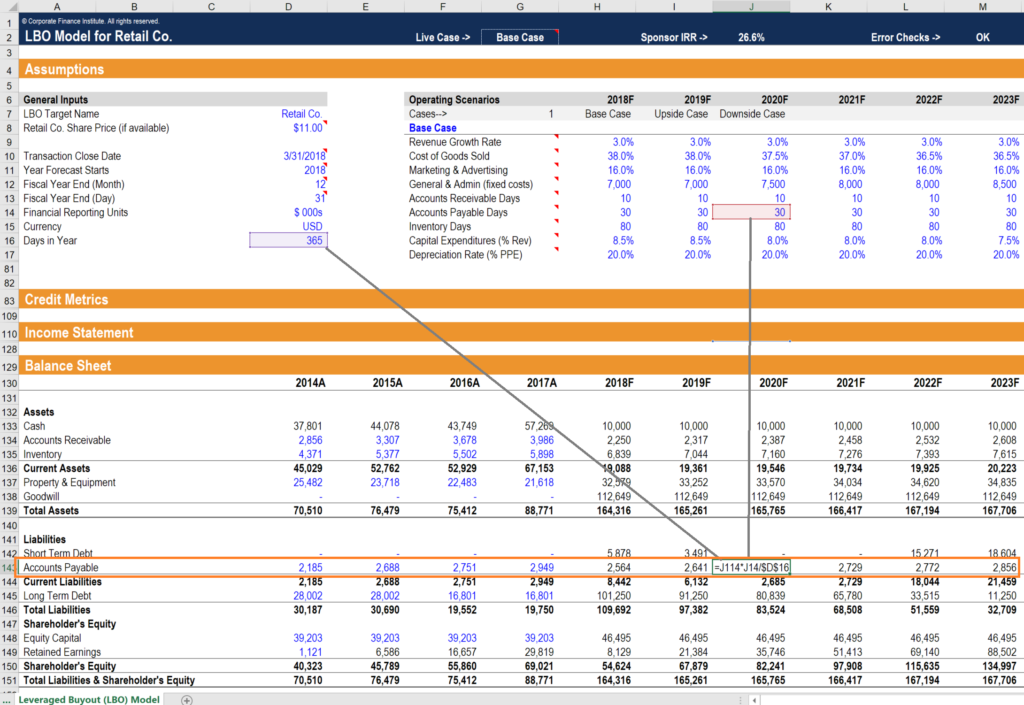
The above screenshot is taken from CFI’s Financial Modeling Course.
Key Takeaways
- The accounts payable turnover ratio is a liquidity ratio that measures how many times a company is able to pay its creditors over a period of time.
- A high ratio may be due to suppliers demanding fast payments or the company taking advantage of early payment discounts.
- A low ratio may be due to favorable credit terms or a worsening financial condition.
- Bargaining power plays a big role in the ratio. Companies with strong bargaining power are given longer credit terms and hence, will report a lower accounts payable turnover ratio.
- Dividing 365 by the ratio results in the accounts payable turnover in days, which measures the number of days that it takes a company, on average, to pay creditors.
- A higher ratio signals creditworthiness and is sought after by creditors.
Related Reading
CFI is the official global provider of the Financial Modeling & Valuation Analyst (FMVA)®Become a Certified Financial Modeling & Valuation Analyst (FMVA)®CFI's Financial Modeling and Valuation Analyst (FMVA)® certification will help you gain the confidence you need in your finance career. Enroll today! certification program to help financial professionals take their careers to the next level. To learn more and advance your career, the following CFI resources will be helpful:
- Analysis of Financial StatementsAnalysis of Financial StatementsHow to perform Analysis of Financial Statements. This guide will teach you to perform financial statement analysis of the income statement,
- Financial Modeling GuideFree Financial Modeling GuideThis financial modeling guide covers Excel tips and best practices on assumptions, drivers, forecasting, linking the three statements, DCF analysis, more
- Inventory Turnover RatioInventory Turnover RatioThe inventory turnover ratio, also known as the stock turnover ratio, is an efficiency ratio that measures how efficiently inventory is managed. The inventory turnover ratio formula is equal to the cost of goods sold divided by total or average inventory to show how many times inventory is “turned” or sold during a period.
- Financial Analysis Ratios GlossaryFinancial Analysis Ratios GlossaryGlossary of terms and definitions for common financial analysis ratios terms. It's important to have an understanding of these important terms.
-
Understanding the Chart of Accounts: A Comprehensive Guide
The chart of accounts is a tool that lists all the financial accounts included in the financial statementsThree Financial StatementsThe three financial statements are the income statement, the balance
-

Variable Cost Ratio: Definition, Calculation & Importance
The variable cost ratio is a cost accounting tool used to express a company’s variable production costs as a percentage of its net sales. The ratio is calculated by dividing the variable costs b
Accounting
- Accounts Payable Turnover Ratio: Meaning, Calculation & Implications
- Accounts Payable vs. Accounts Receivable: A Clear Explanation
- Accounts Payable (AP): Definition, Function & Importance
- Asset Turnover Ratio: Definition & Calculation - Financial Analysis
- Cash Turnover Ratio (CTR): Calculation & Interpretation
- Inventory Turnover Ratio: Definition & Calculation
- Portfolio Turnover Ratio: Definition, Calculation & Significance
- Accounts Receivable Turnover Ratio: Definition & Calculation
- Receivables Turnover Ratio: Definition, Calculation & Importance
-
 Sharpe Ratio: Calculate & Interpret Investment Performance
Named after American economist, William Sharpe, the Sharpe Ratio (or Sharpe Index or Modified Sharpe Ratio) is commonly used to gauge the performance of an investment by adjusting for its risk.The hig...
-
 Understanding the Accounting Cycle: A Comprehensive Guide
The accounting cycle is the holistic process of recording and processing all financial transactions of a company, from when the transaction occurs, to its representation on the financial statementsThr...