
Accounts Receivable Turnover Ratio: Definition & Calculation
The accounts receivable turnover ratio, also known as the debtor’s turnover ratio, is an efficiency ratioFinancial RatiosFinancial ratios are created with the use of numerical values taken from financial statements to gain meaningful information about a company that measures how efficiently a company is collecting revenue – and by extension, how efficiently it is using its assets. The accounts receivable turnover ratio measures the number of times over a given period that a company collects its average accounts receivableAccounts ReceivableAccounts Receivable (AR) represents the credit sales of a business, which have not yet been collected from its customers. Companies allow.
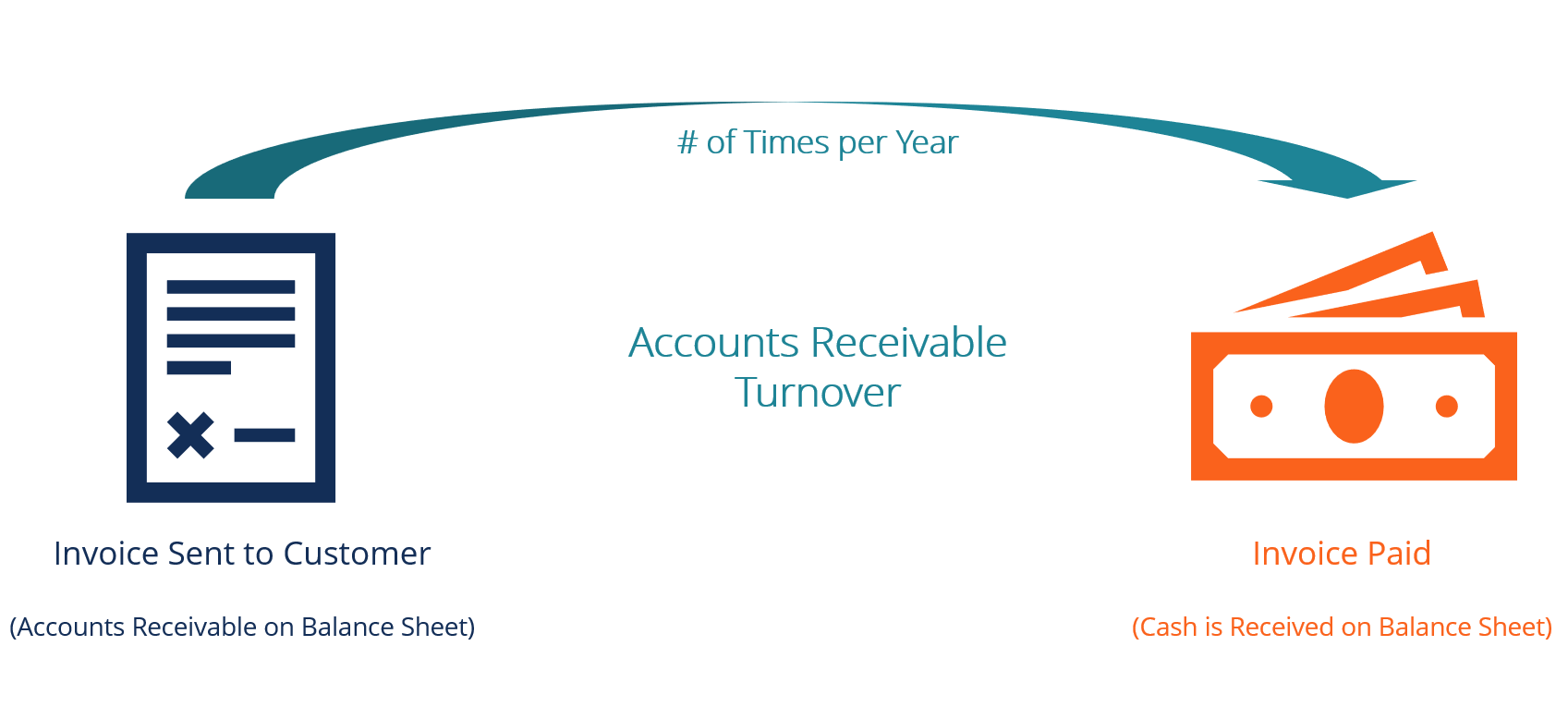
Image: CFI’s Financial Analysis Courses.
Accounts Receivable Turnover Ratio Formula
The accounts receivable turnover ratio formula is as follows:
Accounts Receivable Turnover Ratio = Net Credit Sales / Average Accounts Receivable
Where:
- Net credit salesCredit SalesCredit sales refer to a sale in which the amount owed will be paid at a later date. In other words, credit sales are purchases made by are sales where the cash is collected at a later date. The formula for net credit sales is = Sales on credit – Sales returns – Sales allowances.
- Average accounts receivable is the sum of starting and ending accounts receivable over a time period (such as monthly or quarterly), divided by 2.
Example of the Accounts Receivable Turnover Ratio
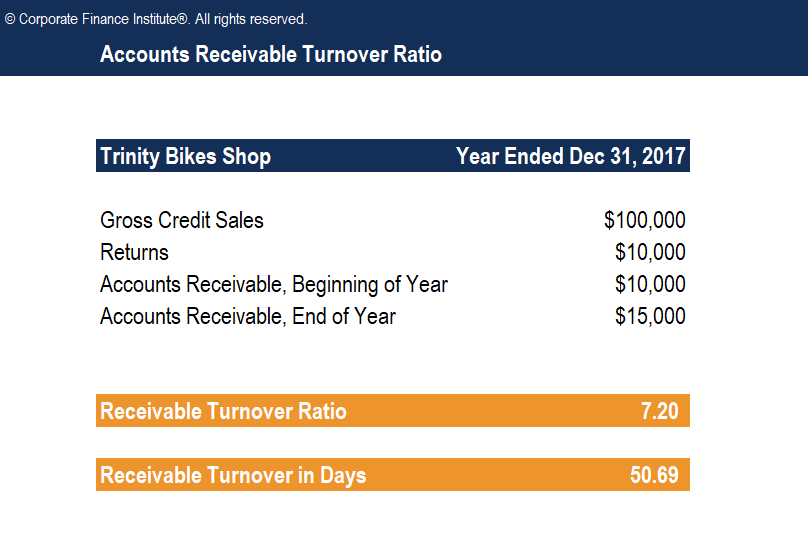
Trinity Bikes Shop is a retail store that sells biking equipment and bikes. Due to declining cash sales, John, the CEOCEOA CEO, short for Chief Executive Officer, is the highest-ranking individual in a company or organization. The CEO is responsible for the overall success of an organization and for making top-level managerial decisions. Read a job description, decides to extend credit sales to all his customers. In the fiscal year ended December 31, 2017, there were $100,000 gross credit sales and returns of $10,000. Starting and ending accounts receivable for the year were $10,000 and $15,000, respectively. John wants to know how many times his company collects its average accounts receivable over the year.

Therefore, Trinity Bikes Shop collected its average accounts receivable approximately 7.2 times over the fiscal yearFiscal Year (FY)A fiscal year (FY) is a 12-month or 52-week period of time used by governments and businesses for accounting purposes to formulate annual ended December 31, 2017.
Accounts Receivable Turnover in Days
The accounts receivable turnover in days shows the average number of days that it takes a customer to pay the company for sales on credit.
The formula for the accounts receivable turnover in days is as follows:
Receivable turnover in days = 365 / Receivable turnover ratio
Determining the accounts receivable turnover in days for Trinity Bikes Shop in the example above:
Receivable turnover in days = 365 / 7.2 = 50.69
Therefore, the average customer takes approximately 51 days to pay their debt to the store. If Trinity Bikes Shop maintains a policy for payments made on credit, such as a 30-day policy, the receivable turnover in days calculated above would indicate that the average customer makes late payments.
Download the Free Template
Enter your name and email in the form below and download the free template now!
Interpretation of Accounts Receivable Turnover Ratio
The accounts receivable turnover ratio is an efficiency ratio and is an indicator of a company’s financial and operational performanceAnalysis of Financial StatementsHow to perform Analysis of Financial Statements. This guide will teach you to perform financial statement analysis of the income statement,. A high ratio is desirable, as it indicates that the company’s collection of accounts receivable is frequent and efficient. A high accounts receivable turnover also indicates that the company enjoys a high-quality customer base that is able to pay their debts quickly. Also, a high ratio can suggest that the company follows a conservative credit policy such as net-20-days or even a net-10-days policy.
On the other hand, a low accounts receivable turnover ratio suggests that the company’s collection process is poor. This can be due to the company extending credit terms to non-creditworthy customers who are experiencing financial difficulties.
Additionally, a low ratio can indicate that the company is extending its credit policy for too long. It can sometimes be seen in earnings management, where managers offer a very long credit policy to generate additional sales. Due to the time value of money principleTime Value of MoneyThe time value of money is a basic financial concept that holds that money in the present is worth more than the same sum of money to be received in the future. This is true because money that you have right now can be invested and earn a return, thus creating a larger amount of money in the future. (Also, with future, the longer a company takes to collect on its credit sales, the more money a company effectively loses, or the less valuable are the company’s sales. Therefore, a low or declining accounts receivable turnover ratio is considered detrimental to a company.
It’s useful to compare a company’s ratio to that of its competitors or similar companies within its industry. Looking at a company’s ratio, relative to that of similar firms, will provide a more meaningful analysis of the company’s performance rather than viewing the number in isolation. For example, a company with a ratio of four, not inherently a “high” number, will appear to be performing considerably better if the average ratio for its industry is two.
Use in Financial Modeling
In financial modelingWhat is Financial ModelingFinancial modeling is performed in Excel to forecast a company's financial performance. Overview of what is financial modeling, how & why to build a model., the accounts receivable turnover ratio (or turnover days) is an important assumption for driving the balance sheet forecast. As you can see in the example below, the accounts receivable balance is driven by the assumption that revenue takes approximately 10 days to be received (on average). Therefore, revenue in each period is multiplied by 10 and divided by the number of days in the period to get the AR balance.
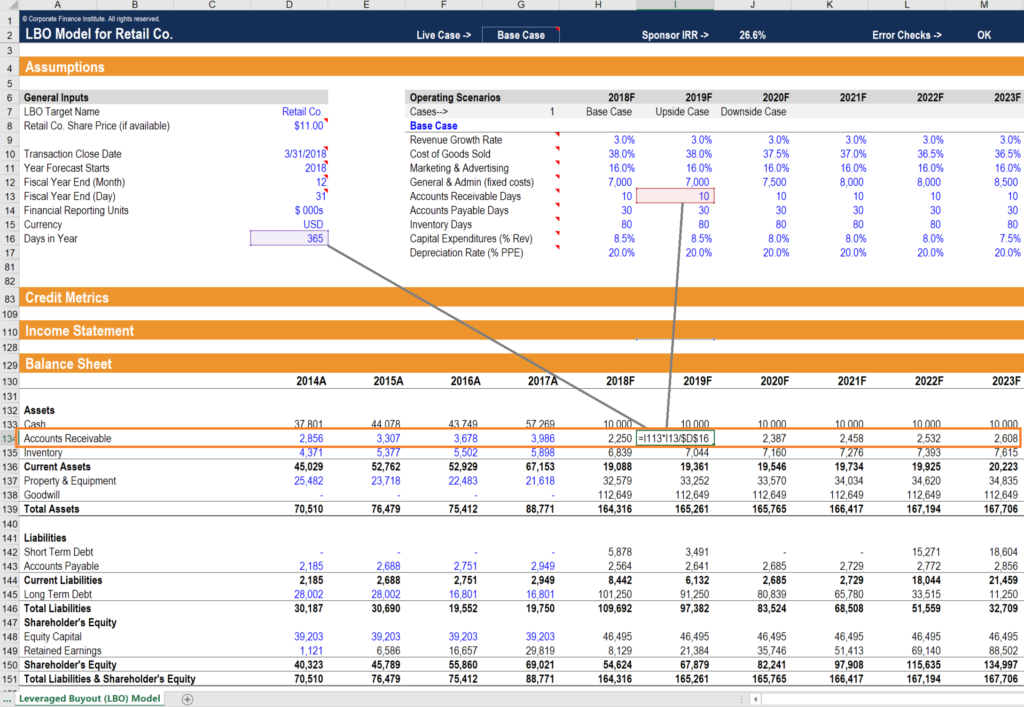
The above screenshot is taken from CFI’s Financial Modeling Course.
Key Takeaways
The main points to be aware of are:
- The accounts receivable turnover ratio is an efficiency ratio that measures the number of times over a year (or another time period) that a company collects its average accounts receivable.
- Dividing 365 by the accounts receivable turnover ratio yields the accounts receivable turnover in days, which gives the average number of days it takes customers to pay their debts.
- A high turnover ratio is desirable, as it suggests that the company’s collection process is efficient, the company enjoys a high-quality customer base, or that the company maintains a conservative credit policy.
- A low accounts receivable turnover is harmful to a company and can suggest a poor collection process, extending credit terms to bad customers, or extending its credit policy for too long.
Video Explanation of Different Accounts Receivable Turnover Ratios
Watch this short video to quickly understand the main concepts covered in this guide, including the commonly used accounts receivable efficiency ratios and the formulas for calculating the accounts receivable turnover ratio.
More Resources
Thank you for reading this CFI guide to the Accounts Receivable Turnover Ratio. CFI is a global provider of the Financial Modeling & Valuation Analyst (FMVA)®Become a Certified Financial Modeling & Valuation Analyst (FMVA)®CFI's Financial Modeling and Valuation Analyst (FMVA)® certification will help you gain the confidence you need in your finance career. Enroll today! certification program and other financial analyst training. To learn more and expand your career, explore the additional relevant resources below.
- Days Inventory Outstanding (DIO)Days Inventory OutstandingDays inventory outstanding (DIO) is the average number of days that a company holds its inventory before selling it. The days inventory
- Day Sales Outstanding (DSO)Days Sales Outstanding (DSO)Days Sales Outstanding (DSO) represents the average number of days it takes credit sales to be converted into cash, or how long it takes a
- Inventory Turnover RatioInventory Turnover RatioThe inventory turnover ratio, also known as the stock turnover ratio, is an efficiency ratio that measures how efficiently inventory is managed. The inventory turnover ratio formula is equal to the cost of goods sold divided by total or average inventory to show how many times inventory is “turned” or sold during a period.
- Financial Analysis Ratios GlossaryFinancial Analysis Ratios GlossaryGlossary of terms and definitions for common financial analysis ratios terms. It's important to have an understanding of these important terms.
-

Understanding the Retention Ratio: Reinvesting for Growth
The retention ratio (also known as the net income retention ratio) is the ratio of a company’s retained income to its net incomeNet IncomeNet Income is a key line item, not only in the income st
-
Sharpe Ratio: Calculate & Interpret Investment Performance
Named after American economist, William Sharpe, the Sharpe Ratio (or Sharpe Index or Modified Sharpe Ratio) is commonly used to gauge the performance of an investment by adjusting for its risk.The hig
Accounting
- Accounts Receivable Turnover Ratio: Calculation & Analysis
- Accounts Payable vs. Accounts Receivable: A Clear Explanation
- Accounts Receivable Turnover Ratio: Meaning, Calculation & Importance
- Accounts Receivable to Sales Ratio: Definition & Analysis
- Inventory Turnover Ratio: Definition & Calculation
- Portfolio Turnover Ratio: Definition, Calculation & Significance
- Accounts Payable Turnover Ratio: Definition & Interpretation
- Understanding Accounts Receivable Quality: A Key Indicator of Financial Health
- Accounts Receivable Turnover Ratio: Calculation, Analysis & Examples
-
 Quick Ratio: Understanding Your Business's Short-Term Liquidity
The Quick Ratio, also known as the Acid-test or Liquidity ratio, measures the ability of a business to pay its short-term liabilities by having assets that are readily convertible into cashCash Equiva...
-
 Reserve Ratio Explained: Understanding Bank Reserves
The reserve ratio – also known as bank reserve ratio, bank reserve requirement, or cash reserve ratio – is the percentage of deposits a financial institution must hold in reserve as cash. ...