
Asset Turnover Ratio: Definition & Calculation - Financial Analysis
The asset turnover ratio, also known as the total asset turnover ratio, measures the efficiency with which a company uses its assets to produce salesSales RevenueSales revenue is the income received by a company from its sales of goods or the provision of services. In accounting, the terms "sales" and. The asset turnover ratio formula is equal to net sales divided by the total or average assetsTypes of AssetsCommon types of assets include current, non-current, physical, intangible, operating, and non-operating. Correctly identifying and of a company. A company with a high asset turnover ratio operates more efficiently as compared to competitors with a lower ratio.
The Formula
The formula for the ratio is as follows:

Where:
- Net sales are the amount of revenue generated after deducting sales returns, sales discounts, and sales allowances.
- Average total assets are the average of aggregate assets at year end of the current or preceding fiscal yearFiscal Year (FY)A fiscal year (FY) is a 12-month or 52-week period of time used by governments and businesses for accounting purposes to formulate annual. Note: an analyst may use either average or end-of-period assets.
Example of Asset Turnover Ratio
Company A reported beginning total assets of $199,500 and ending total assets of $199,203. Over the same period, the company generated sales of $325,300 with sales returns of $15,000.
The asset turnover ratio for Company A is calculated as follows:

Therefore, for every dollar in total assets, Company A generated $1.5565 in sales.
Download the Free Template
Enter your name and email in the form below and download the free template now!
Comparisons of Ratios
Consider four hypothetical companies: Company A, Company B, Company C, and Company D. Companies A and B operate in the fast-food industry, while companies C and D operate in the telecommunications industry:
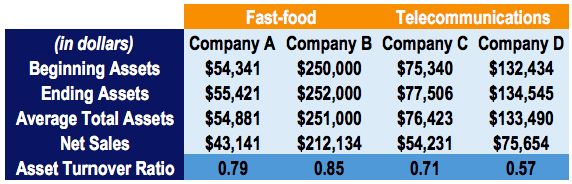
The asset turnover ratio for each company is calculated as net sales divided by average total assets.
Ratio comparisons across markedly different industries do not provide a good insight into how well a company is doing. For example, it would be incorrect to compare the ratios of Company A to that of Company C, as they operate in different industries.
It is only appropriate to compare the asset turnover ratio of companies operating in the same industry. We can see that Company B operates more efficiently than Company A. This may indicate that Company A is experiencing poor sales or that its fixed assets are not being utilized to their full capacity.
Interpretation of the Asset Turnover Ratio
The ratio measures the efficiency of how well a company uses assets to produce sales. A higher ratio is favorable, as it indicates a more efficient use of assets. Conversely, a lower ratio indicates the company is not using its assets as efficiently. This might be due to excess production capacity, poor collection methods, or poor inventory management.
The benchmark asset turnover ratio can vary greatly depending on the industry. Industries with low profit margins tend to generate a higher ratio and capital-intensive industries tend to report a lower ratio.
Key Takeaways
- The asset turnover ratio measures is an efficiency ratio which measures how profitably a company uses its assets to produce sales.
- Comparing the ratios of companies in different industries is not appropriate, as industries vary in capital intensiveness.
- A higher ratio is generally favorable, as it indicates an efficient use of assets.
- A lower ratio indicates poor efficiency, which may be due to poor utilization of fixed assets, poor collection methods, or poor inventory management.
Video Explanation of Asset Turnover Ratio
Watch this short video to quickly understand the definition, formula, and application of this financial metric.
Additional Resources
Thank you for reading CFI’s guide to the asset turnover ratio. CFI is the official global provider of the Financial Modeling & Valuation Analyst (FMVA)™Become a Certified Financial Modeling & Valuation Analyst (FMVA)®CFI's Financial Modeling and Valuation Analyst (FMVA)® certification will help you gain the confidence you need in your finance career. Enroll today! certification program for investment banking professionals. To help you advance your career in the financial services industry, check out the following additional CFI resources:
- Current AssetsCurrent AssetsCurrent assets are all assets that a company expects to convert to cash within one year. They are commonly used to measure the liquidity of a
- Analysis of Financial StatementsAnalysis of Financial StatementsHow to perform Analysis of Financial Statements. This guide will teach you to perform financial statement analysis of the income statement,
- Comparable Company AnalysisComparable Company AnalysisThis guide shows you step-by-step how to build comparable company analysis ("Comps") and includes a free template and many examples.
- Financial Analysis Ratios GlossaryFinancial Analysis Ratios GlossaryGlossary of terms and definitions for common financial analysis ratios terms. It's important to have an understanding of these important terms.
-

Modigliani-Miller Theorem: Understanding Capital Structure & Firm Value
The M&M Theorem, or the Modigliani-Miller Theorem, is one of the most important theorems in corporate finance. The theorem was developed by economists Franco Modigliani and Merton Miller in
-

Operating Ratio: Definition, Calculation & Importance
The operating ratio is a measure of efficiency that is used by management to determine day-to-day operational performance. This metric compares operating expenses, also known as OPEX, to net sales. Th
finance
- Acid-Test Ratio: Understanding Your Company's Short-Term Liquidity
- Cash Turnover Ratio (CTR): Calculation & Interpretation
- Debt-to-Asset Ratio: Definition, Calculation & Significance
- Defensive Interval Ratio (DIR): Understanding Company Liquidity
- Understanding the Envy Ratio in Private Equity
- Inventory Turnover Ratio: Definition & Calculation
- Operating Asset Turnover Ratio: Definition & Analysis
- Portfolio Turnover Ratio: Definition, Calculation & Significance
- Receivables Turnover Ratio: Definition, Calculation & Importance
-
 Current Ratio: Definition, Calculation & Financial Health
The current ratio, also known as the working capitalNet Working CapitalNet Working Capital (NWC) is the difference between a companys current assets (net of cash) and current liabilities (net of debt)...
-
 Equity Ratio: Understanding Financial Leverage & Risk
The equity ratio is a financial metric that measures the amount of leverage used by a company. It uses investments in assets and the amount of equity to determine how well a company manages its debts ...