
Accounts Receivable (AR): Definition, Management & Forecasting
Accounts Receivable (AR) represents the credit sales of a business, which have not yet been collected from its customers. Companies allow their clients to pay for goods and services over a reasonable extended period of time, provided that the terms have been agreed upon. For certain transactions, a customer may receive a small discount for paying the amount due to the company early.
The average AR days measure is an important part of forecasting changes in non-cash working capital in financial modeling.

Why do Companies have Accounts Receivable?
Some businesses allow selling on credit to make the payment process easier. Take, for example, a phone provider. The provider may find it hard to collect payment perpetually every time someone makes a call. Instead, it will bill periodically at the end of the month for the total amount of service used by the customer. Until the monthly invoice has been paid, the amount will be recorded in accounts receivable.
Allowing purchases on credit also encourages more sales. Customers are more likely to buy items if they can pay for them at a later date.
For someone working in FP&AFP&A AnalystBecome an FP&A Analyst at a corporation. We outline the salary, skills, personality, and training you need for FP&A jobs and a successful finance career. FP&A analysts, managers, and directors are responsible for providing executives with the analysis and information they need, equity researchEquity Research AnalystAn equity research analyst provides research coverage of public companies and distributes that research to clients. We cover analyst salary, job description, industry entry points, and possible career paths., or investment bankingInvestment Banking Career PathInvestment banking career guide - plan your IB career path. Learn about investment banking salaries, how to get hired, and what to do after a career in IB. The investment banking division (IBD) helps governments, corporations, and institutions raise capital and complete mergers and acquisitions (M&A)., it’s important to understand the cash conversion cycle – the amount of time it takes a company to convert its inventory into sales and then cash – as it provides important information on the company’s cash flow.
Risks of Outstanding Accounts Receivable Balances
There are several risks associated with carrying a large AR balance, including:
- Uncollected debt – High A/R that goes uncollected for a long time is written off as bad debt. This situation occurs when customers who purchase on credit go bankrupt or otherwise do not pay the invoice.
- Cash flow deficiencies – A business needs cash flowCash FlowCash Flow (CF) is the increase or decrease in the amount of money a business, institution, or individual has. In finance, the term is used to describe the amount of cash (currency) that is generated or consumed in a given time period. There are many types of CF for its operations. Selling on credit may boost revenue and income, but it offers no actual cash inflow. In the short term, it is acceptable, but in the long term, it can cause the company to run short on cash and have to take on other liabilities to fund operations.
AR’s Impact on Cash Flow and Financial Modeling
When a company has an accounts receivable balance, it means that a portion of revenue has not been received as cash payment yet. If payment takes a long time, it can have a meaningful impact on cash flow. For this reason, in financial modelingWhat is Financial ModelingFinancial modeling is performed in Excel to forecast a company's financial performance. Overview of what is financial modeling, how & why to build a model. and valuation, it’s very important to adjust free cash flowValuationFree valuation guides to learn the most important concepts at your own pace. These articles will teach you business valuation best practices and how to value a company using comparable company analysis, discounted cash flow (DCF) modeling, and precedent transactions, as used in investment banking, equity research, for changes in working capital, which includes AR, accounts payable, and inventory.
In the example below, you can see how AR is portrayed on the balance sheet in one of CFI’s financial modelsTemplatesFree business templates to use in your personal or professional life. Templates include Excel, Word, and PowerPoint. These can be used for transactions,.
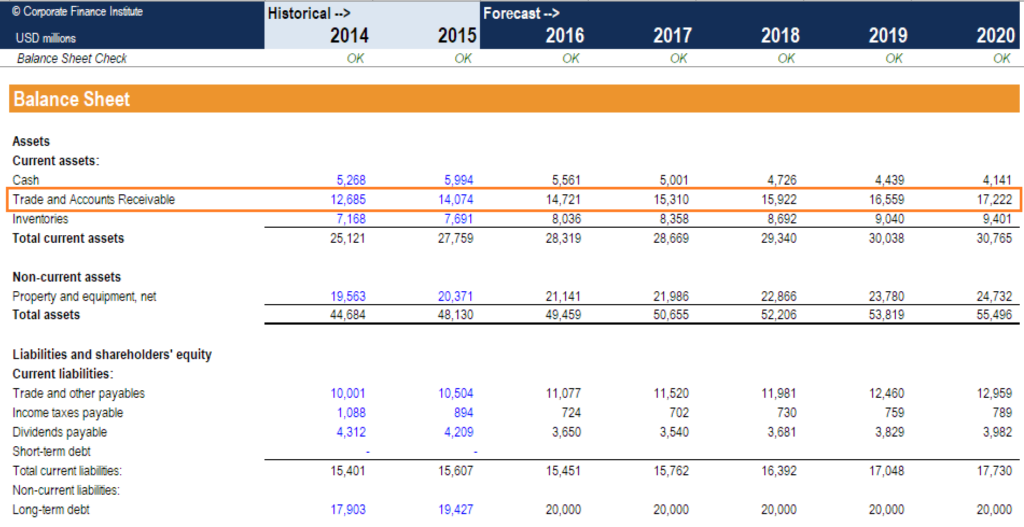
Source: CFI Financial Modeling Course.
Watch the video tutorial below to learn more about accounts receivable and accounts payableAccounts PayableAccounts payable is a liability incurred when an organization receives goods or services from its suppliers on credit. Accounts payables are:
Additional Resources
Thank you for reading this guide to Accounts Receivable (AR) and how it impacts a company’s cash flow. CFI is the official provider of the Financial Modeling and Valuation Analyst (FMVA)®Become a Certified Financial Modeling & Valuation Analyst (FMVA)®CFI's Financial Modeling and Valuation Analyst (FMVA)® certification will help you gain the confidence you need in your finance career. Enroll today! certification program, designed to transform anyone into a world-class financial analyst.
To keep learning and advancing your career as a financial analyst, check out the following additional CFI resources:
- Accounts PayableAccounts PayableAccounts payable is a liability incurred when an organization receives goods or services from its suppliers on credit. Accounts payables are
- Balance SheetBalance SheetThe balance sheet is one of the three fundamental financial statements. The financial statements are key to both financial modeling and accounting.
- InventoryInventoryInventory is a current asset account found on the balance sheet, consisting of all raw materials, work-in-progress, and finished goods that a
- Financial Modeling GuideFree Financial Modeling GuideThis financial modeling guide covers Excel tips and best practices on assumptions, drivers, forecasting, linking the three statements, DCF analysis, more
-

Understanding EBT Cash Accounts: Benefits & How They Work
EBT cards are used for food and cash benefits. Electronic Benefits Transfer, or EBT, is a system provided by various governmental agencies throughout the United States to provide food stamp a
-

Understanding Accounts Receivable (AR): A Comprehensive Guide
Accounts receivable are cash amounts that clients owe your company. The goods or services have been delivered and the invoice sent. Now, it’s just a matter of time before you receive payment for a job
Accounting
- Accounts Payable vs. Accounts Receivable: A Clear Explanation
- Accounts Receivable to Sales Ratio: Definition & Analysis
- Cash Reserves: Definition, Benefits & Short-Term Needs
- Net Cash: Definition, Calculation & Importance for Businesses
- Restricted Cash: Definition, Types & Impact on Financial Statements
- Understanding Accounts Receivable Aging: A Comprehensive Guide
- Accounts Receivable Aging Report: Understanding & Analysis
- Accounts Receivable Factoring: A Comprehensive Guide
- Accounts Receivable Turnover Ratio: Definition & Calculation
-
 OIBDA Explained: Understanding Operating Income Before Depreciation & Amortization
OIBDA is an abbreviation for Operating Income Before Depreciation and Amortization. It is a non-GAAP measure of the financial performance of a company during a specific period of time while excluding ...
-
 Understanding Vouchers: A Guide to Accounts Payable Documents
A voucher is an internal document within a company that is issued by the accounts payable Accounts PayableAccounts payable is a liability incurred when an organization receives goods or services from ...